CC to HP Calculator
Estimate horsepower from engine displacement for small engines, motorcycles and cars, or find the cc you need for a power target. Pick the engine type: it matters more than the cc.
Press Calculate to print your slip
Estimate only. Real power depends on rpm, tuning and how the maker measures it.
Know the weight too? Check the power-to-weight ratio
On this page
Why there is no exact cc to hp formula
Displacement, measured in cubic centimeters (cc), is the volume the pistons sweep. It sets how much air and fuel an engine can burn per revolution, and so how much torque it can make. Horsepower is torque multiplied by rpm, so it also depends on how fast the engine spins and how well it breathes. A 212cc mower engine governed to 3,600 rpm and a 999cc superbike engine revving past 13,000 rpm are worlds apart per cc.
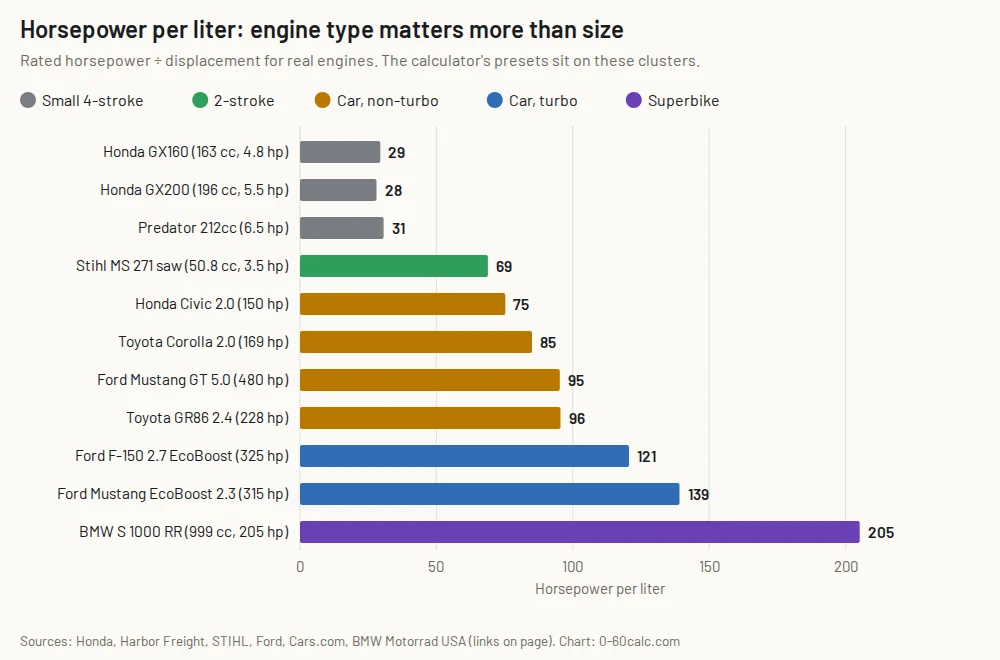
That's why the useful number is specific output: horsepower per liter of displacement. It is fairly consistent within one type of engine, so the calculator multiplies your displacement by the typical figure for the type you pick, and gives a range for engines that are tuned harder or softer.
CC to HP
hp ≈ (cc ÷ 1,000) × hp/L
HP to CC
cc ≈ hp ÷ hp/L × 1,000
- cc
- Cubic centimeters. 1,000 cc = 1 liter = 61.02 cubic inches.
- hp/L
- Specific output: horsepower per liter of displacement.
- Range
- The low and high hp/L for that engine type, from real engines.
- kW and PS
- 1 hp = 0.7457 kW = 1.014 PS.
Worked example: a 212cc small engine at a typical 30 hp/L is 0.212 × 30 = 6.4 hp. Harbor Freight rates its Predator 212cc at 6.5 hp.
Horsepower per liter by engine type
These are the presets the calculator uses. Each typical figure is anchored to published ratings of real engines.
| Engine type | Typical | Range | Real example |
|---|---|---|---|
| Small 4-strokeMowers, generators, pressure washers, go-karts | 30 hp/L | 26 to 33 hp/L | Honda GX200: 196 cc, 5.5 hp (28 hp/L) |
| 2-strokeChainsaws, trimmers, leaf blowers | 70 hp/L | 55 to 90 hp/L | Stihl MS 271 chainsaw: 50.8 cc, 3.5 hp (69 hp/L) |
| MotorcycleCommuters, twins, standards | 90 hp/L | 60 to 115 hp/L | Honda Grom: 125 cc, about 9 hp at the wheel |
| Sport bikeFour-cylinder supersports and superbikes | 190 hp/L | 160 to 215 hp/L | BMW S 1000 RR: 999 cc, 205 hp (205 hp/L) |
| Car, non-turboMost economy cars, V8 muscle cars | 85 hp/L | 72 to 100 hp/L | Toyota Corolla: 1,987 cc, 169 hp (85 hp/L) |
| Car, turboModern turbo fours and sixes | 125 hp/L | 105 to 145 hp/L | Ford F-150 2.7 EcoBoost: 2,694 cc, 325 hp (121 hp/L) |
Chainsaw figure: STIHL USA (3.1 cu in, 3.5 bhp). Other sources are linked in the tables below.
Small engines: 79cc to 670cc to hp
Small four-stroke engines in mowers, generators, pressure washers and go-karts all land close to 30 hp per liter, because they run at similar, governed speeds. That makes the estimate for them the most reliable on this page.
| Displacement | Estimate | Range | Real engine |
|---|---|---|---|
| 79 cc | 2.4 hp | 2.1 to 2.6 hp | Predator 79cc: 3 hpHarbor Freight |
| 118 cc | 3.5 hp | 3.1 to 3.9 hp | Honda GX120: 3.5 hpHonda, net at 3,600 rpm |
| 150 cc | 4.5 hp | 3.9 to 5.0 hp | No common engine; estimate only |
| 163 cc | 4.9 hp | 4.2 to 5.4 hp | Honda GX160: 4.8 hpHonda, net at 3,600 rpm |
| 196 cc | 5.9 hp | 5.1 to 6.5 hp | Honda GX200: 5.5 hpHonda, net at 3,600 rpm |
| 208 cc | 6.2 hp | 5.4 to 6.9 hp | No common engine; estimate only |
| 212 cc | 6.4 hp | 5.5 to 7.0 hp | Predator 212cc: 6.5 hpHarbor Freight |
| 224 cc | 6.7 hp | 5.8 to 7.4 hp | Predator 224cc: 6.6 hpHarbor Freight |
| 252 cc | 7.6 hp | 6.6 to 8.3 hp | No common engine; estimate only |
| 301 cc | 9.0 hp | 7.8 to 9.9 hp | Predator 301cc: 8 hpHarbor Freight |
| 420 cc | 12.6 hp | 10.9 to 13.9 hp | Predator 420cc: 13 hpHarbor Freight |
| 459 cc | 13.8 hp | 11.9 to 15.1 hp | Predator 459cc: 15.8 hpHarbor Freight |
| 670 cc | 20.1 hp | 17.4 to 22.1 hp | Predator 670cc V-twin: 22 hpHarbor Freight |
Compare ratings within one brand where you can. Honda quotes net power at 3,600 rpm, the governed speed most equipment runs at, while other makers may test differently. And many push-mower engines no longer carry a horsepower figure at all: after lawsuits over overstated labels, Briggs & Stratton and other makers settled for $51 million in 2010, and the industry moved to torque ratings for those engines.
Motorcycles: 125cc to 1,900cc to hp
Motorcycle engines vary the most, because a bike maker can choose between low-rpm torque and high-rpm power. Typical claimed crank horsepower by class:
| Class | Typical power | Example |
|---|---|---|
| 125 cc singleMinibikes, commuters, scooters | 9 to 15 hp | Honda Grom: 8.96 hp at the wheelCycle World dyno |
| 250 to 400 ccBeginner sport and naked bikes | 25 to 45 hp | Twins and singles, often built to A2 licence limits |
| 650 to 700 cc twinMiddleweight standards and sport-tourers | 65 to 75 hp | Tuned for mid-range torque rather than peak power |
| 600 cc inline-fourSupersports | 110 to 130 hp | Revs past 14,000 rpm, which is where the power comes from |
| 1,000 cc inline-fourSuperbikes | 190 to 215 hp | BMW S 1000 RR (999 cc): 205 hpBMW Motorrad USA |
| 1,700 to 1,900 cc V-twinLarge cruisers | 85 to 110 hp | Big torque at low rpm, modest peak power |
Use the Motorcycle preset for commuters, twins and standards, and Sport bike for four-cylinder supersports and superbikes. For a big cruiser, enter a custom 55 hp/L.
Car engines: 1.0L to 6.2L, turbo vs non-turbo
A turbocharger forces more air into each cylinder, so a turbo engine makes roughly 40 to 50 percent more power per liter than a similar non-turbo engine. Here is what real current engines make:
| Engine | Displacement | Rated | hp per liter |
|---|---|---|---|
| Honda Civic 2.0 (2026)Non-turbo · Honda | 1,993 cc | 150 hp | 75 |
| Chevrolet Corvette Stingray 6.2 V8Non-turbo | 6,162 cc | 490 hp | 80 |
| Toyota Corolla 2.0 (2026)Non-turbo · Cars.com | 1,987 cc | 169 hp | 85 |
| Toyota GR86 2.4 (2022-26)Non-turbo | 2,387 cc | 228 hp | 96 |
| Ford Mustang GT 5.0 V8 (2026)Non-turbo · Ford | 5,038 cc | 480 hp | 95 |
| Ford F-150 2.7 EcoBoost V6 (2026)Twin-turbo · Ford | 2,694 cc | 325 hp | 121 |
| Ford Mustang EcoBoost 2.3 (2026)Turbo · Ford | 2,264 cc | 315 hp | 139 |
And the typical range for each engine size, using the calculator's car presets:
| Engine size | Non-turbo | Turbo |
|---|---|---|
| 1.0 L1,000 cc | 72 to 100 hp | 105 to 145 hp |
| 1.2 L1,200 cc | 86 to 120 hp | 126 to 174 hp |
| 1.5 L1,500 cc | 108 to 150 hp | 158 to 218 hp |
| 1.6 L1,600 cc | 115 to 160 hp | 168 to 232 hp |
| 2.0 L2,000 cc | 144 to 200 hp | 210 to 290 hp |
| 2.5 L2,500 cc | 180 to 250 hp | 262 to 362 hp |
| 3.0 L3,000 cc | 216 to 300 hp | 315 to 435 hp |
| 3.5 L3,500 cc | 252 to 350 hp | 368 to 508 hp |
| 4.0 L4,000 cc | 288 to 400 hp | 420 to 580 hp |
| 5.0 L5,000 cc | 360 to 500 hp | 525 to 725 hp |
| 6.2 L6,200 cc | 446 to 620 hp | 651 to 899 hp |
GR86 and Corvette ratings as listed, with sources, on our whp to hp calculator; the Corvette's 490 hp is the rating without the Z51 package. High-revving engines such as Porsche's 4.0-liter GT3 flat-six sit above these ranges.
HP to cc: how big an engine do you need?
Switch the calculator to HP to CC to work backwards. It divides your target by the typical specific output, and the range shows how much smaller a high-output engine could be.
| Power | Small 4-stroke | Car, non-turbo | Car, turbo |
|---|---|---|---|
| 3.5 hp | 117 cc | - | - |
| 5.5 hp | 183 cc | - | - |
| 6.5 hp | 217 cc | - | - |
| 13 hp | 433 cc | - | - |
| 100 hp | - | 1.2 L | 0.8 L |
| 150 hp | - | 1.8 L | 1.2 L |
| 200 hp | - | 2.4 L | 1.6 L |
| 300 hp | - | 3.5 L | 2.4 L |
| 500 hp | - | 5.9 L | 4.0 L |
How accurate is a cc to hp estimate?
Within the range, usually
Most engines of a given type fall inside the calculator's range, which spans roughly 15 percent either side of the typical figure. Small engines sit tightest; motorcycles vary most.
Rpm is the big unknown
Two engines of the same size and type can differ a lot if one revs much higher. If you know an engine is a high-revving or race-tuned version, use the top of the range.
Ratings aren't all equal
Net vs gross ratings, SAE vs other test standards and plain marketing all move published figures. Compare engines rated the same way.
Measure it instead
For a real number, use a dyno sheet with the whp to hp calculator, or a time slip with the horsepower calculator.
Sources and method
There is no exact cc-to-hp formula. The estimate multiplies displacement by a typical specific output (horsepower per liter) for the engine type you pick, based on the manufacturer figures on this page, and shows a range.
Updated September 2026. Built and checked by the 0-60calc Team. Found a mistake? Tell us and we will check it against the source.
More calculators
Once you have a horsepower figure, see what it does on the road.
Horsepower Calculator
Horsepower from torque and rpm, a time slip or a 0-60 time, in hp, kW and PS.
OpenPower-to-Weight Ratio
lb/hp, kg/hp and hp per tonne, with a class comparison for cars and bikes.
OpenkW to HP Converter
Convert kilowatts to horsepower and PS, with a chart from 1 to 1,000 kW.
Open0-60 Calculator
0-60 mph and 0-100 km/h from power and weight, for cars, motorcycles and EVs.
OpenWHP to HP Calculator
Turn a dyno's wheel horsepower into crank horsepower and see the drivetrain loss.
OpenQuarter Mile Calculator
1/4 and 1/8 mile ET and trap speed, or horsepower from a time slip.
OpenHP to kW Converter
Convert horsepower to kilowatts, with real car ratings in both units.
OpenG-Force Calculator
Average acceleration in g from any 0-60 or 0-100 km/h time.
Open
Questions people ask
How many horsepower is a 212cc engine?
About 6.5 hp. That is Harbor Freight's rating for its Predator 212cc engine, and our small-engine estimate gives 6.4 hp. Go-kart racers raise it considerably by removing the governor and changing the cam, carburetor and exhaust.
How many horsepower is 1000cc?
It depends on the engine. A 1,000 cc superbike makes around 190 to 215 hp, a 1.0-liter car engine roughly 70 to 100 hp without a turbo and 105 to 145 hp with one, and a 1,000 cc cruiser far less.
Is there a formula to convert cc to hp?
Not an exact one, because horsepower depends on rpm, airflow and tuning as well as displacement. The practical formula is hp ≈ liters × hp per liter, using a typical specific output for the engine type.
How many cc is 5.5 hp?
For a small 4-stroke engine, about 180 to 200 cc. Honda's GX200, the classic 5.5 hp engine, displaces 196 cc.
Does more cc always mean more horsepower?
No. A 999 cc superbike engine makes more power than a 1,993 cc economy-car engine because it revs more than twice as high. Turbocharging also lets a small engine match a much larger one.
Why do lawn mowers list torque or cc instead of horsepower?
After lawsuits claiming horsepower labels were overstated, Briggs & Stratton and other makers agreed to a $51 million settlement in 2010, and many push-mower engines are now labeled by torque or displacement instead.