Gear Ratio Calculator
Turn rpm into road speed in every gear, find cruising rpm at any speed, and see what a new final drive or tire size does. Start from a preset or enter your own ratios.
Press Calculate to print your slip
Theoretical figures. Real speed is a percent or two lower because tires slip and squash under load.
Want the acceleration too? Open the 0-60 Calculator
On this page
Speed in every gear
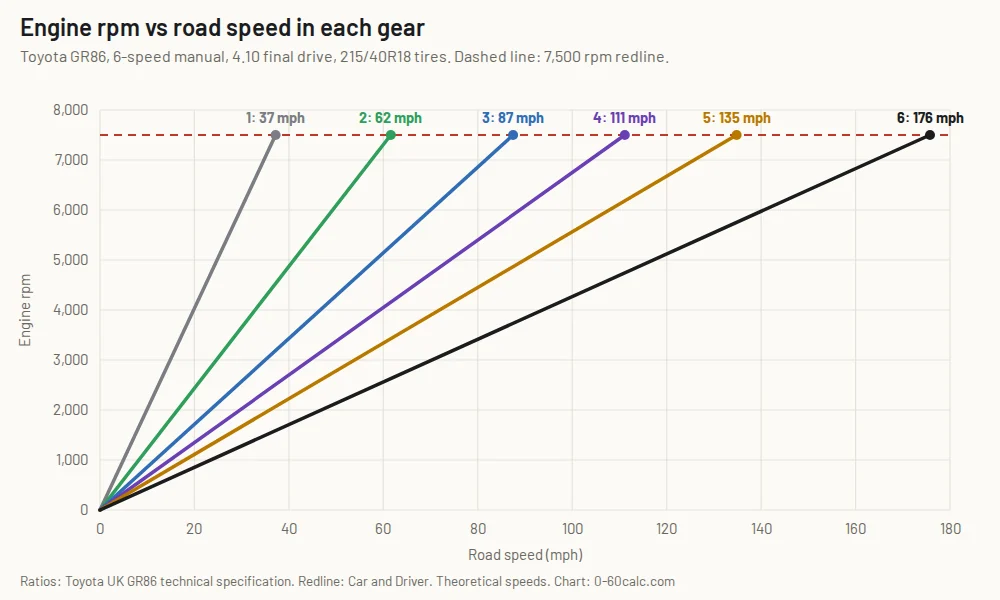
Every gear sets how many times the engine turns for each turn of the wheels. Multiply the gear ratio by the final drive ratio in the differential and you get the overall ratio; divide engine rpm by it and you get wheel rpm, which the tire turns into road speed. The chart shows it for a Toyota GR86 with the manual gearbox: each line is one gear, from standstill to the 7,500 rpm redline.
| Gear | Overall | At 7,500 rpm | Rpm at 70 mph |
|---|---|---|---|
| 1st gear3.626:1 | 14.87:1 | 37 mph | 14,121 rpm |
| 2nd gear2.189:1 | 8.97:1 | 62 mph | 8,525 rpm |
| 3rd gear1.541:1 | 6.32:1 | 87 mph | 6,001 rpm |
| 4th gear1.213:1 | 4.97:1 | 111 mph | 4,724 rpm |
| 5th gear1.000:1 | 4.10:1 | 135 mph | 3,894 rpm |
| 6th gear0.767:1 | 3.14:1 | 176 mph | 2,987 rpm |
Sixth gear would reach 176 mph at redline, but that's the gearing limit, not the car's real top speed: long before then, the engine runs out of power against air drag. More on that below.
RPM to MPH formula
Speed from rpm
mph = rpm × tire dia ÷ (gear × final × 336)
Rpm from speed
rpm = mph × gear × final × 336 ÷ tire dia
- Tire dia
- Overall tire diameter in inches. For 215/40R18: 18 + 2 × 215 × 0.40 ÷ 25.4 = 24.8 in.
- Why 336?
- 63,360 inches in a mile ÷ (60 minutes × π) = 336.13.
- Overall ratio
- Gear ratio × final drive ratio.
- km/h
- Multiply mph by 1.609344.
Worked example: a GR86 in 6th (0.767) with a 4.10 final drive and 24.8-inch tires at 3,000 rpm: 3,000 × 24.8 ÷ (0.767 × 4.10 × 336) = 70 mph.
The constant comes from converting inches per minute into miles per hour; see Crawlpedia's derivation. For plain speed, distance and time sums, use the speed calculator.
Cruising rpm after a gear or tire change
Swapping the rear-end ratio is the classic way to change how a car feels. A numerically higher ratio multiplies torque more, so every gear pulls harder, but the engine spins faster at the same speed. The 2025 Mustang GT's 6-speed manual is offered with three axle ratios; here's what each does at 70 mph:
| Axle ratio | 6th at 70 mph | 5th at 70 mph | Wheel torque vs 3.15 |
|---|---|---|---|
| 3.15:1 axle | 1,705 rpm | 2,232 rpm | +0% |
| 3.55:1 axle | 1,922 rpm | 2,515 rpm | +13% |
| 3.73:1 axle | 2,019 rpm | 2,642 rpm | +18% |
Tire size works the same way in reverse. A taller tire lowers the effective gearing: rpm falls and acceleration softens. Going from 215/40R18 to 225/40R18 makes the tire 1.3% taller, so when the speedometer shows 60 mph you're really doing about 60.8. The Compare a change mode shows both effects at once, and the tire size calculator compares the two sizes in detail.
Top speed: gearing-limited vs drag-limited
Gearing-limited
The speed in top gear at redline. The car can't go faster without over-revving, however much power it has left.
Drag-limited
Air resistance rises with the square of speed and the power needed with its cube. Most cars hit this wall first, below their gearing limit.
Tall overdrives
A Corvette C8's 8th gear (0.33) would reach about 330 mph at its 6,600 rpm redline. It exists for quiet, efficient cruising, not speed.
Electronic limits
Many cars are limited by software, often to 112, 130 or 155 mph, whatever the gearing and power would allow.
So a car's true top speed is usually reached in the gear where its power curve meets the drag curve, which can be one or two gears below top. Use the calculator's redline figures as the upper bound, not a prediction.
Choosing a rear-end ratio for drag racing
For the quarter mile, the goal is to cross the finish line near the rpm of peak power in the gear you finish in, without an extra shift just before the line. Work it backwards from your trap speed:
Rpm at the finish
rpm = trap mph × gear × final × 336 ÷ tire dia
Worked example: a 115 mph trap in 4th (1.00) with a 3.73 rear end and 26-inch tires gives 115 × 1.00 × 3.73 × 336 ÷ 26 = about 5,550 rpm. If peak power is at 6,000 rpm, a slightly steeper ratio would put the engine closer to it at the line.
Don't have a trap speed yet? Estimate one from horsepower and weight in the quarter mile calculator, then come back here. Steeper gearing also helps the launch, but only if the tires can handle the extra torque.
Preset gear ratios
The presets use published figures. Final drive ratios and tire sizes vary by trim and market, so check yours.
| Car and gearbox | Gear ratios | Final drive | Tire | Redline |
|---|---|---|---|---|
| Toyota GR86, 6-speed manual (2022+)Toyota UK spec sheet (EU final drive) | 3.626, 2.189, 1.541, 1.213, 1.000, 0.767 | 4.100 | 215/40R18 | 7,500 rpm |
| Ford Mustang GT, 6-speed manual (2025)Ford technical specs | 3.237, 2.104, 1.422, 1.000, 0.814, 0.622 | 3.15, 3.55 or 3.73 | 255/45R18 | not published |
| Ford Mustang GT, 10-speed automatic (2025)Ford technical specs | 4.696, 2.985, 2.146, 1.769, 1.520, 1.275, 1.000, 0.854, 0.689, 0.636 | 3.15 or 3.55 | 255/45R18 | not published |
| Chevrolet Corvette C8 Stingray, 8-speed dual-clutchTremec; Corvette Magazine | 2.91, 1.76, 1.22, 0.88, 0.65, 0.51, 0.40, 0.33 | 4.89 (Z51: 5.17) | 305/30R20 rear | 6,600 rpm |
| Honda Civic Type R, 6-speed manual (2023+)Honda | 3.625, 2.115, 1.529, 1.125, 0.911, 0.734 | 3.842 | 265/30R19 | 7,000 rpm |
GR86 redline from Car and Driver's road test. Corvette redline from Corvette Magazine. Checked 29 September 2026.
Sources and method
Road speed is rpm × tire diameter ÷ (gear × final drive × 336), where 336 turns inches per minute into miles per hour. The presets use gear ratios from the manufacturer pages linked on this page.
Updated September 2026. Built and checked by the 0-60calc Team. Found a mistake? Tell us and we will check it against the source.
More calculators
From gearing to acceleration, times and speeds.
0-60 Calculator
0-60 mph and 0-100 km/h from power and weight, for cars, motorcycles and EVs.
OpenQuarter Mile Calculator
1/4 and 1/8 mile ET and trap speed, or horsepower from a time slip.
OpenSpeed Calculator
Speed, distance or time from the other two, average speed and speed from rpm.
OpenHorsepower Calculator
Horsepower from torque and rpm, a time slip or a 0-60 time, in hp, kW and PS.
OpenPower-to-Weight Ratio
lb/hp, kg/hp and hp per tonne, with a class comparison for cars and bikes.
OpenKM/H to MPH Converter
Convert kilometers per hour to miles per hour, with a full chart.
OpenG-Force Calculator
Average acceleration in g from any 0-60 or 0-100 km/h time.
Open1/8 to 1/4 Mile Calculator
Convert an eighth-mile ET and mph to a quarter-mile estimate, or back.
OpenTire Size Calculator
Compare two tire sizes: diameter, sidewall, revs per mile and speedometer error.
Open
Questions drivers ask
How do I calculate speed from rpm and gear ratio?
Multiply rpm by the tire diameter in inches, then divide by the gear ratio times the final drive ratio times 336. A GR86 in 6th (0.767) with a 4.10 final drive and 24.8-inch tires at 3,000 rpm is doing about 70 mph.
How do I calculate rpm at a given speed?
Turn the formula around: rpm = mph × gear ratio × final drive × 336 ÷ tire diameter in inches. The calculator does it for every gear at once in the Rpm at a speed mode.
What does a higher final drive ratio do?
A numerically higher ratio, such as 3.73 instead of 3.15, multiplies torque more, so the car accelerates harder in every gear. The trade-off is higher rpm at cruising speed and a lower speed at redline in each gear.
How do bigger tires change my gearing?
A taller tire acts like a lower (numerically smaller) final drive: rpm at a given speed falls and acceleration softens. The speedometer also reads low, because it still counts wheel revolutions for the old size.
Can I work out top speed from gear ratios?
Only the gearing limit: the speed in top gear at redline. Most modern cars run out of power against air drag long before that, so their real top speed is lower, and many are electronically limited.
Where do I find my car's gear ratios?
In the manufacturer's technical specifications, the owner's manual or a road test. The calculator includes presets for several popular cars with their published ratios.