What Is Torque in a Car? A Simple Explanation With Real Numbers
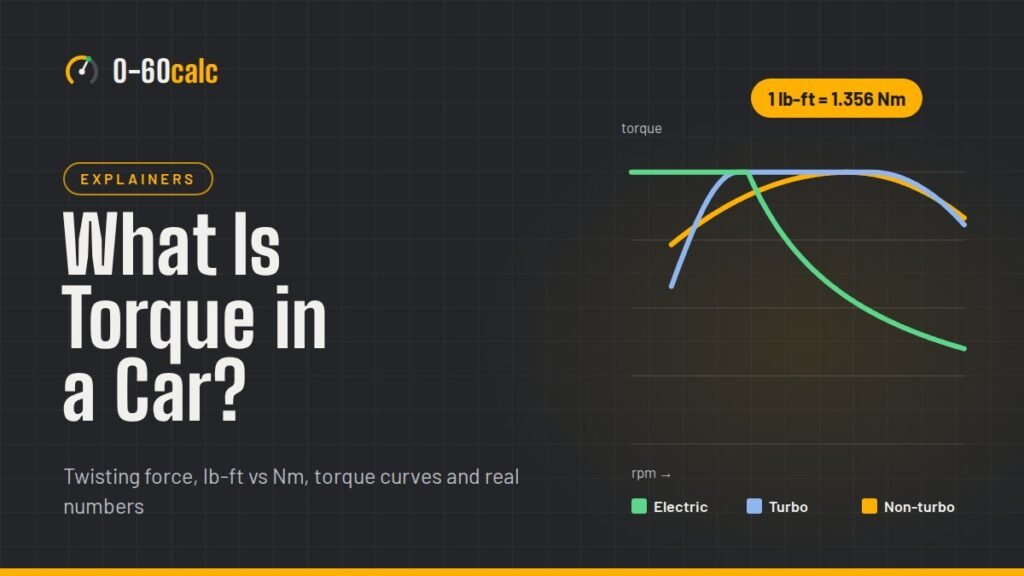
Torque is the twisting force that turns your wheels. What it measures, lb-ft vs Nm, why the rpm where it peaks matters, and how much torque real cars, trucks and EVs make.
Torque is the twisting force an engine or electric motor applies to turn the wheels, measured in pound-feet (lb-ft) or newton-meters (Nm). It’s the shove you feel when you press the accelerator. A compact car makes about 130 to 180 lb-ft, a V8 Mustang 415 lb-ft, and a heavy-duty diesel pickup 975 to 1,200 lb-ft.
In this guide
Torque is the most quoted and least explained number on a spec sheet. This guide covers what it measures, how lb-ft and Nm relate, why the rpm where torque peaks matters as much as the peak itself, and what normal figures look like for real cars, trucks and EVs, including how much torque each liter of engine size buys you.
Last updated 13 October 2026.
Torque, in plain terms
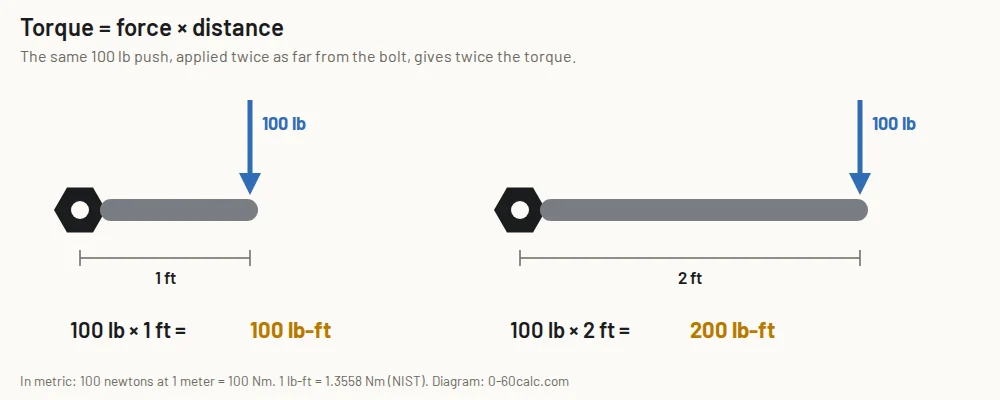
Torque is force applied at a distance from a pivot. Push down with 100 pounds on the end of a wrench 1 foot long and you apply 100 lb-ft to the bolt. Push with the same 100 pounds on a 2-foot wrench and it’s 200 lb-ft, which is why a longer wrench loosens a stubborn nut.
An engine works the same way. Each combustion stroke pushes a piston down, the connecting rod pushes on an offset crank throw, and the crankshaft twists. That twist, averaged over the engine’s firing cycle, is the torque figure on the spec sheet. An electric motor produces it with magnetic force instead, but the unit and meaning are identical.
lb-ft vs Nm
US spec sheets quote torque in pound-feet; most of the rest of the world uses newton-meters. NIST gives the conversion as 1 lb-ft = 1.355818 Nm, so 1 Nm is about 0.7376 lb-ft.
| Newton-meters | Pound-feet | Typical of |
|---|---|---|
| 100 Nm | 73.8 lb-ft | A small city-car engine |
| 180 Nm | 132.8 lb-ft | Honda Civic 2.0 |
| 250 Nm | 184.4 lb-ft | Toyota GR86 |
| 400 Nm | 295.0 lb-ft | A strong turbo four |
| 563 Nm | 415.2 lb-ft | Ford Mustang GT V8 |
| 1,000 Nm | 737.6 lb-ft | Electric pickups, big diesels |
Convert any figure with the Nm to lb-ft converter or the lb-ft to Nm converter. You will also see “ft-lb”: engineers often keep ft-lb for work and energy and lb-ft for torque, but on a car spec sheet the two mean the same number.
What torque feels like from the driver’s seat
The number on the spec sheet is torque at the crankshaft. The gearbox and final drive multiply it before it reaches the wheels, which is why first gear shoves you back in your seat and top gear barely does.
Take a Toyota GR86: 184 lb-ft from the engine, a 3.626 first gear, a 0.767 sixth gear and a 4.10 final drive.
| Gear | Torque at the axle | Push at the tires |
|---|---|---|
| 1st184 × 3.626 × 4.10 | 2,735 lb-ft | about 2,650 lb |
| 6th184 × 0.767 × 4.10 | 579 lb-ft | about 560 lb |
Push at the tires is axle torque divided by the tire’s rolling radius (about 1.03 feet on the GR86’s 18-inch wheels), before drivetrain losses and assuming the tires don’t spin. Same engine, nearly five times the shove in first. Try your own ratios in the gear ratio calculator.
The torque curve: why the peak rpm matters
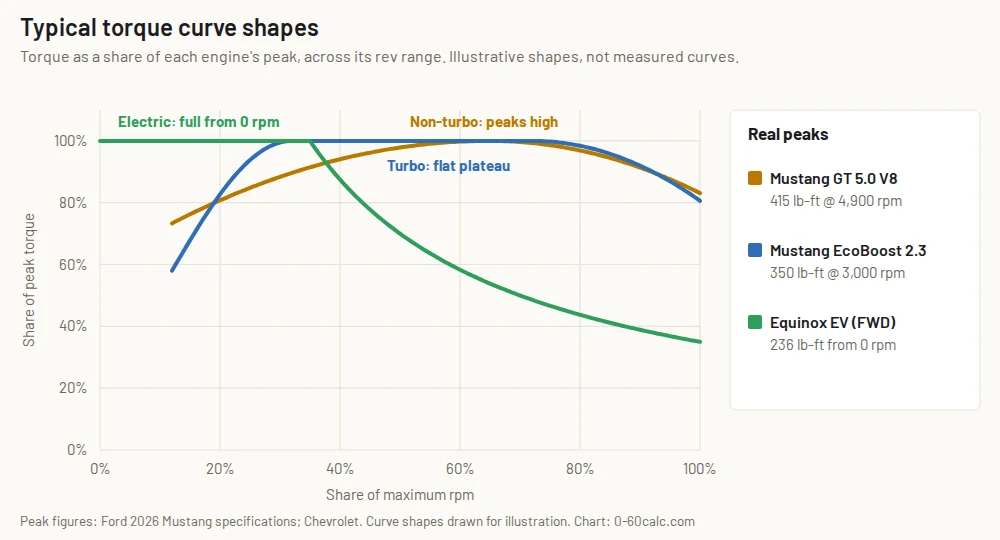
An engine doesn’t make its peak torque everywhere. It builds with rpm, peaks, then tails off. Where that peak sits, and how wide it is, shapes how a car feels far more than the headline number.
| Engine | Peak torque | Peak horsepower | Type |
|---|---|---|---|
| Honda Civic 2.0 (2026)Honda | 133 lb-ft @ 4,000-5,000 rpm | 150 hp @ 6,400 rpm | Non-turbo four |
| Toyota GR86 2.4Toyota, Edmunds | 184 lb-ft @ 3,700 rpm | 228 hp @ 7,000 rpm | Non-turbo flat four |
| Ford Mustang EcoBoost 2.3 (2026)Ford | 350 lb-ft @ 3,000 rpm | 315 hp @ 5,500 rpm | Turbo four |
| Ford F-150 2.7 EcoBoost (2026)Ford | 400 lb-ft @ 3,500 rpm | 325 hp @ 5,500 rpm | Twin-turbo V6 |
| Ford Mustang GT 5.0 (2026)Ford | 415 lb-ft @ 4,900 rpm | 480 hp @ 7,150 rpm | Non-turbo V8 |
| Chevrolet Equinox EV, FWDChevrolet | 236 lb-ft from 0 rpm | 213 hp | Electric motor |
Non-turbo engines
Torque tends to peak in the middle or upper rev range, so they reward revving. Toyota says it retuned the GR86 to peak at 3,700 rpm; the previous generation peaked at 6,600.
Turbo engines
Boost arrives early, so torque plateaus from low rpm. The Mustang EcoBoost makes 350 lb-ft at 3,000 rpm, within 65 lb-ft of the V8 but 1,900 rpm sooner.
Electric motors
“Electric motors can produce peak torque from zero RPM,” as Mazda puts it. That’s why even a modest EV feels strong pulling away from a light.
How much torque do cars make?
| Vehicle | lb-ft | Nm |
|---|---|---|
| Honda Civic 2.0 (2026)Honda | 133 | 180 |
| Toyota Corolla 2.0 (2026)Toyota | 151 | 205 |
| Honda CR-V 1.5 turbo (2026)Honda | 179 | 243 |
| Chevrolet Equinox EV, FWDChevrolet | 236 | 320 |
| Ford Mustang GT 5.0 (2026)Ford | 415 | 563 |
| Ram 1500 3.0 Hurricane (2026)Ram | 469 | 636 |
| Chevrolet Silverado 1500 3.0 Duramax diesel (2026)Chevrolet | 495 | 671 |
| Ford F-150 Lightning (2022-25)Wikipedia | 775 | 1,051 |
| Chevrolet Silverado HD 6.6 Duramax diesel (2026)Chevrolet | 975 | 1,322 |
| Ford Super Duty 6.7 Power Stroke High Output (2026)Ford | 1,200 | 1,627 |
So what’s a good amount? On these figures, compact cars sit around 130 to 180 lb-ft, V8 sports cars and half-ton pickups roughly 400 to 500, and heavy-duty diesel trucks built to tow big trailers close to 1,000 lb-ft or more. More useful than the raw number is torque relative to the vehicle’s weight, and where in the rev range it arrives: 236 lb-ft from a standstill in a compact EV feels livelier in town than the same figure at 5,000 rpm.
Torque per liter: why a small turbo can match a big V8
Divide each engine’s peak torque by its size and the engines sort themselves by type. We worked these out from the manufacturer ratings in the tables above.
| Engine | Size | Peak torque | lb-ft per liter | Nm per liter |
|---|---|---|---|---|
| Honda Civic 2.0Non-turbo four | 2.0 L | 133 lb-ft | 67 | 90 |
| Toyota Corolla 2.0Non-turbo four | 2.0 L | 151 lb-ft | 76 | 102 |
| Toyota GR86 2.4Non-turbo flat four | 2.4 L | 184 lb-ft | 77 | 104 |
| Ford Mustang GT 5.0Non-turbo V8 | 5.0 L | 415 lb-ft | 83 | 113 |
| Honda CR-V 1.5 turboTurbo four | 1.5 L | 179 lb-ft | 119 | 162 |
| Ford F-150 2.7 EcoBoostTwin-turbo V6 | 2.7 L | 400 lb-ft | 148 | 201 |
| Ford Mustang EcoBoost 2.3Turbo four | 2.3 L | 350 lb-ft | 152 | 206 |
| Ram 1500 3.0 HurricaneTwin-turbo straight six | 3.0 L | 469 lb-ft | 156 | 212 |
| Chevrolet Silverado HD 6.6 DuramaxTurbo diesel V8 | 6.6 L | 975 lb-ft | 148 | 200 |
| Chevrolet Silverado 1500 3.0 DuramaxTurbo diesel straight six | 3.0 L | 495 lb-ft | 165 | 224 |
| Ford Super Duty 6.7 Power Stroke High OutputTurbo diesel V8 | 6.7 L | 1,200 lb-ft | 179 | 243 |
Non-turbo gasoline: 65 to 85 lb-ft per liter
Every engine here without a turbo lands in this band, from the Civic’s 2.0 to the Mustang’s 5.0-liter V8.
Turbo gasoline: 120 to 155
Boost packs more air into each cylinder. The 2.3-liter EcoBoost Mustang makes 84% of the V8’s torque from 46% of its displacement.
Turbo diesel: about 150 to 180
High compression and boost give diesels the most torque per liter, and they make it low in the rev range.
A rule of thumb
To estimate torque from engine size, multiply liters by about 75 without a turbo, 140 with one, or 165 for a turbo diesel. A 2.0-liter: roughly 150 lb-ft, or 280 turbocharged.
Electric motors have no displacement, so this measure doesn’t apply to EVs; compare their torque with the vehicle’s weight instead. It’s also a peak figure: two engines with the same torque per liter can feel very different if one makes it at 1,500 rpm and the other at 5,000.
Why diesels and EVs feel so strong
Diesels are built for torque: turbocharged, high compression and long strokes, with their peak low in the rev range. They also rev lower, which is why a diesel’s horsepower looks modest next to its torque. The 6.6-liter Duramax in the Silverado HD makes 975 lb-ft for exactly that job: getting a heavy load moving.
EVs combine instant torque with a single-speed reduction gear, so there’s no wait for revs or a downshift. The front-wheel-drive Chevrolet Equinox EV makes 236 lb-ft, more than a Corolla or a GR86, and the all-wheel-drive version 333 lb-ft. The electric F-150 Lightning’s 775 lb-ft sits between a gas half-ton and a heavy-duty diesel.
Torque and horsepower in one line
Horsepower isn’t a separate force; it’s torque multiplied by how fast the engine turns: hp = torque (lb-ft) × rpm ÷ 5,252. The Mustang GT’s 415 lb-ft at 4,900 rpm is 387 hp at that moment. Its 480 hp peak comes at 7,150 rpm, where torque has fallen to about 353 lb-ft but the crank spins much faster.
That’s the short version. For which one matters for acceleration, towing and everyday driving, read our full guide to torque vs horsepower, or work out either number with the horsepower calculator.
The other torque on your car: lug nuts and bolts
Torque also appears in your owner’s manual as a tightening spec. Wheel lug nuts need a set torque so the wheel is clamped evenly without stretching the studs: 80 lb-ft on a Honda Civic, 129 lb-ft on a Tesla Model 3 and 150 lb-ft on a Ford F-150, according to their manuals. Use a torque wrench, and convert specs given in Nm with the lb-ft to Nm converter, which lists more vehicles.
Convert any torque figure
Switch between newton-meters and pound-feet, with real engine ratings for comparison.
Nm to lb-ft ConverterKey takeaways
- Torque is twisting force: force × distance, in lb-ft or Nm (1 lb-ft = 1.3558 Nm).
- Gearing multiplies engine torque; first gear gives several times the push of top gear.
- Where torque peaks matters: turbos peak low, non-turbo engines high, EVs from 0 rpm.
- Compact cars make about 130 to 180 lb-ft; heavy-duty diesels close to 1,000 or more.
- Turbocharging roughly doubles torque per liter: about 65 to 85 lb-ft per liter without a turbo, 120 to 180 with one.
- Horsepower = torque × rpm ÷ 5,252, so they are two views of the same output.
FAQ
What is torque in a car, in simple terms?
The twisting force the engine or motor puts on the crankshaft or axle to turn the wheels. It’s what you feel as the push in your back when you accelerate from low speed.
Is more torque better?
For pulling away, climbing and towing, yes, especially when it arrives low in the rev range. For top-end speed, horsepower matters more. A heavier vehicle also needs more torque to feel as lively.
What is a good amount of torque for a car?
Around 130 to 180 lb-ft is normal for a compact car, 250 to 420 lb-ft feels strong in a mid-size or sporty car, and trucks built for heavy towing make 400 to 1,200 lb-ft.
How much torque does a 2.0-liter engine make?
On the ratios in our table, about 130 to 170 lb-ft without a turbo and roughly 240 to 310 lb-ft with one. The 2026 Honda Civic’s non-turbo 2.0 makes 133 lb-ft.
Why do EVs have so much torque?
Electric motors can make peak torque from zero rpm, and they drive the wheels through a single reduction gear, so full twisting force is available the instant you press the pedal.
Why do diesel engines have more torque?
Turbocharging, high compression and long strokes give diesels a lot of torque at low rpm. They rev lower than gasoline engines, so their horsepower is smaller relative to their torque.
What does lb-ft mean?
Pound-feet: one pound of force applied one foot from the pivot. One lb-ft equals 1.3558 newton-meters.
What’s the difference between torque and horsepower?
Torque is the twisting force; horsepower is how quickly that force does work, torque × rpm ÷ 5,252. Our torque vs horsepower guide covers it in detail.
Sources
- NIST SP 811, Appendix B.9: pound-force foot to newton meter (1.355818)
- Toyota: GR86 228 hp and 184 lb-ft at 3,700 rpm and Toyota: previous generation peaked at 6,600 rpm
- Edmunds: GR86 horsepower peak rpm
- Ford: 2026 Mustang technical specifications and 2026 F-150 specifications
- Chevrolet: Equinox EV power and torque
- Mazda USA: electric motors and instant torque
- Motor Authority: why horsepower and torque cross at 5,252 rpm
- Torque ratings for the other vehicles in the table are linked in each row; lug-nut specs are sourced on our lb-ft to Nm page.
Related guides
What Is a Dyno? Dyno Testing, Tuning Costs & How to Read a Dyno Sheet
A dyno measures an engine's torque and rpm under load and calculates horsepower. Engine vs chassis…

What Is G-Force? Meaning, Examples in Cars & F1, and How Many G’s Humans Can Take
G-force is acceleration measured against gravity: 1 g is 9.80665 m/s². How to work it out,…
What Is Horsepower? Meaning, Formula & What It Means for Your Car
Horsepower is how fast an engine does work: 33,000 foot-pounds per minute, or 745.7 watts. The…