What Is Horsepower? Meaning, Formula & What It Means for Your Car
Horsepower is how fast an engine does work: 33,000 foot-pounds per minute, or 745.7 watts. The formula with a real engine, hp vs bhp vs whp vs PS vs kW, how it's measured, and how much your car needs.
Horsepower is a unit of power: it measures how fast an engine can do work. One horsepower is 33,000 foot-pounds of work per minute, which is 745.7 watts. On a car it’s the engine’s peak output at the crankshaft, and you can work it out from torque and rpm: hp = lb-ft × rpm ÷ 5,252. The average new US vehicle makes about 260 hp.
In this guide
Horsepower is the headline number on almost every spec sheet, but most explanations stop at “how strong the engine is”. This guide gives the exact definition, the formula with a worked example from a real engine, what hp, bhp, whp, PS and kW each mean, how the number is measured, and how much of it a car actually needs. To find your own car’s figure, the horsepower calculator works it out from torque and rpm, a time slip or a 0-60 time.
Last updated 7 October 2026.
Horsepower in one sentence
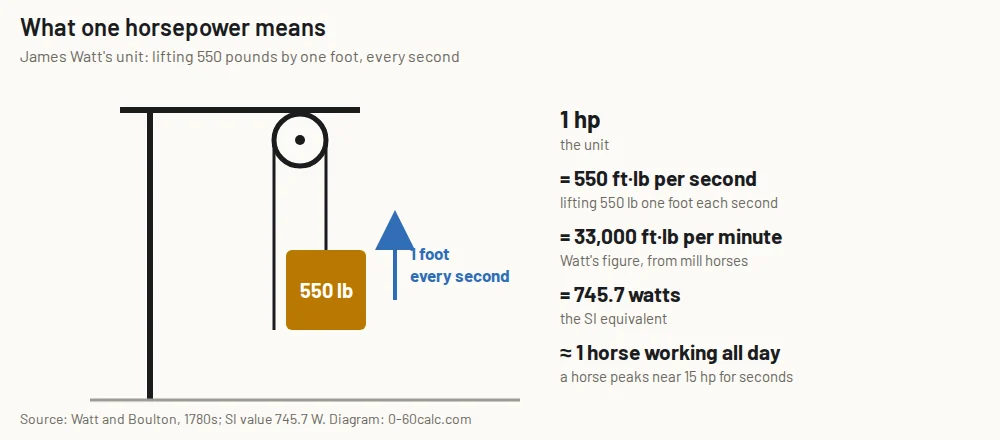
Horsepower is the rate of doing work: how much force an engine can apply, over how much distance, in how much time. Lift 550 pounds one foot in one second and you are producing exactly one horsepower. Lift the same weight the same distance in two seconds and it’s half a horsepower, even though the work is identical. Torque describes the force; horsepower adds the speed.
That’s why two engines with similar horsepower can feel nothing alike. Ford’s high-output 6.7-liter diesel in its Super Duty pickups makes 500 hp at 2,600 rpm, with 1,200 lb-ft of torque. The Mustang GT’s V8 makes 480 hp at 7,150 rpm, with 415 lb-ft. The diesel pushes very hard a few times; the V8 pushes less hard far more often. At their peaks, both do about the same amount of work every second.
Where the unit came from
The Scottish engineer James Watt invented the unit to sell his steam engines to mill and mine owners who still used horses. In 1782 he worked out that a horse turning a mill produced about 32,400 foot-pounds of work per minute, and the following year he and his partner Matthew Boulton rounded the figure to 33,000. An engine rated at 10 horsepower could replace ten horses.
Watt’s figure is still the definition: 33,000 foot-pounds per minute, or 550 foot-pounds per second. It’s close to what a horse can keep up through a working day, not its maximum. A horse can briefly make close to 15 hp, as we explain in how much horsepower a horse has.
The horsepower formula (with a worked example)
For an engine, horsepower comes straight from two numbers on the spec sheet: torque and the rpm it’s measured at.
Horsepower from torque and rpm
hp = lb-ft × rpm ÷ 5,252
- lb-ft
- Torque in pound-feet at that engine speed.
- rpm
- Engine speed in revolutions per minute.
- 5,252
- 33,000 ÷ 2π. One horsepower is 33,000 foot-pounds per minute, and each turn of the crankshaft sweeps 2π radians.
In metric units the same formula is kW = Nm × rpm ÷ 9,549.
Worked example: Ford rates the Mustang GT’s 5.0-liter V8 at 415 lb-ft at 4,900 rpm and 480 hp at 7,150 rpm.
- Power at peak torque: 415 × 4,900 ÷ 5,252 = 387 hp.
- Torque at peak power: 480 × 5,252 ÷ 7,150 = 353 lb-ft.
- What it means: at 7,150 rpm the engine makes 62 lb-ft less torque than its peak, but 93 hp more power, because it’s turning 46% faster.
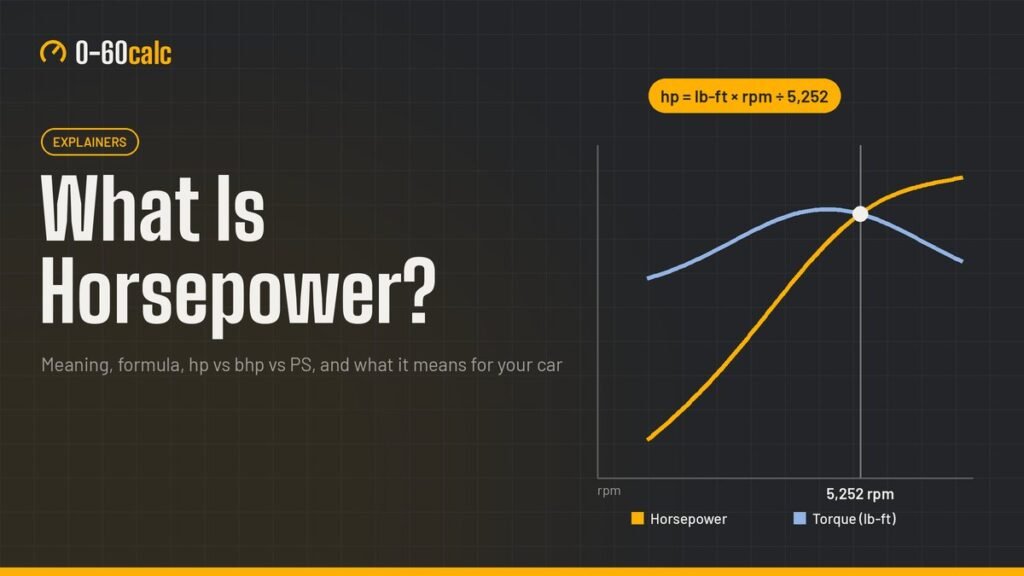
The same arithmetic explains why the horsepower and torque curves on a dyno chart drawn in lb-ft always cross at 5,252 rpm, and why peak power arrives higher in the rev range than peak torque. Our guide to torque vs horsepower covers what each number does on the road. To go the other way, from horsepower to torque, use the HP to torque calculator.
hp, bhp, whp, PS and kW
Spec sheets use several names for power. Some are different units; others are the same unit measured in a different place.
| Unit | What it is | In watts | Where you’ll see it |
|---|---|---|---|
| hpMechanical horsepower | Watt’s 33,000 ft-lb per minute | 745.7 W | US spec sheets |
| bhpBrake horsepower | The same unit, measured at the crankshaft on a brake dynamometer | 745.7 W | UK reviews and ads |
| whpWheel horsepower | The same unit, measured at the tires after drivetrain losses | 745.7 W (a lower reading) | Tuners’ dyno sheets |
| PS, CV, pkMetric horsepower | 75 kilogram-meters per second; 1 PS = 0.986 hp | 735.5 W | European spec sheets |
| kWKilowatt | The SI unit of power; 1 kW = 1.341 hp | 1,000 W | EVs, international data |
| Electric hpMotor nameplates | Defined for electric motors | 746 W exactly | Industrial motors |
One more label matters for classic cars: gross vs net. Until the early 1970s, US carmakers quoted SAE gross horsepower, measured on a bare engine on a test stand without its air cleaner, accessories or production exhaust. Net ratings, taken with the engine as installed, were used across the board from the 1972 model year, and many muscle cars appeared to lose 100 hp or more overnight. Today’s US ratings follow the SAE J1349 net standard.
For the gap between crank and wheel figures, see WHP vs BHP vs HP. To convert, use the kW to hp or PS to hp converter.
How horsepower is measured
Nobody measures horsepower directly. A dynamometer measures torque and rpm, and the horsepower is calculated from them with the formula above. Our guide to what a dyno is covers the types and how to read the results.
Engine dyno: brake horsepower
The engine runs on a test stand against a brake or absorber, and a load cell reads the torque. The idea goes back to the Prony brake, invented by the French engineer Gaspard de Prony in 1821, which is where “brake horsepower” comes from.
Chassis dyno: wheel horsepower
The whole car drives a set of rollers. Tuners use it because the engine stays in the car. It reads lower, because the gearbox, driveshaft and differential take their share.
Factory ratings: SAE J1349
US carmakers rate engines under SAE J1349, which tests the engine as installed, with its accessories and exhaust, and corrects the result to standard air conditions so tests run on different days can be compared. SAE first issued it in 1980 and last revised it in 2025.
SAE certified power
Under SAE J2723, introduced in 2005, a carmaker can call a rating “SAE Certified” only if an SAE-approved witness watched the J1349 test.
You can also estimate horsepower without a dyno. A car’s weight and quarter-mile trap speed give a surprisingly close figure: run through our horsepower calculator, Car and Driver’s results for a Mustang GT, Civic Type R and Corvette Z06 land within about 2% of the factory ratings.
How much horsepower do you need?
The average new vehicle sold in the US made 258 hp in model year 2024, according to the EPA, and the preliminary figure for 2025 is 264 hp. But horsepower alone doesn’t tell you how quick a car feels: weight does half the job. Pounds per horsepower is the better yardstick, and these road-tested cars show how it lines up with 0-60 times.
| Car | hp | Weight | lb per hp | Tested 0-60 |
|---|---|---|---|---|
| Honda Civic Sport sedan (2025, CVT)Tested by Car and Driver | 150 | 2,934 lb | 19.6 | 8.9 s |
| Toyota Camry XSE AWD hybrid (2025)Tested by Car and Driver | 232 | 3,774 lb | 16.3 | 6.8 s |
| Toyota GR86 (2022, manual)Tested by Car and Driver | 228 | 2,838 lb | 12.4 | 5.4 s |
| Ford Mustang GT (2024, manual)Tested by Car and Driver | 486 | 3,947 lb | 8.1 | 4.2 s |
| Porsche 911 Turbo S (2021)Tested by Car and Driver | 640 | 3,646 lb | 5.7 | 2.2 s |
The GR86 has slightly less horsepower than the Camry but reaches 60 mph 1.4 seconds sooner, because it weighs 936 lb less. As a rough guide, 150 to 250 hp is comfortable for everyday driving in a typical car, and anything near the national average is plenty. For figures by segment, see average car horsepower; to check your own car, use the power-to-weight calculator.
Find your car’s horsepower
Work it out from torque and rpm, a quarter-mile time slip or a 0-60 time.
Horsepower CalculatorKey takeaways
- Horsepower is the rate of doing work: 1 hp is 33,000 ft-lb per minute, or 745.7 watts.
- James Watt defined the unit in the 1780s to compare steam engines with horses.
- For an engine, hp = torque (lb-ft) × rpm ÷ 5,252.
- hp and bhp are crank figures, whp is measured at the wheels, 1 PS is 0.986 hp and 1 kW is 1.341 hp.
- Weight matters as much as power: pounds per horsepower predicts acceleration better than horsepower alone.
FAQ
What is horsepower in simple terms?
How fast an engine can do work. One horsepower is enough to lift 550 pounds one foot in one second.
What does horsepower mean in a car?
It’s the engine’s peak power output, measured at the crankshaft. More horsepower lets a car keep accelerating hard at higher speeds, but how quick it feels also depends on weight, gearing and traction.
Why is it called horsepower?
James Watt chose the name in the 1780s so that customers could compare his steam engines with the horses they would replace. He set one horsepower at 33,000 foot-pounds of work per minute.
How much is 1 horsepower?
33,000 foot-pounds per minute, 550 foot-pounds per second, or 745.7 watts. A metric horsepower (PS) is slightly smaller at 735.5 watts.
How is horsepower measured?
On a dynamometer, which measures torque and rpm. Horsepower is then calculated as torque × rpm ÷ 5,252. An engine dyno gives crank (brake) horsepower; a chassis dyno gives wheel horsepower.
Is bhp the same as hp?
For modern cars, effectively yes: both are measured at the crankshaft with the engine’s accessories fitted. Wheel horsepower is lower because the drivetrain takes a share.
Is horsepower or torque more important?
They’re two views of the same output: torque is the force, horsepower is how fast that force does work. For acceleration, what counts is power relative to weight. Our torque vs horsepower guide explains when each one matters.
Sources
- Britannica: horsepower (33,000 foot-pounds per minute; brake and shaft horsepower)
- NIST SP 811, Appendix B.8: mechanical, metric and electric horsepower in watts
- Wikipedia: Horsepower (Watt’s 1782 figure, the 5,252 constant, SAE J2723)
- SAE J1349: engine power test code, as-installed net power rating
- Hagerty: SAE gross vs net horsepower and the 1972 switch
- Britannica: Prony brake (1821)
- Ford: Mustang specifications and Super Duty specifications
- US EPA: 2025 Automotive Trends Report (average horsepower)
- Car and Driver test results linked in each row of the table above
Related guides
What Is a Dyno? Dyno Testing, Tuning Costs & How to Read a Dyno Sheet
A dyno measures an engine's torque and rpm under load and calculates horsepower. Engine vs chassis…

What Is G-Force? Meaning, Examples in Cars & F1, and How Many G’s Humans Can Take
G-force is acceleration measured against gravity: 1 g is 9.80665 m/s². How to work it out,…
What Is Torque in a Car? A Simple Explanation With Real Numbers
Torque is the twisting force that turns your wheels. What it measures, lb-ft vs Nm, why…