What Is G-Force? Meaning, Examples in Cars & F1, and How Many G’s Humans Can Take
G-force is acceleration measured against gravity: 1 g is 9.80665 m/s². How to work it out, how many g cars, F1, roller coasters and fighter jets pull, how much a human can take, and the highest g ever survived.
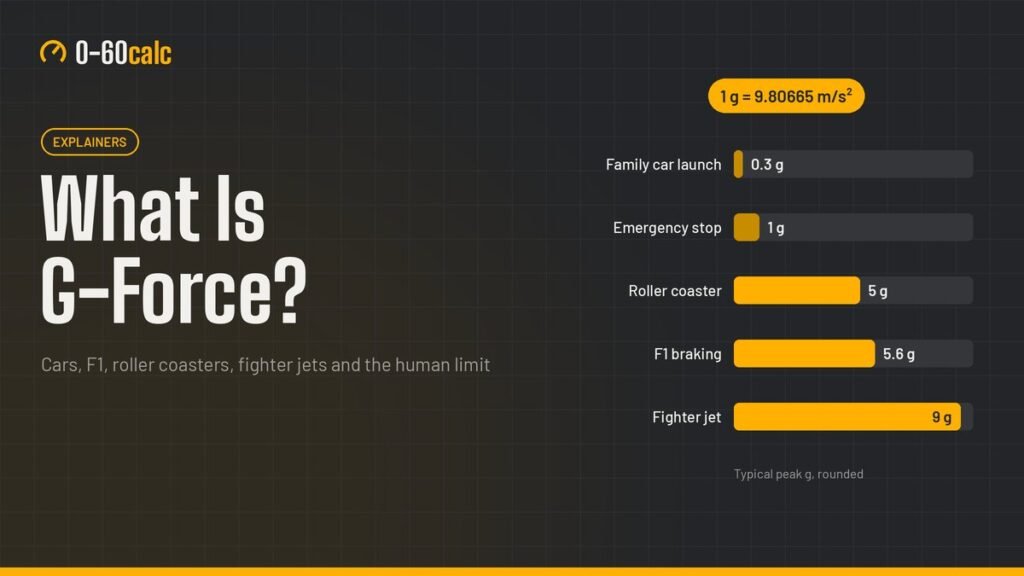
G-force is acceleration measured as a multiple of Earth’s gravity. One g is 9.80665 m/s², the same as gaining about 22 mph every second. A family car pulls about 0.3 g accelerating and about 1 g in an emergency stop, an F1 car 5 to 6 g under braking, and fighter pilots are trained to 9 g. Without training or a g-suit, most people pass out at around 4.5 to 6.3 g held for a few seconds.
In this guide
You feel g-force every time a car launches, brakes hard or takes a fast corner. This guide explains what it is in plain terms, how to calculate it from a 0-60 time or a braking distance, how many g cars, F1, roller coasters and fighter jets pull, how much the human body can take, and the highest g-forces anyone has survived. To work out your own car’s figure, use the g-force calculator.
Last updated 7 October 2026.
G-force explained simply
Despite the name, g-force isn’t a force. It’s acceleration, expressed against the pull of gravity, which is why the unit is written as a lowercase g. Sitting still, you feel 1 g: the seat pushing up on you is what you sense as your weight. At 2 g everything feels twice as heavy, including your head and arms. At 0 g, as in free fall or on the International Space Station, you feel weightless.
The feeling depends on direction as well as size. In a car, acceleration presses you back into the seat, braking throws you forward into the belt, and cornering pushes you sideways. Mercedes-AMG’s F1 team gives a sense of scale: at the 5 g a Formula 1 car pulls through fast corners, its 70 kg driver George Russell feels as if he weighs about 350 kg.
Forward and back (Gx)
Chest to back, as in a car launch, hard braking or an astronaut lying in a capsule seat. The body handles this direction best.
Head to foot (Gz)
A pilot pulling out of a dive or a roller coaster at the bottom of a drop. Blood drains from the head, so tolerance is much lower.
Sideways (Gy)
Cornering. Road cars manage about 0.6 to 1.1 g on a skidpad; F1 cars more than 5 g with downforce.
Negative g
Foot to head, as in pushing over the top of a hill or an outside loop. Blood rushes to the head, and people tolerate it worst of all.
How to calculate g-force
Divide the acceleration by standard gravity, 9.80665 m/s². For cars, three shortcuts cover most situations:
Average g from a 0-60 mph time
g = 2.735 ÷ seconds
Average g from a braking distance
g = mph² ÷ (29.9 × feet)
Cornering g from speed and radius
g = mph² ÷ (15 × radius in feet)
2.735 is 60 mph (26.82 m/s) divided by 9.80665. All three give averages over the run or the turn; the peak is higher.
Worked examples, all from Car and Driver tests:
- Honda Civic Sport, 0-60 in 8.9 s: 2.735 ÷ 8.9 = 0.31 g.
- Chevrolet Corvette ZR1, 0-60 in 2.2 s: 2.735 ÷ 2.2 = 1.24 g. Car and Driver says the ZR1 holds more than 1 g of acceleration all the way to 85 mph.
- Hyundai Elantra Hybrid, 70-0 mph in 166 ft: 70² ÷ (29.9 × 166) = 0.99 g, on all-season tires.
- Corvette ZR1, 70-0 mph in 140 ft: 70² ÷ (29.9 × 140) = 1.17 g, on track tires.
Car and Driver’s times leave out the first foot of travel, as US magazines do, which makes 0-60 times slightly quicker and these averages slightly higher. The g-force calculator runs all three formulas and shows the result in m/s² and ft/s².
How many g in cars, F1, roller coasters and fighter jets
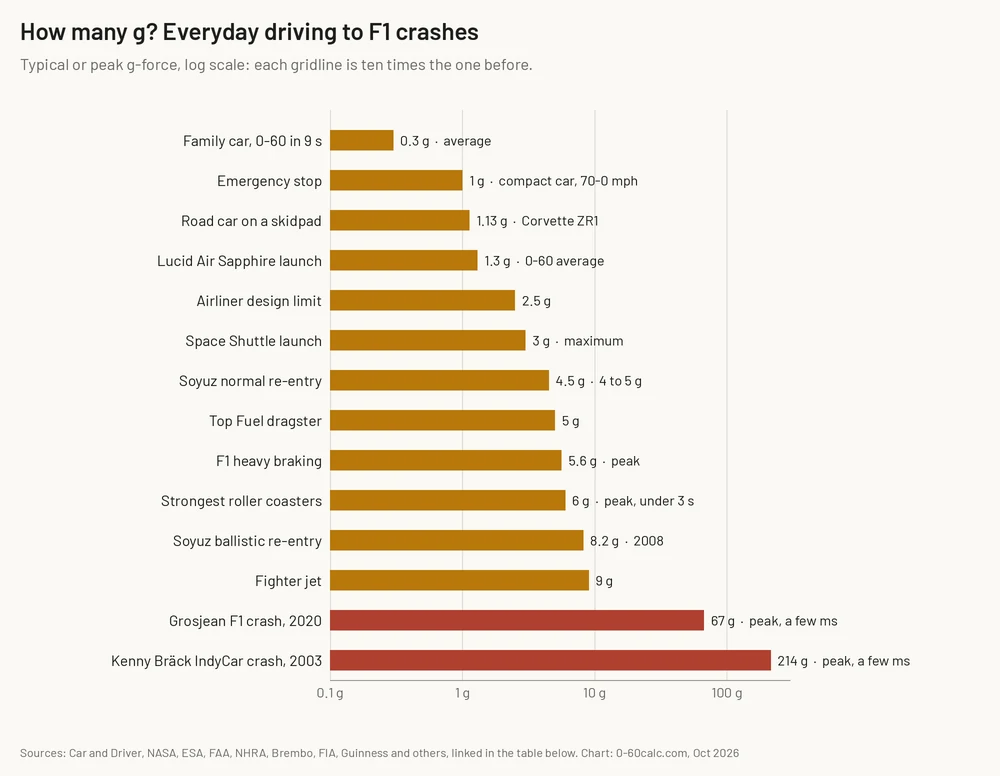
| Situation | About | Direction | Source |
|---|---|---|---|
| Family car accelerating0-60 mph in about 9 s | 0.3 g | Back into the seat | Car and Driver |
| Road car cornering300-ft skidpad, Mercedes G-class to Corvette ZR1 | 0.63 to 1.13 g | Sideways | Car and Driver |
| Emergency stopCompact car, 70-0 mph in 166 ft | 1.0 g | Forward into the belt | Car and Driver |
| Quick electric car launchLucid Air Sapphire, 0-60 mph in 2.1 s | 1.3 g average | Back into the seat | Car and Driver |
| Airliner design limitUS rules for transport aircraft | +2.5 g | Head to foot | 14 CFR 25.337 |
| Space Shuttle launchMaximum allowed | 3 g | Chest to back | NASA |
| Soyuz return to EarthNormal descent | 4 to 5 g | Chest to back | ESA |
| Roller coastersThe most powerful rides, for under 3 s | 4 to 6 g peak | Mostly head to foot | Smith and Meaney, 2002 |
| Top Fuel dragster11,000 hp, 1,000 ft in under 3.7 s at over 330 mph | About 5 g | Back into the seat | NHRA |
| F1 fast cornerSuzuka Turn 1, 2024 season | Over 5 g | Sideways | Mercedes-AMG F1 |
| F1 heavy brakingBrembo data, Montreal final chicane | 5.6 g peak | Forward into the belts | Formula1.com |
| Soyuz ballistic re-entryPeggy Whitson, 2008 | 8.2 g | Chest to back | Air & Space |
| Fighter jetsHard turns and pull-ups | Up to 9 g | Head to foot | FAA |
| F1 crashRomain Grosjean, Bahrain 2020 | 67 g peak | Impact | FIA |
Two things stand out. Road cars live between about 0.3 and 1.3 g, limited by tire grip, while race cars use downforce to press the tires harder into the track and reach several times that. And duration matters as much as size: a coaster’s 5 g lasts a second or two, a fighter pilot’s 9 g can last many seconds. F1 figures are from recent seasons; the 2026 rules cut downforce, so peak cornering loads may come down. For how that grip turns into acceleration, see F1 car 0-60 and Top Fuel dragster 0-60.
How much g-force can a human handle?
There is no single number. Tolerance depends on the direction of the force, how long it lasts, how fast it builds, and on fitness, hydration and training, and it varies for the same person from day to day.
- Chest to back is easiest. NASA’s guidance says 2 g is tolerable for at least 24 hours and 4 g for at least an hour in this direction. At 8 g you can’t lift your arms or legs, and at 9 g you can’t lift your head.
- Head to foot is hardest. Blood drains from the brain. Relaxed and unprotected, people start losing peripheral vision at about 3.4 to 4.8 g, black out at 4 to 5.6 g and lose consciousness at 4.5 to 6.3 g, a condition pilots call G-LOC.
- Training raises the limit. A properly done anti-g straining maneuver, tensing the legs and torso while controlling the breath, adds about 4 g of tolerance, and a g-suit about 3 g more. Even so, jets are held to about 9 g because that’s the pilot’s limit, not the airplane’s, and the US Air Force trains students to no more than 9 g in its centrifuge.
- Negative g is tolerated worst. At −1 g you feel pressure in the head; at −2 to −3 g comes severe facial congestion, a throbbing headache and blurred or reddened vision, known as redout, after about 5 seconds.
So how much g-force is lethal? It depends on time. A few seconds at 5 or 6 g head to foot can knock an unprotected person out, while a properly restrained driver can survive a crash spike of more than 100 g because it lasts only thousandths of a second.
Highest g-force ever survived
| Person | Peak g | What happened |
|---|---|---|
| Kenny BräckGuinness World Records | 214 g | IndyCar crash at 220 mph, Texas Motor Speedway, 2003. Recorded by the car’s crash recorder. |
| David PurleyGoodwood | 179.8 g (estimate) | F1 practice crash, Silverstone, 1977: 108 mph to a stop in 66 cm. |
| Eli Beeding JrGuinness World Records | 82.6 g | Rocket-sled test, Holloman Air Force Base, 1958, for 0.04 seconds. The highest g endured voluntarily. |
| Romain GrosjeanFIA investigation | 67 g | Hit the barrier at 192 km/h in the 2020 Bahrain Grand Prix. |
| Max VerstappenRed Bull team figure | 51 g | Crash at Copse corner, 2021 British Grand Prix. |
| John Paul StappSmithsonian | 46.2 g | US Air Force rocket sled, 1954: 632 mph to a stop in about 1.4 seconds. |
Every one of these was a spike lasting a tiny fraction of a second, and several were badly hurt: Bräck broke his right thigh bone, his sternum, a vertebra and his ankles. Stapp’s run shows the difference between peak and average. Stopping from 632 mph in 1.4 seconds averages about 20 g; 46.2 g was the peak.
Work out your car’s g-force
Turn a 0-60 time, a braking distance or a cornering speed into g.
G-Force CalculatorKey takeaways
- G-force is acceleration measured against gravity: 1 g is 9.80665 m/s², about 22 mph gained every second.
- Average g from a 0-60 time is 2.735 ÷ seconds; road cars range from about 0.3 to 1.3 g.
- F1 cars pull more than 5 g in fast corners and under braking; fighter jets up to 9 g.
- Unprotected people lose consciousness at about 4.5 to 6.3 g head to foot; chest to back is far easier.
- The highest g survived is 214 g, by Kenny Bräck in 2003, for a fraction of a second.
FAQ
What is g-force in simple terms?
How hard you are being accelerated, compared with Earth’s gravity. At 1 g you feel your normal weight; at 3 g you feel three times as heavy.
What does the g in g-force stand for?
Gravity. One g is the standard acceleration of gravity, set at exactly 9.80665 m/s², or about 32.17 ft/s².
How many g is 0-60 in 3 seconds?
About 0.91 g on average: 2.735 ÷ 3. The peak, just after launch, is higher.
How many g does an F1 car pull?
In recent seasons, more than 5 g through the fastest corners and around 5 to 6 g under the heaviest braking, according to Mercedes-AMG and Brembo data.
How many g can a human handle?
Relaxed and unprotected, most people lose consciousness at about 4.5 to 6.3 g head to foot. Trained pilots with g-suits fly at up to 9 g. Chest to back, people tolerate much more.
What is the highest g-force ever survived?
214 g, by IndyCar driver Kenny Bräck in a 2003 crash at Texas Motor Speedway, according to Guinness World Records. It lasted a fraction of a second.
What is negative g-force?
Acceleration that pushes from foot to head, as at the top of a hill on a roller coaster or when a pilot pushes into a dive. It sends blood to the head and is tolerated worse than positive g.
What does g-force feel like?
Like extra weight in the direction of the push. Around 1 g of braking throws you hard into the seat belt; at 4 to 5 g head to foot your vision starts to grey out.
Sources
- NIST: standard acceleration of gravity, 9.80665 m/s² (exact)
- Car and Driver: 2025 Corvette ZR1 test (0-60, braking, skidpad, over 1 g to 85 mph)
- NASA OCHMO-TB-024: acceleration limits by direction
- StatPearls: aerospace gravitational effects (vision loss, blackout, G-LOC)
- Frontiers in Physiology (2026): anti-g straining maneuvers and the 9 g ceiling
- US Air Force Research Laboratory: centrifuge training to 9 g
- Mercedes-AMG F1: g-force and Formula One explained
- Guinness World Records: highest g-force endured (Kenny Bräck) and voluntary record (Eli Beeding Jr)
- Goodwood: David Purley’s 179.8 g crash
- Formula1.com: Red Bull on Verstappen’s 51 g crash
- Smithsonian National Air and Space Museum: John Paul Stapp
- Other figures are linked in each row of the table above
Related guides

What Is a Dyno? Dyno Testing, Tuning Costs & How to Read a Dyno Sheet
A dyno measures an engine's torque and rpm under load and calculates horsepower. Engine vs chassis…

What Is Horsepower? Meaning, Formula & What It Means for Your Car
Horsepower is how fast an engine does work: 33,000 foot-pounds per minute, or 745.7 watts. The…

What Is Torque in a Car? A Simple Explanation With Real Numbers
Torque is the twisting force that turns your wheels. What it measures, lb-ft vs Nm, why…