Power-to-Weight Ratio Calculator
Work out any car or bike's power-to-weight ratio in hp per tonne, lb/hp, kg/hp and W/kg, or find the power or weight you need to hit a target.
Press Calculate to print your slip
Estimate only. Real numbers vary with the dyno, the track and the day.
Want the full 0-60 slip? Open the 0-60 Calculator
On this page
Three ways to use it
Work out a vehicle's power-to-weight ratio, find the power you'd need to hit a target ratio, or find how light a car must be for the power it has. Every result shows the ratio in the units people actually use, plus an estimated 0-60 and quarter-mile time.
What you need
- Power
- In hp, kW or PS, straight from the spec sheet.
- Weight
- Curb weight in pounds or kilograms. Add a driver or passengers as extra weight if you want.
- A target, if you have one
- A ratio you want to reach, in hp per tonne or pounds (or kilograms) per hp.
What you get
- hp per tonne and per US ton, lb/hp or kg/hp, W/kg and PS per tonne
- A class, from economy car to superbike
- Power needed, or maximum weight, for a target ratio
- Estimated 0-60 mph and quarter-mile times from the same numbers
What power-to-weight ratio tells you
Power-to-weight ratio is engine power divided by the mass it has to move. It's the single best predictor of how hard a vehicle accelerates, far better than horsepower on its own: a 300 hp SUV and a 300 hp sports car make the same power, but the lighter car gets far more of it per kilogram.
You'll also see it written upside down, as weight-to-power: pounds or kilograms per horsepower. Same idea, opposite direction. A higher power-to-weight figure is better, and a lower weight-to-power figure is better.
The units, and who uses them
hp per tonne
Horsepower per 1,000 kg. The standard in UK and European magazines and the headline figure here.
lb per hp
Pounds each horsepower has to move. Common in the US and in drag racing. Lower is quicker.
kg per hp
The metric version of lb/hp, used on many European and Asian spec sheets.
PS per tonne and hp per ton
The same ratio in metric horsepower, or per 2,000 lb US short ton, which some American spec sheets use.
W/kg
Watts per kilogram, the unit cyclists and engineers use. It is the same number as kW per tonne; 1 hp per tonne is 0.7457 W/kg.
Crank or wheel power
Ratios are normally quoted with crank horsepower. Use the same kind of figure for every vehicle you compare.
The formulas
hp per tonne
hp/t = hp ÷ (kg ÷ 1,000)
Weight to power
lb/hp = lb ÷ hp
Power for a target
hp = hp/t × kg ÷ 1,000
Weight for a target
kg = hp ÷ hp/t × 1,000
- Conversions
- 1 kg = 2.20462 lb. 1 hp = 0.7457 kW = 1.014 PS = 745.7 W.
- Time estimates
- 0-60 and quarter-mile use the same model as the 0-60 calculator, assuming a rear-drive car with a manual gearbox.
Worked example: 300 hp and 3,300 lb (1,497 kg) is 300 ÷ 1.497 = 200 hp per tonne, 11.0 lb/hp, or about 149 W/kg.
Where your number sits
The classes printed on your slip. Real cars overlap the boundaries; gearing, traction and aerodynamics decide the rest.
| Class | hp per tonne | lb per hp | kg per hp |
|---|---|---|---|
| Economy carCity cars and basic compacts | under 80 | over 27.6 | over 12.5 |
| Everyday carMost family cars and crossovers | 80 to 125 | 17.6 to 27.6 | 8.0 to 12.5 |
| Warm hatchQuick hatchbacks and sporty sedans | 125 to 170 | 13.0 to 17.6 | 5.9 to 8.0 |
| Sports carHot hatches, coupes, quick EVs | 170 to 250 | 8.8 to 13.0 | 4.0 to 5.9 |
| Performance carV8 coupes and track-focused cars | 250 to 350 | 6.3 to 8.8 | 2.9 to 4.0 |
| SupercarMid-engine exotics | 350 to 500 | 4.4 to 6.3 | 2.0 to 2.9 |
| HypercarThe fastest road cars | 500 to 800 | 2.8 to 4.4 | 1.25 to 2.0 |
| Superbike territorySport bikes without a rider | over 800 | under 2.8 | under 1.25 |
More power or less weight?
They trade almost one for one
Cutting 10% of the weight raises the ratio by about 11%, the same as adding 11% more power.
Weight helps everywhere
A lighter car also brakes shorter, turns in sharper and wears its tires and brakes less. Extra power only helps when you accelerate.
Start with what you carry
Spare wheels, tools and a full tank can add 50 kg or more. Enter them as extra weight to see what they cost.
Power needs traction
Past a point, more power just spins the tires. That is why high-ratio cars lean on AWD, wide tires and launch control.
How to use it
Pick what to find
Your ratio, the power for a target, or the weight for a target.
Enter the numbers
Power in hp, kW or PS, and weight in lb or kg. The units convert as you switch.
Add extra weight
Optional: driver, passengers, fuel or cargo, to see the car as you actually drive it.
Read the slip
Press Calculate for the ratio in every unit, a class and estimated 0-60 and quarter-mile times.
Example ratios
| Example build | hp per tonne | lb per hp | W/kg |
|---|---|---|---|
| Compact sedan158 hp, 2,900 lb | 120 | 18.4 | 90 |
| Hot hatch241 hp, 3,150 lb | 169 | 13.1 | 126 |
| Sports coupe300 hp, 3,300 lb | 200 | 11.0 | 149 |
| Dual-motor EV425 hp, 4,030 lb | 232 | 9.5 | 173 |
| V8 coupe480 hp, 3,850 lb | 275 | 8.0 | 205 |
| Superbike with rider200 hp, 440 lb bike plus 170 lb | 723 | 3.0 | 539 |
Example builds with round numbers, not specific models.
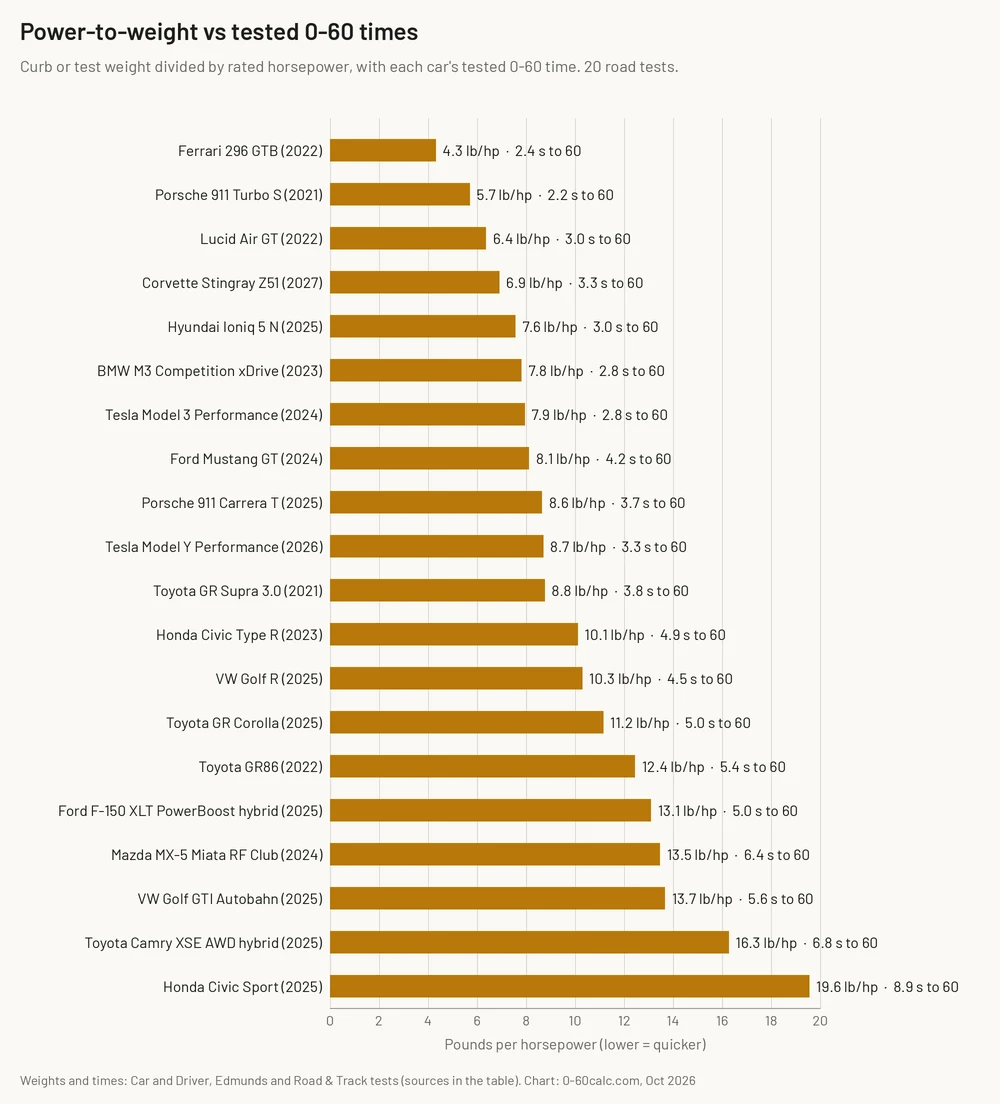
Real cars: power-to-weight vs tested 0-60
Twenty road-tested cars, from a Honda Civic to a Ferrari 296 GTB, ranked by pounds per horsepower, with the 0-60 time each tester measured. Weights are the figures published with each test, and hybrid and electric horsepower is the combined system rating (the Ioniq 5 N figure is with its boost mode on).
| Car | hp | Weight (lb) | lb/hp | hp/tonne | Tested 0-60 |
|---|---|---|---|---|---|
| Ferrari 296 GTB (2022)Tested by Car and Driver | 819 | 3,532 | 4.3 | 511 | 2.4 s |
| Porsche 911 Turbo S (2021)Tested by Car and Driver | 640 | 3,646 | 5.7 | 387 | 2.2 s |
| Lucid Air Grand Touring (2022)Tested by Car and Driver | 819 | 5,212 | 6.4 | 346 | 3.0 s |
| Chevrolet Corvette Stingray Z51 (2027)Tested by Edmunds | 535 | 3,693 | 6.9 | 319 | 3.3 s |
| Hyundai Ioniq 5 N (2025)Tested by Car and Driver | 641 | 4,849 | 7.6 | 291 | 3.0 s |
| BMW M3 Competition xDrive (2023)Tested by Car and Driver | 503 | 3,929 | 7.8 | 282 | 2.8 s |
| Tesla Model 3 Performance (2024)Tested by Road & Track | 510 | 4,050 | 7.9 | 278 | 2.8 s |
| Ford Mustang GT (2024, manual)Tested by Car and Driver | 486 | 3,947 | 8.1 | 271 | 4.2 s |
| Porsche 911 Carrera T (2025, manual)Tested by Car and Driver | 388 | 3,355 | 8.6 | 255 | 3.7 s |
| Tesla Model Y Performance (2026)Tested by Car and Driver | 510 | 4,438 | 8.7 | 253 | 3.3 s |
| Toyota GR Supra 3.0 (2021, automatic)Tested by Car and Driver | 382 | 3,347 | 8.8 | 252 | 3.8 s |
| Honda Civic Type R (2023, manual)Tested by Car and Driver | 315 | 3,183 | 10.1 | 218 | 4.9 s |
| Volkswagen Golf R (2025)Tested by Edmunds | 328 | 3,376 | 10.3 | 214 | 4.5 s |
| Toyota GR Corolla (2025, automatic)Tested by Car and Driver | 300 | 3,345 | 11.2 | 198 | 5.0 s |
| Toyota GR86 (2022, manual)Tested by Car and Driver | 228 | 2,838 | 12.4 | 177 | 5.4 s |
| Ford F-150 XLT PowerBoost hybrid (2025)Tested by Car and Driver | 430 | 5,631 | 13.1 | 168 | 5.0 s |
| Mazda MX-5 Miata RF Club (2024)Tested by Edmunds | 181 | 2,437 | 13.5 | 164 | 6.4 s |
| Volkswagen Golf GTI Autobahn (2025, DCT)Tested by Car and Driver | 241 | 3,293 | 13.7 | 161 | 5.6 s |
| Toyota Camry XSE AWD hybrid (2025)Tested by Car and Driver | 232 | 3,774 | 16.3 | 136 | 6.8 s |
| Honda Civic Sport sedan (2025, CVT)Tested by Car and Driver | 150 | 2,934 | 19.6 | 113 | 8.9 s |
What the table shows. Power-to-weight sorts the field well: every car under 8 lb/hp reaches 60 mph in about 3.3 seconds or less, and every car over 13 lb/hp needs 5 seconds or more. Within a band, traction and gearing decide the order. The all-wheel-drive Porsche 911 Turbo S beats the Ferrari 296 GTB to 60 even though the Ferrari has the better ratio, and the 5,631 lb Ford F-150 hybrid matches the GR Corolla to 60 despite weighing about 2,300 lb more. To see where these times sit on the scale from family car to hypercar, read what counts as a good 0-60 time. For a stranger comparison, our guide to how much horsepower a horse has puts horses, sprinters and cars on the same power-to-weight scale.
Car and Driver and Road & Track subtract a one-foot rollout from 0-60 times; Edmunds does not, which adds roughly 0.2 to 0.4 seconds.
Curb weight, test weight or weight with driver?
Curb weight in US specs is the car with all fluids and a full tank but no people or cargo. Test weight in a magazine test is usually the measured curb weight of that exact car, options included. In Europe, the official mass in running order already adds a 75 kg (165 lb) driver and luggage allowance, so European figures look heavier for the same car.
For a realistic ratio, use curb weight plus the driver: add about 150 to 200 lb (70 to 90 kg). When you compare cars, just make sure you use the same kind of weight for all of them. See what counts as a good power-to-weight ratio for benchmarks.
Sources and method
Power-to-weight is plain division, and the unit conversions use exact factors (1 lb = 0.45359237 kg, 1 hp = 745.7 W). The real-car table uses each car's rated horsepower with the weight and 0-60 time its tester measured.
Updated October 2026. Built and checked by the 0-60calc Team. Found a mistake? Tell us and we will check it against the source.
More calculators
Turn a ratio into times, or work out the power figure first.
0-60 Calculator
0-60 mph and 0-100 km/h from power and weight, for cars, motorcycles and EVs.
OpenQuarter Mile Calculator
1/4 and 1/8 mile ET and trap speed, or horsepower from a time slip.
OpenHorsepower Calculator
Horsepower from torque and rpm, a time slip or a 0-60 time, in hp, kW and PS.
OpenkW to HP Converter
Convert kilowatts to horsepower and PS, with a chart from 1 to 1,000 kW.
OpenWHP to HP Calculator
Turn a dyno's wheel horsepower into crank horsepower and see the drivetrain loss.
OpenG-Force Calculator
Average acceleration in g from any 0-60 or 0-100 km/h time.
OpenTire Speed Rating Chart
Every speed rating letter in mph and km/h, plus a sidewall code decoder.
OpenKM/H to MPH Converter
Convert kilometers per hour to miles per hour, with a full chart.
OpenMPH to KM/H Converter
Convert miles per hour to kilometers per hour, with a full chart.
OpenSpeed Calculator
Speed, distance or time from the other two, average speed and speed from rpm.
Open
Questions people ask
What is a good power-to-weight ratio for a car?
Most everyday cars sit between about 80 and 125 hp per tonne. Warm hatches and quick sedans reach 125 to 170, sports cars 170 to 250, and supercars start around 350. Anything above 500 is hypercar or superbike territory.
Is a higher power-to-weight ratio better?
For acceleration, yes: more horsepower per tonne means a quicker car. If the figure is written the other way round, as weight-to-power in lb/hp or kg/hp, then lower is better.
Should I include the driver in the weight?
To compare cars, use curb weight, because that is how manufacturers and magazines quote it. To see your own car as you drive it, add yourself, passengers and fuel in the Extra weight box.
Does torque matter as well as power?
Torque and gearing shape how a car feels, but at any given road speed the push at the wheels comes from power. That is why peak horsepower divided by weight predicts acceleration better than peak torque does.
What is W/kg?
Watts per kilogram, the unit cyclists and engineers use. One horsepower per tonne is 0.7457 W/kg, so a 200 hp per tonne car works out at about 149 W/kg.
Why is my motorcycle ratio so high?
Bikes are light. A 200 hp superbike weighing 440 lb has about 1,000 hp per tonne on its own, and still over 700 with a 170 lb rider. They are limited by traction and wheelies off the line, not by power.