What Is a Good 0-60 Time?
From city cars to hypercars: where 0-60 times fall today, why two tests of the same car disagree, and how to get an honest number for your own.
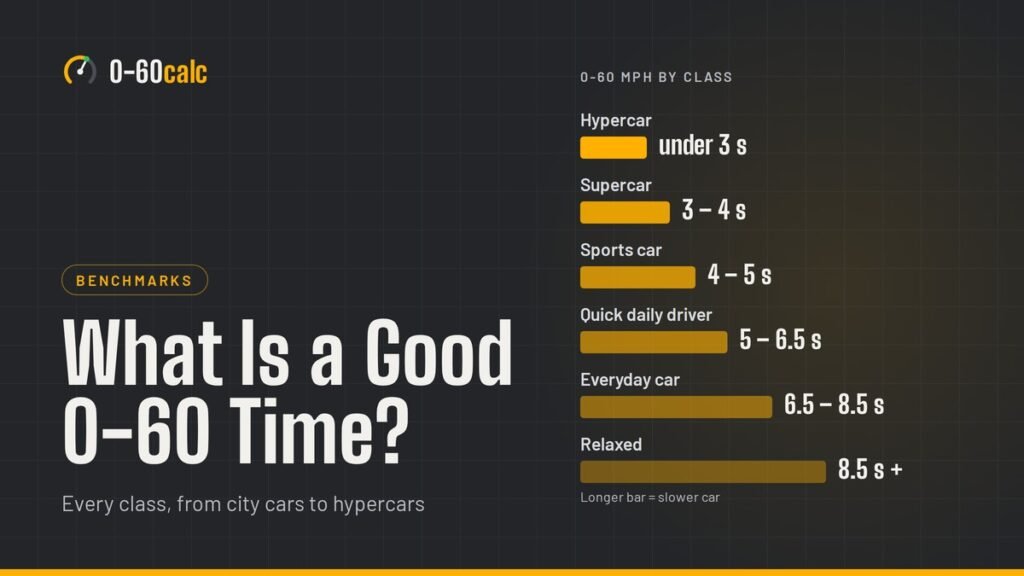
Under 6.5 seconds is quick for a daily driver. Under 5 is sports-car quick, under 4 is supercar territory, and under 3 seconds puts a car among hypercars and the quickest EVs. Most family cars and crossovers run 0-60 mph in 7 to 10 seconds.
In this guide
A 0-60 mph time is the number everyone quotes and almost nobody measures the same way. This guide gives you the scale first, then explains why the same car can post different times, how 0-60 compares with 0-100 km/h, and how to get an honest number for your own car.
Last updated 29 September 2026: added tested examples for every 0-60 time from 3 to 8 seconds, and the EPA’s average for new cars.
What counts as quick in 2026
These are the classes our 0-60 calculator prints on your time slip. The boundaries are broad on purpose: gearing, traction and launch control blur every line.
| Class | 0-60 mph | Typical power-to-weight | Feels like |
|---|---|---|---|
| HypercarAlso the quickest EVs | under 3 s | 500+ hp/t | A roller coaster launch |
| SupercarMid-engine exotics, quick EVs | 3 to 4 s | 350 to 500 hp/t | Pinned to the seat |
| Sports carV8 coupes, hot hatches | 4 to 5 s | 170 to 350 hp/t | Genuinely fast |
| Quick daily driverWarm hatches, sport sedans | 5 to 6.5 s | 125 to 170 hp/t | Eager |
| Everyday carFamily cars and crossovers | 6.5 to 8.5 s | 80 to 125 hp/t | Fine for traffic |
| RelaxedCity cars, base engines | over 8.5 s | under 80 hp/t | Plan your overtakes |
Two things stand out. The gaps shrink as cars get quicker: going from 8 to 6 seconds transforms a car on the road, while 3.5 to 3.0 is mostly bragging rights. And power-to-weight ratio tracks the classes closely, which is exactly why our calculator starts from it.
Is 0-60 in 3, 4, 5, 6, 7 or 8 seconds fast?
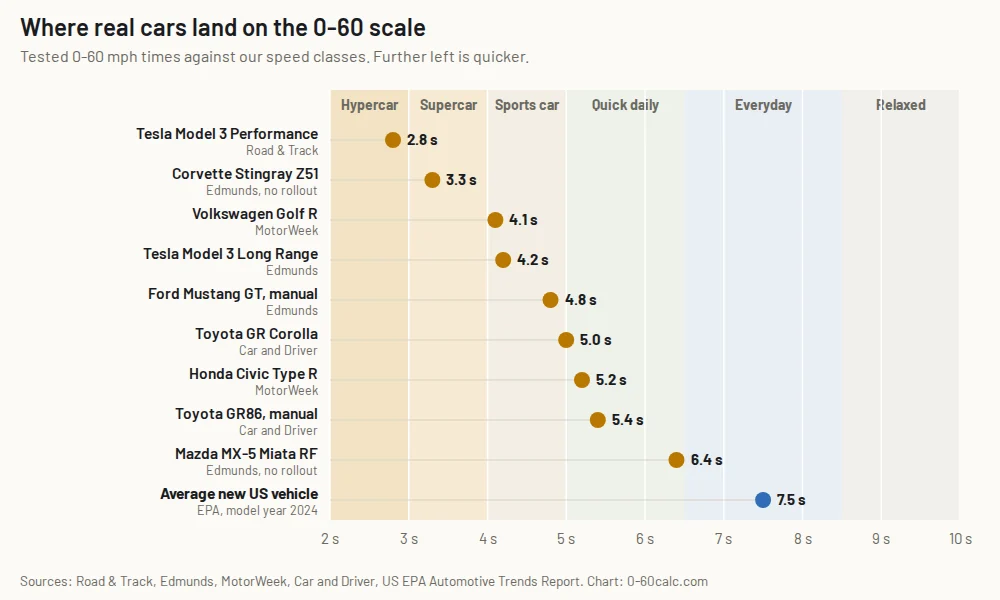
Here’s what each whole-second mark means in practice, with independently tested cars that sit there. For scale, the US EPA calculates that the average new vehicle for model year 2024 reached 60 mph in 7.5 seconds.
Is a 3-second 0-60 fast?
Very. Under 3 seconds is hypercar territory and 3 to 4 seconds is supercar pace. The Tesla Model 3 Performance ran 2.8 seconds in Road & Track’s test, and a Chevrolet Corvette Stingray Z51 did 3.3 seconds in Edmunds’ test, which doesn’t subtract rollout.
Is a 4-second 0-60 fast?
Yes. It’s the line between supercars and sports cars, and anything in the 4s is quick by any standard. A Volkswagen Golf R ran 4.1 seconds for MotorWeek (4.5 in Edmunds’ no-rollout test), and a Tesla Model 3 Long Range 4.2 seconds for Edmunds. The manual Ford Mustang GT did 4.8.
Is a 5-second 0-60 fast?
Yes: 5 seconds is sports-car pace, about two and a half seconds quicker than the average new car. The Toyota GR Corolla ran 5.0 seconds in Car and Driver’s test, the Honda Civic Type R 5.2 for MotorWeek and the manual Toyota GR86 5.4 for Car and Driver.
Is a 6-second 0-60 fast?
It’s quick for a daily driver, and about a second better than the average new car. The Mazda MX-5 Miata RF ran 6.4 seconds in Edmunds’ test. Most warm hatchbacks and sport sedans land between 5 and 6.5 seconds.
Is a 7-second 0-60 fast?
It’s about average. A 7-second car is slightly quicker than the EPA’s 7.5-second figure for model year 2024 new vehicles, and plenty for merging and overtaking.
Is an 8-second 0-60 fast?
Not fast, but not slow for everyday use either. It’s a little behind today’s average and still roughly twice as quick as the average new vehicle of 1980, which the EPA puts at 15.6 seconds.
Where the very top sits now
The ceiling keeps dropping. In Car and Driver’s instrumented testing, the 2026 Chevrolet Corvette ZR1X reached 60 mph in 1.8 seconds, a tenth quicker than the Lucid Air Sapphire and Porsche Taycan Turbo GT, which both recorded 1.9. A decade ago, anything under 3 seconds was headline news. Our list of the fastest 0-60 cars keeps tested times and official claims side by side.
Why the same car gets different times
Take one car to three outlets and you can get three numbers. None of them are lying; they measure slightly different things.
Rollout
Car and Driver and MotorTrend start the clock after the car has rolled about a foot, drag-strip style. That trims roughly 0.2 seconds. Edmunds does not: its Lucid Air Sapphire test showed 2.2 seconds without rollout and 2.1 with it.
Official vs tested
Manufacturers often quote their best run on a prepared surface. Chevrolet’s own 1.68-second ZR1X run was on a prepped drag strip; independent tests on ordinary tarmac came out slower.
Launch, tires and surface
A perfect launch on warm, sticky tires can be worth half a second. Cold tires, dust or a damp surface cost the same.
Air, fuel and load
Hot, humid or thin air cuts engine power. A full tank and a passenger add weight the spec sheet ignores, and in a manual the driver’s shifts matter too.
When you compare times, compare like with like: same test method, same outlet if possible, and never a manufacturer claim against an independent test.
Check any car in 30 seconds
Enter horsepower and weight and the calculator prints a time slip with 0-60, 0-100 km/h and quarter-mile estimates.
Open the 0-60 Calculator0-60 mph vs 0-100 km/h
Outside the US, cars are measured to 100 km/h, which is 62.1 mph. Because the target is higher and acceleration fades as speed rises, a 0-100 km/h time usually runs about 4 to 6 percent longer than the 0-60 mph time for the same car. Our calculators use 5 percent.
| 0-60 mph | About 0-100 km/h | Class |
|---|---|---|
| 3.0 s | 3.2 s | Supercar |
| 4.0 s | 4.2 s | Sports car |
| 5.0 s | 5.3 s | Quick daily driver |
| 6.5 s | 6.8 s | Everyday car |
| 8.5 s | 8.9 s | Relaxed |
Does 0-60 still matter?
Less than it used to for everyday driving. Merging and overtaking happen from a rolling start, so the times that decide how a car feels on the road are passing sprints such as 30-50 mph and 50-70 mph. A turbocharged or electric car with strong mid-range pull can feel quicker in traffic than its 0-60 time suggests, while a car that needs a downshift first can feel slower.
0-60 is still the best single comparison, because every outlet measures it and it captures power, weight and traction at once. Just don’t buy a car on tenths of a second.
How EVs changed the scale
Electric motors deliver full torque from a standstill and don’t need to shift, so mid-priced dual-motor EVs now run in the 4 to 5 second range and the quickest ones dip under 2. The trade-offs are weight and repeatability: times can fall off when the battery is cold or low. Our calculator applies a separate factor for EVs for exactly this reason.
Motorcycles
Superbikes have power-to-weight ratios no road car can match, but they can’t use all of it off the line. A single rear tire and the risk of a wheelie cap the launch, which is why a 200 hp bike runs a similar 0-60 to a supercar rather than beating it outright. Add the rider’s weight to the bike’s wet weight when you estimate; it makes a big difference.
How to measure your own car
- Use a GPS performance meter or an app built for acceleration runs. The speedometer is not accurate enough.
- Test on a drag strip, a closed road or a track day. Never on public roads.
- Run at least three passes in each direction and average them. A single run is mostly luck.
- Note whether your app applies rollout, and say so when you share the number.
- Record the temperature, tires and fuel level so you can compare runs later.
Then put your time into the g-force calculator to see how hard the car really pulled.
Key takeaways
- Under 6.5 seconds is quick for a daily driver; under 4 is supercar territory.
- Most published US times subtract a one-foot rollout worth about 0.2 seconds.
- 0-100 km/h runs about 5 percent longer than 0-60 mph.
- Power-to-weight ratio predicts the class better than horsepower alone.
- Measure with GPS, off public roads, and average several runs.
- The average new US vehicle does 0-60 in 7.5 seconds, according to the EPA.
FAQ
Is a 0-60 time measured with or without rollout?
Both, which is why numbers disagree. Car and Driver and MotorTrend subtract a one-foot rollout, worth about 0.2 seconds. Edmunds and most GPS apps measure from a true standstill unless you switch rollout on. Manufacturer claims vary.
What is a good 0-60 time for a daily driver?
Anything under 6.5 seconds feels quick in everyday traffic, and under 5 seconds is genuinely fast. Most family cars and crossovers run 7 to 10 seconds, which is plenty for merging and overtaking.
Do automatic cars have slower 0-60 times?
Not any more. Modern dual-clutch and torque-converter automatics with launch control usually beat a manual, because they shift faster and launch more consistently. Older automatics without launch control can lose a few tenths.
How much slower is 0-100 km/h than 0-60 mph?
About 5 percent for most cars, because 100 km/h is 62.1 mph and acceleration fades as speed rises. A 5.0-second 0-60 car usually runs 0-100 km/h in about 5.2 to 5.3 seconds.
What is the quickest 0-60 time ever tested?
In Car and Driver’s testing, the Chevrolet Corvette ZR1X holds the record at 1.8 seconds with a one-foot rollout. Some hypercars claim quicker times, but those are manufacturer figures rather than independent tests.
Is 0-60 in 5 seconds fast?
Yes. Five seconds is sports-car pace, about 2.5 seconds quicker than the average new vehicle. The Toyota GR Corolla and Honda Civic Type R both test at around 5 seconds.
Is 0 to 60 in 6 seconds fast?
Yes, for a daily driver. It is about 1.5 seconds quicker than the average new vehicle’s 7.5 seconds, according to the EPA, and sits in our quick daily driver class. The Mazda MX-5 Miata RF tested at 6.4 seconds.
Is a 7-second 0-60 good?
It’s about average. The EPA puts the average new vehicle for model year 2024 at 7.5 seconds, so 7 seconds is slightly quicker than typical and plenty for everyday driving.
What is the average 0-60 time for a new car?
7.5 seconds for new US vehicles in model year 2024, according to the EPA, which calculates it from each vehicle’s power and weight. The EPA projects 7.3 seconds for model year 2025.
Sources
- Carscoops: Car and Driver’s Corvette ZR1X acceleration test
- Edmunds: Lucid Air Sapphire track test, with and without rollout
- Carscoops: MotorTrend’s Lucid Air Sapphire test and rollout
- US EPA Automotive Trends Report (2025 edition): average 0-60 of 7.5 s for model year 2024, 15.6 s in 1980
- Road & Track (via Yahoo): Tesla Model 3 Performance, 2.8 s
- Edmunds: Corvette Stingray Z51 track test
- MotorWeek: Volkswagen Golf R and Edmunds: Golf R track test
- Edmunds: Tesla Model 3 Long Range
- Edmunds: tested Ford Mustang performance numbers
- Car and Driver (via Yahoo): Toyota GR Corolla automatic
- MotorWeek: Honda Civic Type R
- Car and Driver (via Yahoo): GR86 test, with the manual’s time for comparison
- Edmunds: Mazda MX-5 Miata RF Club track test
Related guides
What Is a Dyno? Dyno Testing, Tuning Costs & How to Read a Dyno Sheet
A dyno measures an engine's torque and rpm under load and calculates horsepower. Engine vs chassis…

What Is G-Force? Meaning, Examples in Cars & F1, and How Many G’s Humans Can Take
G-force is acceleration measured against gravity: 1 g is 9.80665 m/s². How to work it out,…
What Is Horsepower? Meaning, Formula & What It Means for Your Car
Horsepower is how fast an engine does work: 33,000 foot-pounds per minute, or 745.7 watts. The…