Average Car Horsepower in 2026: By Segment, EVs and How Much Is Good
The average new US vehicle makes about 260 hp, per the EPA. How that has grown since 1975, what today's best-sellers and EVs make, and how much horsepower is good for daily driving.
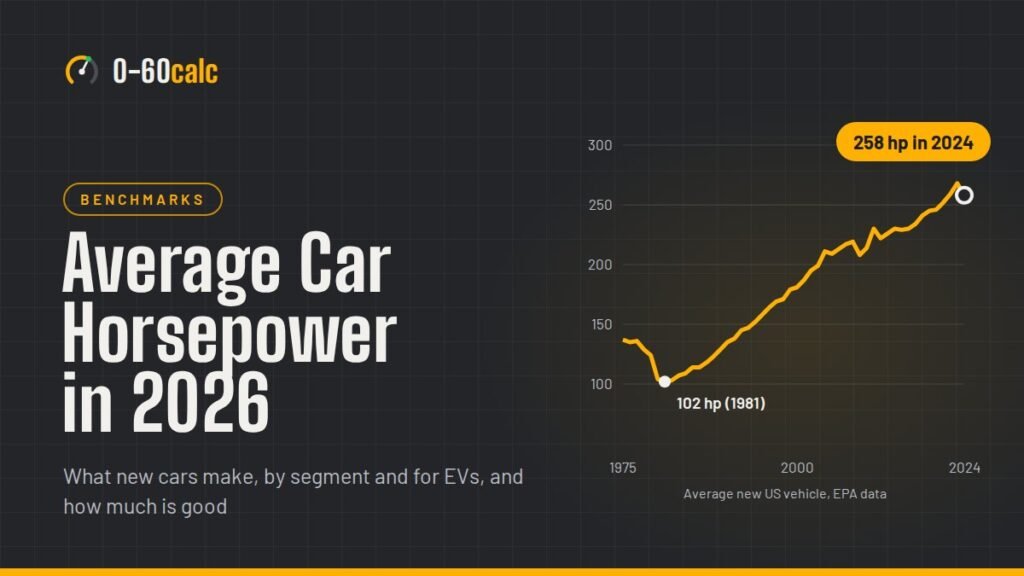
The average new vehicle sold in the US makes about 260 horsepower: 258 hp in model year 2024 and 264 hp in the EPA’s preliminary figure for 2025. That’s the average across cars, SUVs, pickups and minivans. It’s more than double the 1981 low of 102 hp, and the average new vehicle now reaches 60 mph in about 7.5 seconds.
In this guide
The best source for “average horsepower” is the US Environmental Protection Agency’s Automotive Trends Report, which averages every new light-duty vehicle sold, weighted by how many were built. Below are its latest figures, how power has grown since the 1970s, what today’s best-sellers actually make, and how much horsepower you really need.
Last updated 29 September 2026, with the EPA’s 2025 Automotive Trends Report (published February 2026).
The average in 2026
The EPA publishes final figures a year or more after a model year ends, so the newest numbers available in 2026 are these:
| Model year | Average horsepower | Note |
|---|---|---|
| 2025Preliminary | 264 hp | Based on automakers’ production forecasts |
| 2024 | 258 hp | 245 hp without EVs and plug-in hybrids |
| 2023 | 268 hp | The record so far |
| 1981 | 102 hp | The lowest on record |
| 1975 | 137 hp | First year of EPA data |
The same report puts the average model-year 2024 vehicle at 4,354 pounds with a 0-60 mph time of 7.5 seconds. Divide the weight by the power and the average new vehicle carries about 17 pounds per horsepower, a number you can compare with your own car in the power-to-weight ratio calculator.
The small dip in 2024 came in a year when, the EPA notes, average weight and footprint also fell slightly. The preliminary 2025 figure is already back up to 264 hp.
How horsepower grew since 1975
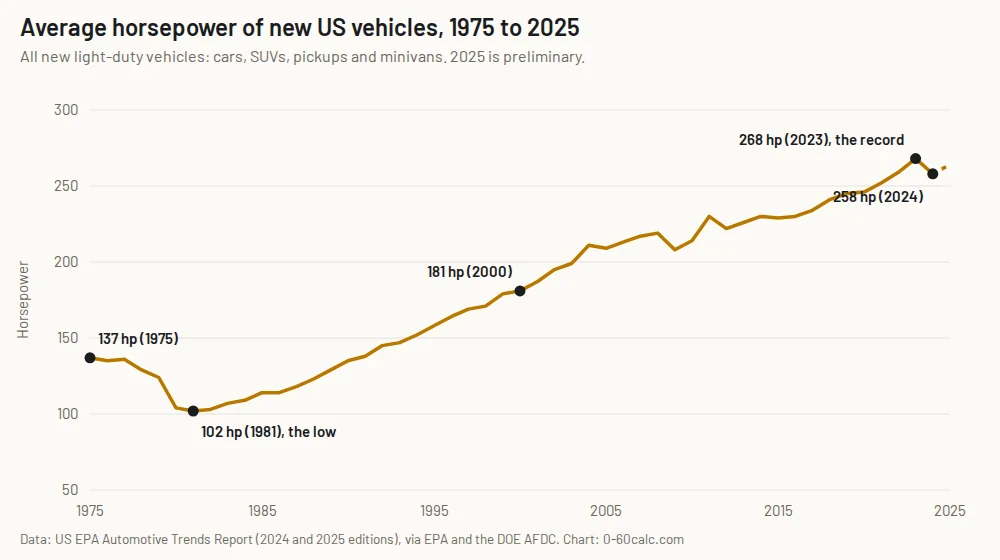
Power fell sharply in the late 1970s, as automakers and buyers moved to smaller, more fuel-efficient engines after the oil crises, and bottomed out at 102 hp in 1981. It has climbed almost every year since, as fuel injection, multi-valve engines, turbocharging, more gears and, lately, electric motors all added power. According to the EPA, the average model-year 2024 vehicle made 88% more power than a 1975 vehicle and 153% more than a 1981 vehicle, while fuel economy also rose.
Not every type grew at the same rate. Between 1975 and 2024, average power rose 54% for sedans and wagons, 77% for truck-based SUVs, 82% for minivans and vans, 118% for car-based SUVs and 138% for pickups.
What today’s best-sellers make
The EPA average hides a wide spread. Here’s what some of the most familiar 2026 models are rated at, from the manufacturers’ published figures:
| Segment and model | Horsepower | Source |
|---|---|---|
| Compact carHonda Civic 2.0 / Civic Hybrid | 150 / 200 hp | Honda |
| Compact carToyota Corolla 2.0 | 169 hp | Cars.com |
| Midsize carToyota Camry Hybrid, FWD / AWD | 225 / 232 hp | Toyota, via Wikipedia |
| Compact SUVHonda CR-V turbo / hybrid | 190 / 204 hp | Honda |
| Compact SUVToyota RAV4 Hybrid FWD / AWD, plug-in hybrid | 226 / 236 hp, 324 hp | Autoblog |
| Electric SUVChevrolet Equinox EV, FWD | 213 hp | Edmunds |
| Full-size pickupFord F-150, base V6 to hybrid | 325 to 430 hp | Ford |
| Sports carFord Mustang EcoBoost / GT | 315 / 480 hp | Ford |
Compact cars sit well below the average, family SUVs close to it, and full-size pickups well above it, which is why pickups pull the overall figure up. The F-150’s range excludes the Raptor models (450 and 720 hp).
Electric cars are pushing the average up
The EPA found that for each of the four most popular vehicle types, electric and plug-in hybrid versions have more horsepower than their gasoline-only counterparts. Take them out and the model-year 2024 average drops from 258 hp to 245 hp. The RAV4 shows the effect within one model: the plug-in hybrid makes 324 hp against the regular hybrid’s 226 to 236. Electric motors also deliver their torque instantly, so EVs usually feel quicker than their horsepower suggests. For what torque is and how much real cars make, see what torque is in a car.
EVs are often rated in kilowatts. To compare them with gas cars, convert with the kW to hp converter.
How much horsepower is good for a daily driver?
Horsepower alone doesn’t decide how a car feels: a light car needs much less than a heavy SUV or pickup. As a rough guide for a typical 3,000 to 4,500 lb vehicle:
| Horsepower | How it feels | Typical of |
|---|---|---|
| Under 150 hp | Adequate in a light car; slow to merge when loaded | Base compact cars, older economy cars |
| 150 to 250 hp | Comfortable for everyday driving and highway passing | Most compact cars, midsize sedans, family SUVs |
| 250 to 350 hp | Brisk, with easy passing and towing headroom | Pickups, turbo sedans, hot hatches |
| 350 hp and up | Performance-car quick, especially in a light car | Sports cars, V8s, performance EVs |
For most drivers, anything near the national average of about 260 hp is plenty. What matters more is power relative to weight: our guide to a good power-to-weight ratio gives benchmarks, and the 0-60 calculator shows what a given horsepower and weight mean in seconds. For a sense of where the unit comes from, see how much horsepower a horse has.
See what your horsepower does
Enter your car’s horsepower and weight to estimate its 0-60 mph and 0-100 km/h times.
0-60 CalculatorKey takeaways
- The average new US vehicle makes about 260 hp: 258 hp in 2024, 264 hp preliminary for 2025.
- The record is 268 hp in model year 2023; the low was 102 hp in 1981.
- The average new vehicle weighs 4,354 lb and reaches 60 mph in about 7.5 seconds.
- Pickups and EVs pull the average up; compact cars sit well below it.
- 150 to 250 hp is comfortable for most daily driving; weight matters as much as power.
FAQ
What is the average horsepower of a car in 2026?
About 260 hp for the average new US vehicle, including SUVs and pickups. The EPA’s latest figures are 258 hp for model year 2024 and a preliminary 264 hp for 2025.
What was the average horsepower of a car in the 1980s?
It started the decade at its lowest ever: 104 hp in 1980 and 102 hp in 1981, according to EPA data. By 1989 the average had recovered to 129 hp.
Is 200 horsepower good?
Yes, for a compact car or small SUV. 200 hp is typical of today’s family cars and gives comfortable performance for everyday driving. In a heavy pickup it would feel slow.
Is 300 horsepower fast?
It’s above average, and in a car weighing around 3,300 lb it’s genuinely quick. In a 5,000 lb pickup or SUV, 300 hp is simply adequate.
Do electric cars have more horsepower?
Usually. The EPA found that electric and plug-in hybrid versions of the most popular vehicle types have more horsepower than gasoline-only versions, and without them the 2024 average falls from 258 hp to 245 hp.
How much horsepower does an average SUV have?
Popular compact SUVs such as the Honda CR-V and Toyota RAV4 make about 190 to 240 hp in 2026, and plug-in hybrid versions over 300 hp. Larger SUVs typically make more.
Sources
- US EPA: The 2025 EPA Automotive Trends Report (February 2026)
- US EPA: 2025 Automotive Trends Report, Executive Summary
- US DOE Alternative Fuels Data Center: power and fuel economy of the average light-duty vehicle, 1975 onward (EPA data)
- Manufacturer and spec-site pages linked in the table above
Related guides
What Is a Dyno? Dyno Testing, Tuning Costs & How to Read a Dyno Sheet
A dyno measures an engine's torque and rpm under load and calculates horsepower. Engine vs chassis…

What Is G-Force? Meaning, Examples in Cars & F1, and How Many G’s Humans Can Take
G-force is acceleration measured against gravity: 1 g is 9.80665 m/s². How to work it out,…

What Is Horsepower? Meaning, Formula & What It Means for Your Car
Horsepower is how fast an engine does work: 33,000 foot-pounds per minute, or 745.7 watts. The…