What Is an Odometer Reading? How to Read It and Spot Fraud
What the odometer reading means, how to read analog and digital odometers, what a normal reading looks like, and how to spot a rolled-back one.
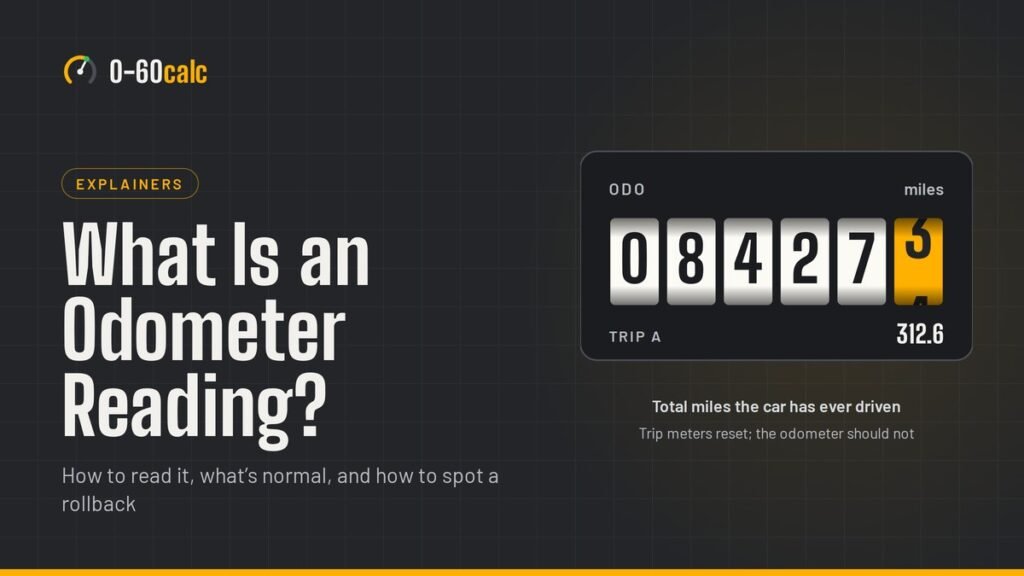
An odometer reading is the total distance a vehicle has traveled since it was built, shown on the dashboard in miles or kilometers. Unlike the trip meter, it can’t be reset. It decides service intervals, warranty cover, insurance and resale value, and in the US the seller must disclose it in writing when ownership changes.
In this guide
Every car has one number that follows it for life: the mileage on the odometer. Buyers check it first, mechanics plan maintenance around it and insurers ask for it. This guide explains what the reading means, how to read analog and digital odometers, what a normal reading looks like, and how to spot a rolled-back one.
What the odometer measures
The odometer counts every mile or kilometer the vehicle has covered. Older cars used a mechanical counter driven by a cable from the transmission; modern cars calculate distance electronically from wheel or transmission sensors and store it in the instrument cluster and other control units.
Odometer
Total lifetime distance. It only counts up and can’t legally be reset or rolled back.
Trip meter (Trip A / Trip B)
A second counter you can reset to zero whenever you like, to measure a single journey or the distance since a fill-up.
Speedometer
Shows how fast you’re going right now. It usually sits right next to the odometer, which causes the mix-ups.
Miles or kilometers
US and UK cars count miles; most other countries count kilometers. Imported cars can show either, so check the unit next to the number.
How to read your odometer
- Digital odometersSwitch the ignition on or to accessory mode. If you see a trip figure instead, press the ODO/TRIP button or the trip reset stem until “ODO” appears.
- Analog odometersRead the row of number drums left to right. A differently colored last drum shows tenths; ignore it when you write the mileage down.
- Leading zerosA display showing 045621 means 45,621 miles (or km).
- Infotainment and appsMany newer cars also show the odometer in the settings menu, the service menu or the maker’s phone app.
- PaperworkThe title, service invoices, inspection reports and the odometer disclosure statement all record the reading at a given date.
Why the reading matters
Maintenance
Oil changes, timing belts, spark plugs and brake fluid are all scheduled by mileage as well as time.
Warranty
New-car warranties end at a mileage limit as well as an age limit, whichever comes first.
Insurance and leasing
Insurers price by how much you drive, and leases include an annual mileage allowance with charges for going over.
Resale value
Mileage is one of the biggest factors in a used car’s price. The more miles, the more wear, and the lower the value.
What’s a normal odometer reading?
The benchmark most people use comes from the Federal Highway Administration: about 13,476 miles per driver per year in the US. Multiply by the car’s age for a rough expectation.
| Vehicle age | Typical reading | In kilometers |
|---|---|---|
| 1 year | about 13,500 mi | about 21,700 km |
| 3 years | about 40,000 mi | about 65,000 km |
| 5 years | about 67,000 mi | about 108,000 km |
| 8 years | about 108,000 mi | about 174,000 km |
| 10 years | about 135,000 mi | about 217,000 km |
Higher isn’t automatically bad: highway miles are gentle on a car, while short trips and stop-start driving wear it faster. A well-documented service history tells you more than the number alone. Far below average can also be a warning sign if the car’s condition doesn’t match.
Work out a trip’s distance or time
Distance from speed and time, or time from distance and speed, in miles or kilometers.
Open the Speed CalculatorOdometer fraud: how to spot a rolled-back reading
The National Highway Traffic Safety Administration defines odometer fraud as disconnecting, resetting or altering an odometer to change the miles it shows. NHTSA estimates that more than 450,000 vehicles are sold each year in the US with false readings, costing buyers over $1 billion a year. Digital odometers are harder to check than mechanical ones, because there are no moving parts to show tampering.
- Compare the paperwork. Match the dash reading with the title, service invoices, inspection reports and oil-change stickers. Mileage should only ever go up.
- Get a vehicle history report. Readings logged at inspections, services and past sales reveal sudden drops.
- Check the wear. A worn steering wheel, shiny pedals, sagging driver’s seat or tired carpets don’t fit a low-mileage car.
- Look at the tires. A car claiming very low miles shouldn’t be on its second or third set.
- On analog odometers, look for digits that don’t line up or gaps between the drums.
- Ask for the disclosure statement and read it before you sign.
What the law says in the US
Federal law requires the seller to give the buyer a written mileage disclosure on the title when ownership transfers, and to say if the reading is known to be wrong. Since January 1, 2021, vehicles from model year 2011 onward need this disclosure for their first 20 years; model year 2010 and older vehicles stay under the old 10-year rule and are now exempt.
Odometer tampering is a federal crime. Victims can also sue: the law allows damages of three times the actual loss or $10,000, whichever is greater.
When an odometer is repaired or replaced
If an instrument cluster is repaired or replaced, the new odometer must show the car’s real mileage. If that isn’t possible, it has to be set to zero and a written notice attached to the driver’s door frame, stating the mileage before the repair and the date. Keep the invoice: you’ll need it when you sell.
Very old cars with five-digit mechanical odometers roll over from 99,999 back to zero. That’s why disclosure forms include an option saying the mileage exceeds the odometer’s mechanical limits.
Key takeaways
- The odometer shows a vehicle’s total lifetime distance; the trip meter is the resettable one.
- Check the unit: miles in the US and UK, kilometers in most other countries.
- About 13,500 miles per year is the usual benchmark for a normal reading.
- Paperwork, history reports and wear are your best defence against rolled-back mileage.
- US sellers must disclose mileage for a vehicle’s first 20 years from model year 2011.
FAQ
What does odometer reading mean?
It’s the total distance a vehicle has traveled since it was built, as shown on its odometer. On a US car it’s measured in miles; in most other countries, in kilometers.
Where do I find my odometer reading?
On the instrument cluster behind the steering wheel. On digital dashboards, switch the ignition on and press the ODO/TRIP button until “ODO” shows. It’s also recorded on service invoices and the vehicle title.
Can an odometer be reset?
The trip meter can be reset any time, but the odometer can’t legally be rolled back or reset. The only exception is a repair or replacement where the true mileage can’t be restored, which requires a written notice on the door frame.
What is a good odometer reading for a used car?
Around 12,000 to 15,000 miles per year of age is typical. Condition, service records and how the miles were driven matter more than the number itself.
Is the odometer in miles or kilometers?
It depends on the market the car was built for. US and UK cars use miles; most other countries use kilometers. The unit is printed next to the reading or shown in the display.
Sources
- NHTSA: odometer fraud and how to protect yourself
- NHTSA’s 20-year odometer disclosure rule
- Federal Highway Administration: average annual miles per driver
- Allen Stewart PC: odometer disclosure and penalties
Related guides
What Is a Dyno? Dyno Testing, Tuning Costs & How to Read a Dyno Sheet
A dyno measures an engine's torque and rpm under load and calculates horsepower. Engine vs chassis…

What Is G-Force? Meaning, Examples in Cars & F1, and How Many G’s Humans Can Take
G-force is acceleration measured against gravity: 1 g is 9.80665 m/s². How to work it out,…

What Is Horsepower? Meaning, Formula & What It Means for Your Car
Horsepower is how fast an engine does work: 33,000 foot-pounds per minute, or 745.7 watts. The…