WHP vs BHP vs HP: What Each Horsepower Number Means
Wheel horsepower and crank horsepower measure the same engine in different places. Here's where the missing power goes, what a normal gap looks like, and why two dynos can disagree.
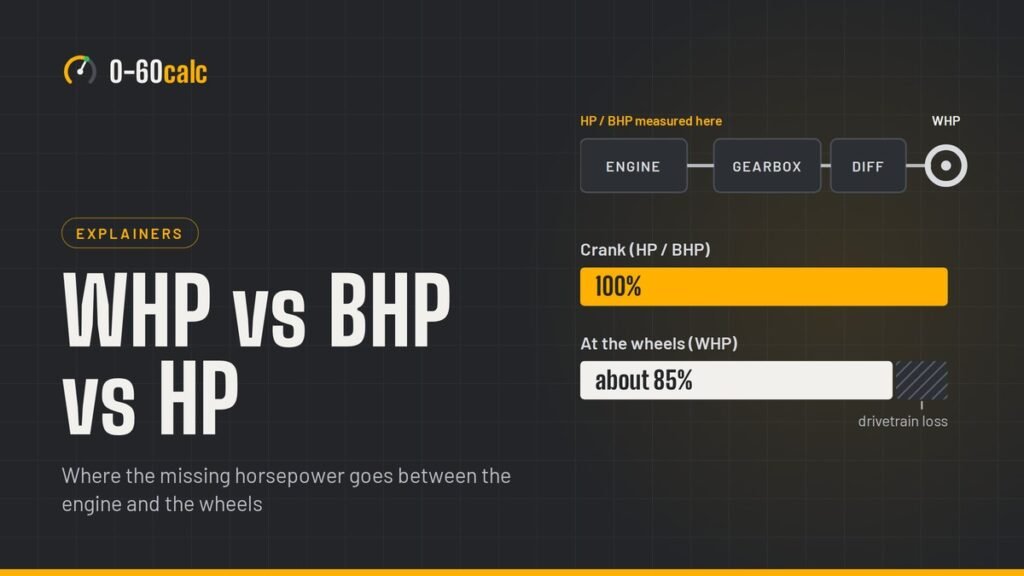
HP and BHP (brake horsepower) are both measured at the engine’s crankshaft, so on a modern spec sheet they describe the same thing. WHP (wheel horsepower) is measured at the tires on a chassis dyno, after the gearbox, driveshaft and differential have taken their share. That drivetrain loss is typically about 12% for front-wheel drive, 15% for rear-wheel drive and 20% for all-wheel drive, and the dyno type can move the number by several percent more. To turn a dyno reading into crank horsepower, use the WHP to HP calculator.
In this guide
You bolt your car to a dyno, and the sheet says 255. The brochure said 300. A British review said 296 bhp, and a German spec sheet said 304 PS. Nothing is wrong: these numbers measure the same engine in different places or in slightly different units. This guide explains what each one means, how big the gaps should be, and how to compare them without fooling yourself.
Crank horsepower vs wheel horsepower
Crank horsepower (hp, bhp)
Measured at the crankshaft on an engine dyno, before the gearbox. Manufacturer ratings are crank figures, rated under the SAE J1349 net power standard in the US.
Wheel horsepower (whp)
Measured at the tires on a chassis dyno, with the whole driveline in the way. It’s what actually pushes the car, and what tuners measure.
What is BHP (brake horsepower)?
BHP is engine power measured at the crankshaft. The “brake” comes from the brake dynamometers, such as the early Prony brake, that engineers used to load an engine while measuring its output. The engine is measured on its own, so nothing from the gearbox onward is counted.
BHP is the figure British and many Commonwealth car reviews and classified ads quote. US manufacturers simply say “horsepower”, but their number is also measured at the crankshaft. So when a UK review lists a car at 296 bhp and the US brochure says 300 hp, the difference comes from rounding and rating rules, not from where the power was measured.
HP vs BHP: is there any difference?
Today: essentially no
Both are crank figures measured with the engine’s accessories fitted. For comparing two modern cars, treat hp and bhp as the same number.
Old US ratings: yes
Until the early 1970s, US makers quoted SAE gross horsepower, measured on a bare engine without all its accessories and a full exhaust. From the 1972 model year they switched to SAE net, which is lower and closer to real life. Be careful comparing a classic muscle car’s rating with a modern one.
PS is slightly smaller
European spec sheets use PS (metric horsepower). One PS is 735.5 watts and one hp is 745.7 watts, so 300 PS is about 296 hp.
“HP” is sometimes used loosely
On forums, “hp” can mean a wheel figure from a dyno. If it’s a tuned car’s number, ask whether it’s crank or wheel horsepower before comparing.
Where the missing power goes
Every component between the crankshaft and the road turns a little power into heat or spends it spinning up mass:
- Gear meshes and bearings in the transmission
- The driveshaft and its joints, in rear- and all-wheel-drive cars
- The differential, plus a transfer case and second differential in AWD
- Axles, CV joints and wheel bearings
- Tires flexing against the dyno rollers
- Oil churning in the gearbox and differential, which grows with temperature and speed
Typical drivetrain loss by layout
| Layout | Typical loss | Common range | Why |
|---|---|---|---|
| Front-wheel driveTransverse engine, transaxle | 12% | 10 to 15% | Shortest path, no driveshaft |
| Rear-wheel driveDriveshaft and rear differential | 15% | 12 to 18% | Extra shaft and a 90° gear set |
| All-wheel driveTransfer case, two differentials | 20% | 18 to 25% | More gears, shafts and oil |
| MotorcycleChain final drive | 10% | 8 to 12% | Light, simple driveline |
| Electric vehicleSingle-speed reduction | 10% | 8 to 12% | One gear, no clutch |
Conventional torque-converter automatics usually sit at the top of each range; manuals and dual-clutch gearboxes at the bottom.
Real stock cars on the dyno
Those percentages are averages. Here is what seven stock cars actually made at the wheels in published dyno tests, compared with their factory crank ratings.
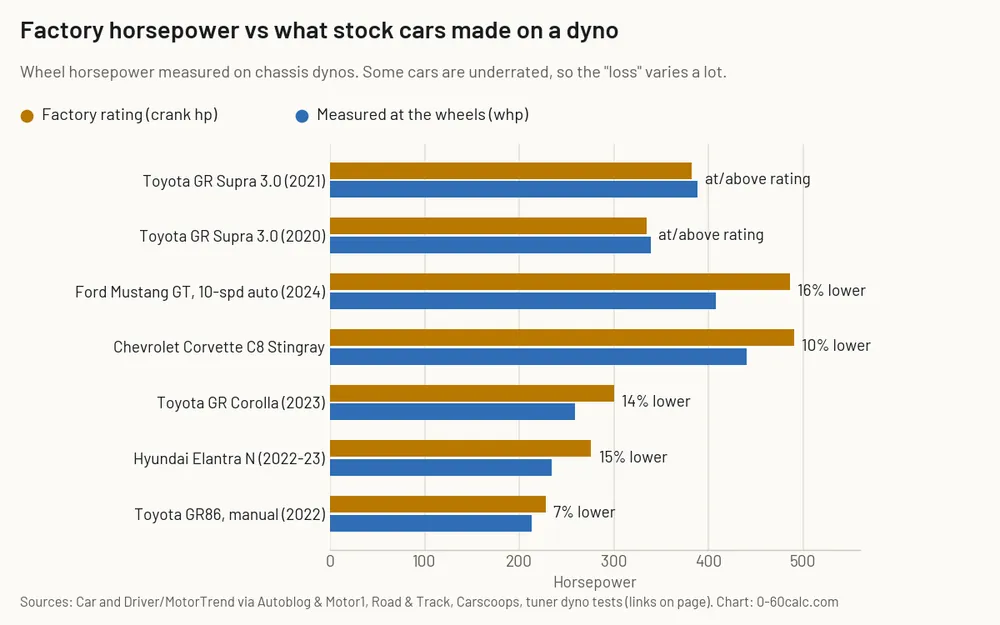
| Car | Factory hp | Wheel hp | Difference | Source |
|---|---|---|---|---|
| Toyota GR Supra 3.0 (2021, auto) | 382 | 388 | 2% higher | Car and Driver, via Motor1 |
| Toyota GR Supra 3.0 (2020) | 335 | 339 | 1% higher | Car and Driver (Dynojet), via Autoblog |
| Ford Mustang GT (2024, 10-speed auto) | 486 | 408 | 16% lower | Middleton Motorsports, via Motor1 |
| Chevrolet Corvette C8 Stingray | 490 | 440 | 10% lower | Carlyle Racing (Dynojet), via autoevolution |
| Toyota GR Corolla (2023) | 300 | 259 | 14% lower | Owner’s car (Dynojet AWD), via Carscoops |
| Hyundai Elantra N (2022-23) | 276 | 234 | 15% lower | Stillen tuner baseline |
| Toyota GR86 (2022, manual) | 228 | 213 | 7% lower | JST Performance, 91 octane |
The Mustang GT and Elantra N lost 15 to 16 percent, right on the typical figures. The GR Supra made more at the wheels than Toyota claims at the crank, which tells you its factory rating is conservative, not that it has no drivetrain loss. So a surprisingly small “loss” often means an underrated engine, and a surprisingly big one can mean a generous rating or a low-reading dyno. You can try any of these numbers in the WHP to HP calculator.
Is loss a percentage or a fixed number?
Both, which is why tuners argue about it. Part of the loss is roughly fixed friction, and part grows with load and speed. A flat percentage overstates the loss on very powerful cars and understates it on weak ones, but for stock and mildly tuned street cars it’s close enough, which is why everyone uses it. If you know your car’s real loss from a before-and-after test, use that instead.
Convert your dyno number
Wheel to crank, crank to wheel, or your own loss from both figures.
WHP to HP CalculatorWhy two dynos disagree
Inertia vs load dynos
Inertia dynos, such as Dynojet, measure how fast the car spins a heavy drum. Load-bearing dynos, such as Mustang and Dynapack, apply resistance. Inertia dynos usually read higher; gaps around 10 to 15 percent are commonly reported for the same car.
Correction factors
Dynos correct readings to standard weather. The older STD standard reads a few percent higher than SAE J1349, the one manufacturers use, so check which the sheet shows.
Setup and heat
Strap tension, tire pressure, the gear used and heat soak all shift the result. Back-to-back pulls on a hot engine often read lower.
Smoothing and software
Different smoothing settings can raise or lower the peak without changing the car. Compare the shape of the curves, not just the peaks.
The rule that saves arguments: compare numbers from the same dyno, same correction factor and similar weather. A gain measured that way is real, whatever the absolute number. For dyno types, correction factors and every line of a dyno sheet, see our guide to what a dyno is.
Estimating crank horsepower from a dyno sheet
Divide wheel horsepower by one minus the loss. For a rear-wheel-drive car with a 15% loss: 255 ÷ 0.85 = 300 crank horsepower.
| Dyno reading | Layout and loss | About crank hp | Lost |
|---|---|---|---|
| 200 whp | FWD, 12% | 227 hp | 27 hp |
| 255 whp | RWD, 15% | 300 hp | 45 hp |
| 400 whp | AWD, 20% | 500 hp | 100 hp |
| 150 whp | Motorcycle, 10% | 167 hp | 17 hp |
Once you have a crank figure, the 0-60 calculator and quarter mile calculator accept either, as long as you tell them which one you entered.
BHP, PS and kW conversions
Spec sheets from different countries use different units for the same crank power. These factors convert between them.
| From | Multiply by | To get | Example |
|---|---|---|---|
| PS (metric hp) | 0.9863 | hp or bhp | 300 PS = 295.9 hp |
| hp or bhp | 1.0139 | PS | 400 hp = 405.6 PS |
| kW | 1.3410 | hp or bhp | 250 kW = 335.3 hp |
| hp or bhp | 0.7457 | kW | 400 hp = 298.3 kW |
| kW | 1.3596 | PS | 150 kW = 203.9 PS |
Electric cars are usually rated in kW. A 150 kW motor is about 201 hp; a 250 kW motor is about 335 hp. For any other figure, use the kW to hp converter, the hp to kW converter or, for European PS figures, the PS to hp converter.
If your number looks too low
- Check the dyno type and correction factor before blaming the car.
- Ask for the gear used; most shops pull in the gear closest to 1:1.
- Compare the curve with a known stock car on the same dyno, if the shop has one.
- Rule out heat soak by letting the car cool between pulls.
- Remember that some factory ratings are conservative and some are generous, so a “big loss” can really be a low crank rating.
Key takeaways
- HP and BHP are both crank figures; WHP is measured at the tires.
- Typical losses: FWD 12%, RWD 15%, AWD 20%, bikes and EVs about 10%.
- Crank hp = whp ÷ (1 − loss).
- Real cars vary: some stock engines make more than their rating at the wheels.
- PS is about 1.4% smaller than hp; 1 kW is 1.341 hp.
- Only compare numbers from the same dyno and correction factor.
FAQ
What does bhp mean in cars?
BHP stands for brake horsepower: the engine’s power measured at the crankshaft, before the gearbox and the rest of the drivetrain. It’s the figure UK reviews and adverts quote, and it’s the same kind of number US makers call horsepower.
Is bhp the same as hp?
For modern cars, yes in practice. Both are crank figures measured with the engine’s accessories fitted. Old US ratings from before the 1972 model year used SAE gross horsepower, which reads higher, and European PS figures are about 1.4% larger numbers for the same power.
What is the difference between whp and hp?
Hp, or crank horsepower, is measured at the engine’s crankshaft. Whp is measured at the wheels, after the gearbox, driveshaft and differential have taken their share. Whp is normally lower.
Is bhp higher than whp?
Normally yes, by about 10 to 20 percent. The exception is a car with a conservative factory rating: a stock Toyota GR Supra has measured more at the wheels than Toyota’s crank rating.
How much horsepower is lost through the drivetrain?
Usually 10 to 20 percent: about 12% for front-wheel drive, 15% for rear-wheel drive and 20% for all-wheel drive. Motorcycles and EVs lose around 10%.
How do I convert PS to hp?
Multiply PS by 0.9863. For example, 300 PS is about 296 hp. To go from hp to PS, multiply by 1.0139, or use the PS to hp converter.
Why does a Dynojet read higher than a Mustang dyno?
A Dynojet is an inertia dyno: it measures how fast the car accelerates a heavy drum. A Mustang dyno applies a load, which is closer to real-world resistance and tends to read lower. Neither is wrong; they measure differently.
How do I convert whp to hp?
Divide wheel horsepower by one minus your drivetrain loss. With a 15% loss, 255 whp ÷ 0.85 = 300 hp. The WHP to HP calculator does it for every layout and can work out your real loss if you know both figures.
Sources
- Motor1: Car and Driver’s 2021 GR Supra dyno test
- Autoblog: Car and Driver and MotorTrend dyno tests of the 2020 GR Supra
- Motor1: 2024 Mustang GT dyno test
- autoevolution: C8 Corvette dyno run
- Carscoops: 2023 GR Corolla dyno
- Stillen: Elantra N dyno baseline
- JST Performance: 2022 GR86 dyno
Related guides
What Is a Dyno? Dyno Testing, Tuning Costs & How to Read a Dyno Sheet
A dyno measures an engine's torque and rpm under load and calculates horsepower. Engine vs chassis…

What Is G-Force? Meaning, Examples in Cars & F1, and How Many G’s Humans Can Take
G-force is acceleration measured against gravity: 1 g is 9.80665 m/s². How to work it out,…
What Is Horsepower? Meaning, Formula & What It Means for Your Car
Horsepower is how fast an engine does work: 33,000 foot-pounds per minute, or 745.7 watts. The…