Top Fuel Dragster 0-60: Under Half a Second, Explained
A Top Fuel dragster hits 60 mph in under half a second and 100 mph in about 0.8. The current 346.95 mph and 3.623-second records, how 11,000 hp is made, and why the race is only 1,000 feet.
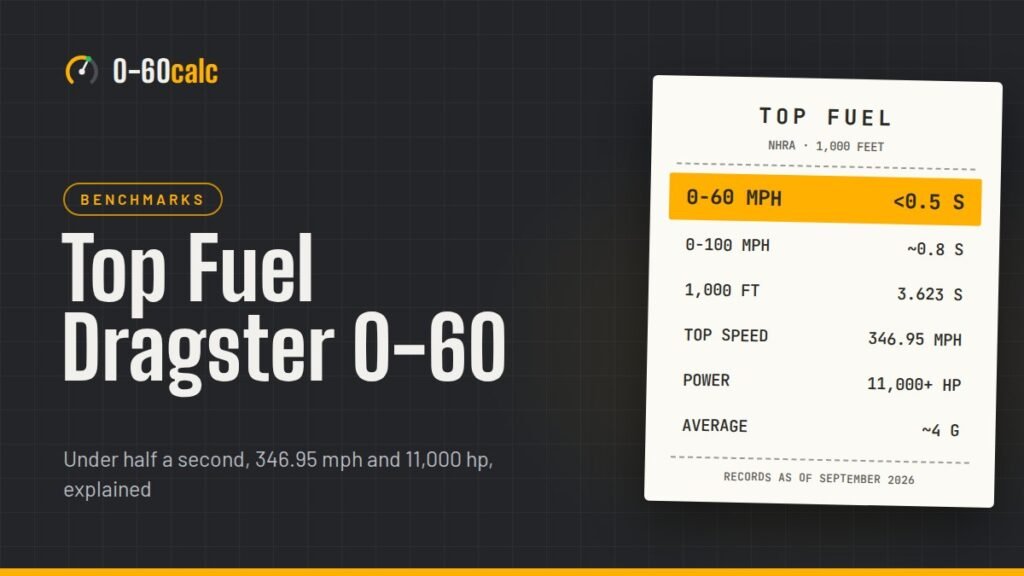
A Top Fuel dragster reaches 60 mph in under half a second and 100 mph in about 0.8 seconds. It covers the 1,000-foot race distance in about 3.6 to 3.7 seconds, at up to 346.95 mph, the record Shawn Langdon set in September 2026. That takes more than 11,000 hp and averages about 4 g over the whole run.
In this guide
Nothing with wheels accelerates harder. A Top Fuel dragster is a long, thin chassis, a supercharged V8 burning mostly nitromethane, and a pair of enormous rear tires, all built to do one thing for less than four seconds. Here is what those seconds look like, the current records, and why the race stops at 1,000 feet.
Last updated 13 October 2026. Records checked against NHRA news on that date and against Guinness World Records on 29 September 2026.
Top Fuel acceleration in numbers
| Measure | Figure | Source |
|---|---|---|
| 0-60 mph | under 0.5 s | Competition Plus |
| 0-100 mph | as little as 0.8 s | Wikipedia |
| 1,000 ft, record elapsed timeBrittany Force, 2019 | 3.623 s | Guinness World Records |
| Top speed, recordShawn Langdon, 2026 | 346.95 mph | NHRA |
| Peak power | over 11,000 hp | Wikipedia, Competition Plus |
| Fuel | up to 90% nitromethane, rest methanol | Wikipedia, Competition Plus |
| Acceleration over the run | about 4 g average, peaks over 5.6 g | Wikipedia |
The averages check out. 60 mph in half a second is 5.5 g, and Langdon’s record run, 346.95 mph in 3.663 seconds, averages 4.3 g from start to finish. The NHRA’s own description is simpler: at 5 g, “no wheeled vehicle on earth” comes close.
A Top Fuel run, second by second
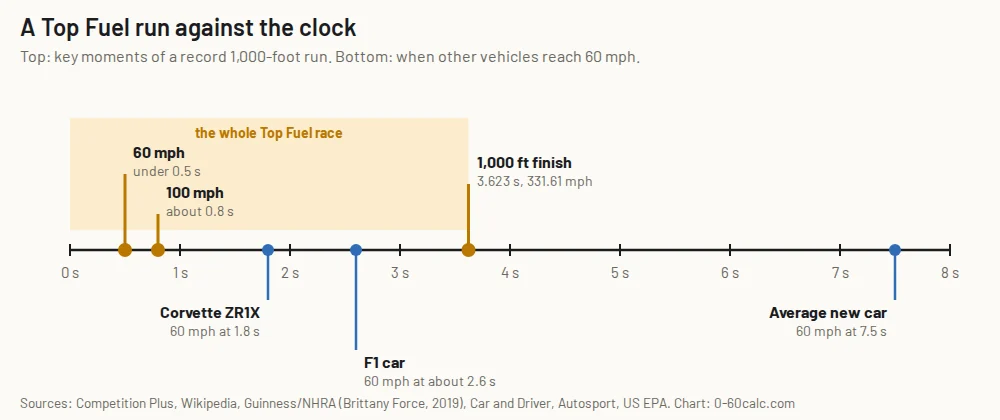
- 0 to 0.5 seconds: the car leaves the line and passes 60 mph. The clutch is designed to slip and lock up progressively, because full power at once would just spin the tires.
- About 0.8 seconds: 100 mph. The quickest road car in independent testing, the Corvette ZR1X, needs 1.8 seconds to reach 60.
- About 2.6 seconds: an F1 car, starting alongside, would only now be passing 60 mph. The dragster is already well past 200 mph.
- 3.6 to 3.7 seconds: the 1,000-foot finish line at more than 330 mph. Parachutes and carbon brakes then stop the car in the shutdown area.
The mid-run speed in step 3 is our conservative estimate from the average acceleration; the other marks are the published figures above.
A record run, mark by mark
Timing lights split every run into increments. Brittany Force’s pass at Sonoma on 25 July 2025, the fastest in NHRA history at the time, gives a clean set: 0.819 seconds to 60 feet, 2.940 seconds and 304.94 mph at the eighth mile, and 3.645 seconds at 343.16 mph at the 1,000-foot finish. We worked out the average acceleration over each stretch.
| Stretch | Time | Speed at the end | Average g |
|---|---|---|---|
| Start to 60 ftThe launch | 0.819 s | about 100 mph | 5.6 g |
| 60 ft to 660 ftOn to the eighth mile | 2.121 s | 304.94 mph | 4.4 g |
| 660 ft to 1,000 ftOn to the finish | 0.705 s | 343.16 mph | 2.5 g |
| Whole run | 3.645 s | 343.16 mph | 4.3 g |
The car does most of its work early. It reaches the eighth mile, 66% of the race distance, in 81% of the race time and at 89% of its final speed. Over the last 340 feet it adds only 38 mph, because aerodynamic drag grows with the square of speed. The 60-foot speed assumes steady acceleration over the first 60 feet; the other speeds are the timing system’s, measured over a short stretch just before each mark, so treat the g figures as close estimates. For where each timing mark sits on a strip, see how long a quarter mile is.
Top Fuel and Funny Car records
| Record | Mark | Driver | When and where |
|---|---|---|---|
| Top Fuel speed | 346.95 mph (3.663 s) | Shawn Langdon | 21 Sep 2026, Great Lakes Nationals, Martin, Michigan |
| Top Fuel elapsed time | 3.623 s (331.61 mph) | Brittany Force | 14 Sep 2019, Maple Grove Raceway, Pennsylvania |
| Funny Car speed | 341.68 mph (3.828 s) | Austin Prock | 17 Nov 2024, NHRA Finals, Pomona, California |
| Funny Car elapsed time | 3.793 s | Robert Hight | 18 Aug 2017, Brainerd, Minnesota |
Langdon’s 346.95 mph run was the fastest in Top Fuel history, and he backed it up at 346.15 mph in the final. It broke the roughly 345 mph mark he had set at the Southern Nationals in May 2026, which in turn had beaten Brittany Force’s 343.51 mph from the 2025 U.S. Nationals.
Langdon also ran 3.621 seconds in February 2026, two thousandths quicker than Force’s elapsed-time record. It doesn’t count: it happened in testing at Gainesville, not at a points event. NHRA doesn’t publish a single public records table, so we rely on NHRA news reports and Guinness World Records, and the Funny Car marks are the latest we could confirm.
Why Top Fuel races 1,000 feet, not a quarter mile
Top Fuel and Funny Car raced the full quarter mile (1,320 feet) until 2008. After Scott Kalitta was killed in a crash at Englishtown, New Jersey, on 21 June 2008, the NHRA shortened both classes to 1,000 feet from early July that year, giving cars at 300-plus mph more room to stop. Every other class still runs the quarter or the eighth.
In the quarter-mile era, the quickest run we could confirm was Doug Kalitta’s 4.420 seconds at 328.22 mph in May 2004 at Joliet. It didn’t become the official record because his backup run missed the required margin by one thousandth of a second. Tony Schumacher’s fastest quarter-mile speed was 337.58 mph, at Brainerd in 2005. For the full layout of a strip, see how long a quarter mile is.
How a dragster makes 11,000 hp
Nitromethane
Nitromethane carries its own oxygen, so an engine can burn far more of it per cycle than gasoline. Top Fuel allows up to 90% nitro, with methanol making up the rest.
Supercharging
A belt-driven supercharger forces huge amounts of air and fuel into the V8. Output is estimated rather than measured on an engine dyno; tests in 2015 put peak power above 11,000 hp.
Tires and clutch
Wide, soft rear tires wrinkle and grow at launch for grip, while a multi-stage clutch feeds power in over the run so the tires don’t spin.
Short life
The engine is torn down and rebuilt between rounds. It lives for about four seconds at full power, not for miles.
Top Fuel vs F1 vs the quickest road car
| Vehicle | 0-60 mph | Average g to 60 |
|---|---|---|
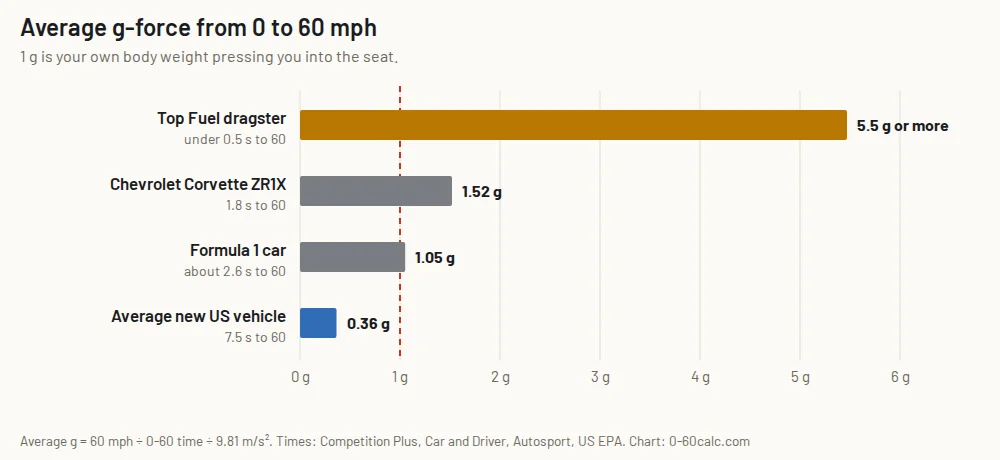
| Top Fuel dragster | under 0.5 s | 5.5 g or more |
| Chevrolet Corvette ZR1XCar and Driver test | 1.8 s | 1.52 g |
| Formula 1 carAutosport estimate | about 2.6 s | 1.05 g |
| Average new US vehicleEPA, model year 2024 | 7.5 s | 0.36 g |
A Top Fuel launch is more than three times as violent as the quickest road car’s and about fifteen times the average new car’s. Our guide to F1 car 0-60 explains why the F1 car sits below the road car here, and the g-force calculator works out the same number for any time you enter.
Put your own car on the scale
Enter a 0-60 time and see the average g-force, then compare it with a dragster’s 5 g.
G-Force CalculatorKey takeaways
- A Top Fuel dragster reaches 60 mph in under 0.5 seconds and 100 mph in about 0.8.
- Top speed record: 346.95 mph, Shawn Langdon, September 2026.
- Elapsed-time record: 3.623 seconds over 1,000 feet, Brittany Force, 2019.
- Acceleration fades over the run: about 5.6 g over the first 60 feet, 2.5 g over the last 340.
- More than 11,000 hp from a supercharged V8 on up to 90% nitromethane.
- Top Fuel has raced 1,000 feet, not a quarter mile, since 2008.
For how road cars compare, see what counts as a good 0-60 time.
FAQ
How fast does a Top Fuel dragster go 0-60?
In under half a second. It reaches 100 mph in as little as 0.8 seconds.
What is the Top Fuel speed record?
346.95 mph, set by Shawn Langdon on 21 September 2026 at the NHRA Great Lakes Nationals in Martin, Michigan, on a 3.663-second run.
What is the quickest Top Fuel run ever?
The official record is 3.623 seconds, by Brittany Force at Maple Grove in 2019. Shawn Langdon ran 3.621 in testing in February 2026, but testing runs don’t count as records.
How fast is a Top Fuel dragster at the eighth mile?
Around 300 mph. On Brittany Force’s 343.16 mph run at Sonoma in July 2025, a speed record at the time, the car passed the eighth mile (660 feet) in 2.940 seconds at 304.94 mph.
How many g does a Top Fuel driver pull?
About 4 g on average over the run and over 5.6 g at peak, according to Wikipedia; the NHRA describes it as 5 g.
How much horsepower does a Top Fuel dragster have?
More than 11,000 hp, based on tests in 2015. It is an estimate worked out from test data rather than a dyno reading.
Why do Top Fuel cars race only 1,000 feet?
For safety. The NHRA shortened Top Fuel and Funny Car races from 1,320 to 1,000 feet in 2008, after Scott Kalitta’s fatal crash, to give the cars more room to stop.
Is a Top Fuel dragster faster than an F1 car?
In a straight line from a standstill, by a huge margin: under 0.5 seconds to 60 mph against about 2.6. An F1 car is built for braking and cornering instead, and would lap a circuit far faster.
Sources
- NHRA: Langdon’s 346.95 mph run at the Great Lakes Nationals (2026)
- American Cars and Racing: Langdon’s record, backup run and May 2026 mark
- Performance Racing Industry: Brittany Force’s 343.51 mph (2025)
- Guinness World Records: lowest Top Fuel elapsed time and NHRA: Force’s 3.623 at 331.61 mph
- Competition Plus: Langdon’s unofficial 3.621 in testing
- NHRA: Brittany Force’s 343.16 mph at Sonoma, with 304.94 mph at the eighth mile (2025) and Dragzine: the same run’s 60-foot and eighth-mile times
- Guinness World Records: Funny Car elapsed time and NHRA: Austin Prock’s 341.68 mph
- Competition Plus: Top Fuel guide, 0-60, horsepower and fuel
- Wikipedia: Top Fuel, acceleration, power and nitromethane limit
- NHRA: how many g a Top Fuel dragster pulls
- SEMA: NHRA shortens Top Fuel and Funny Car to 1,000 feet (2008) and Wikipedia: Scott Kalitta
- Drag Race Results: Doug Kalitta’s 4.420 at Joliet (2004) and Wikipedia: Tony Schumacher
- US EPA Automotive Trends Report (2025 edition): average 0-60 of 7.5 s
Related guides
What Is a Dyno? Dyno Testing, Tuning Costs & How to Read a Dyno Sheet
A dyno measures an engine's torque and rpm under load and calculates horsepower. Engine vs chassis…

What Is G-Force? Meaning, Examples in Cars & F1, and How Many G’s Humans Can Take
G-force is acceleration measured against gravity: 1 g is 9.80665 m/s². How to work it out,…

What Is Horsepower? Meaning, Formula & What It Means for Your Car
Horsepower is how fast an engine does work: 33,000 foot-pounds per minute, or 745.7 watts. The…