What Is a Dyno? Dyno Testing, Tuning Costs & How to Read a Dyno Sheet
A dyno measures an engine's torque and rpm under load and calculates horsepower. Engine vs chassis vs hub dynos, Dynojet vs Mustang, how to read a dyno sheet, SAE vs STD correction, and what a dyno test or tune costs.
A dyno, short for dynamometer, is a machine that loads an engine and measures its torque and rpm, then calculates horsepower from them. An engine dyno measures at the crankshaft. A chassis dyno, the kind most tuning shops use, measures at the wheels with the car strapped onto rollers. At the shops we checked, a baseline of three pulls costs $200 to $275, and a custom tune on the dyno starts at about $750.
In this guide
A dyno sheet is the closest thing a car has to a medical chart: it shows exactly how much power the engine makes, where in the rev range it makes it, and what changed after a modification. This guide covers how a dyno works, the main types and why they disagree, how to read a dyno sheet line by line, the correction factors printed on it, and what a dyno test or tune costs. To turn a wheel figure into crank horsepower, use the WHP to HP calculator.
Last updated 13 October 2026.
What a dyno measures
Mustang Advanced Engineering, which builds them, puts it simply: a dynamometer “is any sort of device that measures force, torque or power.” For cars that means applying a load the engine has to work against, and measuring two things while it does: the twisting force (torque) and how fast it turns (rpm). Horsepower is then calculated, not measured: torque × rpm ÷ 5,252, as we explain in what horsepower is. The idea dates back to 1821, when the French engineer Gaspard de Prony clamped a brake around a spinning shaft and weighed the force on its lever arm, which is where “brake horsepower” comes from.
People put cars on a dyno for four reasons:
- A baseline. What the car really makes today, before any changes.
- Before and after. Proof of what an intake, exhaust or turbo upgrade actually gained.
- Tuning. Adjusting fuel, ignition timing and boost while watching the result live.
- Diagnosis. Engine builder Steve Morris told Engine Builder magazine that a chassis dyno finds wiring, mechanical and torque-converter problems an engine dyno never sees.
Engine dyno vs chassis dyno vs hub dyno
The three types measure the same engine in different places, which is why their numbers never match. The machine prices are from Engine Builder’s guide to dyno options.
| Type | Where it measures | Best for | Machine cost |
|---|---|---|---|
| Engine dynoEngine out of the car, on a test stand | Crankshaft: no drivetrain loss, the highest number | Engine development and builders | $60,000 to $4 million |
| Chassis dynoDrive wheels on rollers, car strapped down | Tire contact patch: after the gearbox, axles and tires | Tuning shops, quick before-and-after tests | $25,000 to $120,000 |
| Hub dynoBolts straight to the wheel hubs | Hubs: after the drivetrain, but no tire loss | Precise tuning, drag-run simulation with gear changes | $60,000 to $80,000; AWD about $120,000 |
Because a hub dyno removes the tires from the measurement, Morris says “a hub dyno’s horsepower number will always be bigger than a wheel chassis dyno.” Factory ratings are crank figures, which is why a stock car almost always shows less on a chassis dyno than its brochure claims. Our WHP vs BHP vs HP guide shows the typical gap by drivetrain layout.
Dynojet vs Mustang: inertia vs load-bearing dynos
Chassis dynos come in two kinds, and the brand names stand in for them in most conversations.
Inertia dyno (Dynojet)
The car spins up a heavy roller of known inertia, and the dyno works out power from how quickly it accelerates. Results are very repeatable, which suits back-to-back part tests, but the dyno can’t hold the engine at a fixed rpm or load.
Load-bearing dyno (Mustang)
An eddy-current brake, “essentially an electrical brake on the side of the roller”, resists the wheels while a load cell measures the force directly. It can hold any rpm and throttle position, which tuners need for part-throttle and steady-state work.
The two read differently for the same car. As EngineLabs puts it, “inertia dynos will generally read higher than steady-state dynos.” Neither is wrong; they measure differently. What matters is comparing numbers from the same dyno.
How to read a dyno sheet
A dyno sheet is a graph of power and torque against engine speed, with the test conditions printed above it. The numbers on this example match the list below.
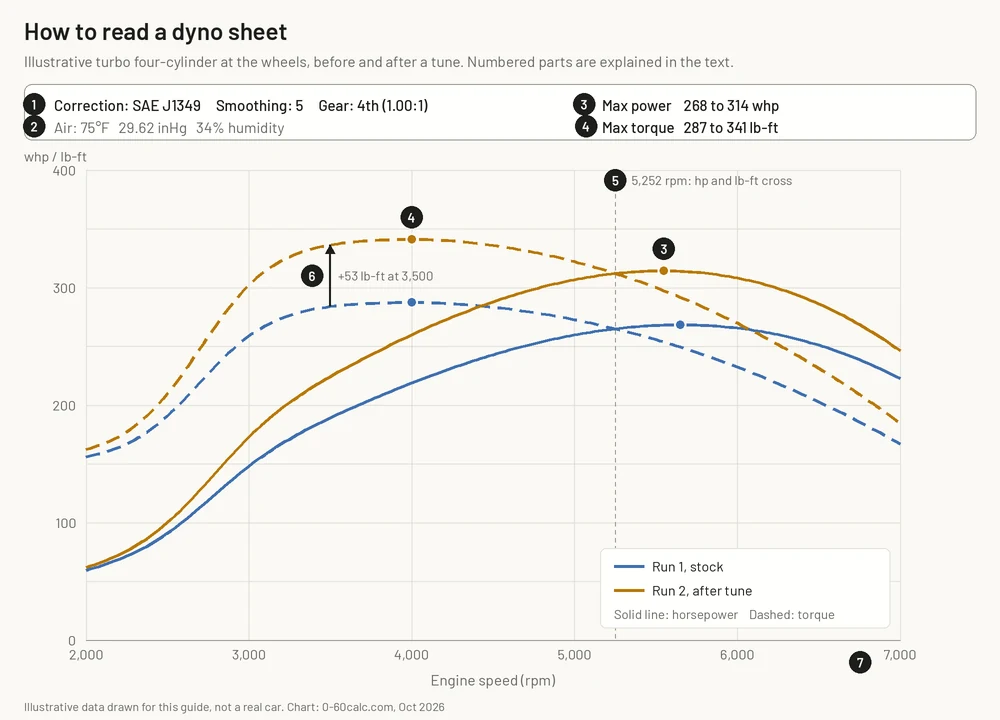
- Correction factor and smoothing. The correction standard adjusts the result to standard weather; SAE J1349 is the one carmakers use. Smoothing averages out spikes in the trace, and a higher setting can trim or flatter the peak, so check it matches between sheets.
- Weather. Air temperature, pressure and humidity on the day. They feed the correction, and hot, thin air makes less power.
- Peak power. 268 whp stock and 314 whp after the tune. The “w” means it was measured at the wheels, not the crank.
- Peak torque. 287 lb-ft rising to 341 lb-ft, both at about 4,000 rpm.
- The 5,252 rpm crossover. On a chart drawn in hp and lb-ft the two curves always cross here. If they don’t, the axes use different scales. Torque vs horsepower explains why.
- The gain in the middle. 53 lb-ft more at 3,500 rpm. Where you drive matters more than the peak: a tune that adds power across the whole curve feels stronger than one that only adds a big number at redline.
- The horizontal axis. Engine rpm here. Some sheets plot road speed instead, which only makes sense alongside the gear the pull was made in.
Real cars show why wheel numbers need context. Car and Driver measured 388 whp from a 2021 Toyota GR Supra rated at 382 hp at the crank, a sign of a conservative factory rating, while a 2024 Mustang GT rated at 486 hp made 408 whp. Both results are on our WHP vs HP page with their sources.
SAE vs STD correction
Dynos correct every run to standard conditions so a test on a hot day can be compared with one on a cold day. Two standards dominate dyno sheets, and they don’t agree. Ford Performance says SAE J1349 is “typically about 4% lower” than SAE J607, which dyno software often labels STD.
| Label on the sheet | Standard | Reads | Who uses it |
|---|---|---|---|
| SAEJ1349 | 77°F inlet air, 29.31 inHg | The lower, stricter figure | Carmakers, which “almost always quote J1349 corrected numbers” |
| STDSAE J607 | An older, more generous baseline | About 4% higher | Some shops, because the number looks bigger |
| Uncorrected | The weather on the day | Depends on the weather | Comparing runs made minutes apart |
So 300 whp SAE is about 312 whp STD for the same car on the same day. If a friend’s sheet shows STD and yours shows SAE, convert one before comparing.
What happens during a dyno test
- Strap down. The drive wheels go on the rollers and ratchet straps hold the car in place. Some shops charge extra if underbody panels must come off to reach the strap points.
- Sensors and cooling. An rpm pickup, a wideband oxygen sensor to read the air-fuel ratio, often a boost gauge on turbo cars, and big fans in front of the radiator.
- Pick a gear. Usually the one closest to 1:1, often fourth in a manual. Ford notes drivetrain efficiency falls as the ratio moves away from 1:1, so the gear changes the wheel number.
- Make the pulls. Full throttle from low rpm to redline, usually three times, letting the car cool between runs so heat soak doesn’t drag the numbers down.
- Read the sheet. The shop prints the runs, overlaid so you can compare them, with the before and after curves on one sheet if you are tuning.
What a dyno test or tune costs
Prices vary by region, dyno type and car. These are the published rates of three US performance shops, checked on 13 October 2026:
| Shop | 3 baseline pulls | Dyno time | Custom tune |
|---|---|---|---|
| Force EngineeringPlainwell, Michigan. Mustang MD-AWD-150. Price list | $200 | $200 first hour, then $165 an hour | From $750 plus software credits (HP Tuners) |
| Kozmic MotorsportsHouston, Texas. Mustang MD-AWD-500-SE. Price list | $275, with boost and wideband | $300 first hour, then $200 an hour | From $750 to $1,800, by platform |
| SP RacingUS shop. Price list | $200 2WD, $225 AWD | $225 an hour 2WD, $250 AWD | $900 to $1,780, by ECU and setup |
A baseline session is a one-off cost of about $200 to $275. A tune costs more because it takes hours of dyno time and often a software license; turbocharged and flex-fuel tunes cost more than naturally aspirated ones. Ask what correction factor the shop prints, and keep the sheets: they are the only fair way to compare the next modification.
Turn your dyno sheet into crank horsepower
Enter the wheel figure and your drivetrain to see the estimated crank rating and the loss.
WHP to HP CalculatorKey takeaways
- A dyno measures torque and rpm under load and calculates horsepower from them.
- Engine dynos read at the crank, hub dynos at the hubs and chassis dynos at the tires, in that order from highest to lowest.
- Inertia dynos such as Dynojet generally read higher than load-bearing dynos such as Mustang.
- SAE J1349 reads about 4% lower than STD; carmakers use J1349.
- Three baseline pulls cost about $200 to $275; custom tunes start around $750.
FAQ
What is a dyno?
A dynamometer: a machine that puts a load on an engine and measures its torque and rpm, then calculates horsepower. Tuning shops mostly use chassis dynos, where the car’s drive wheels turn a set of rollers.
What does dyno tuning mean?
Adjusting the engine’s fuel, ignition timing and boost on a dyno while watching power, torque and the air-fuel ratio live, so each change can be measured instead of guessed.
How much does it cost to dyno a car?
At the US shops we checked, three baseline pulls cost $200 to $275 and dyno time $165 to $300 an hour. A custom tune starts at about $750 and can pass $1,700 for turbo or flex-fuel setups.
Why is my dyno number lower than the factory horsepower?
Factory ratings are measured at the crankshaft, while a chassis dyno measures at the tires, after the gearbox, driveshaft, differential and tires have taken their share. A loss of 10 to 20% is normal; the WHP to HP calculator estimates the crank figure.
Is a Dynojet or a Mustang dyno more accurate?
Both are consistent with themselves. Inertia dynos like Dynojet generally read higher; load-bearing dynos like Mustang apply a controlled load, which allows steady-state and part-throttle tuning. Compare results only from the same dyno and correction factor.
What is the difference between SAE and STD on a dyno sheet?
They are two correction standards. Ford Performance says SAE J1349 typically reads about 4% lower than SAE J607, which dynos label STD. Carmakers quote J1349.
Can a dyno test damage a car?
A dyno pull is a full-throttle run through one gear, much like hard acceleration on the road, with the car strapped down and fans cooling it. Failures are rare but do happen, mostly tires and driveshafts on very powerful cars, so use an experienced shop and fix known problems first.
Sources
- Mustang Advanced Engineering: What is a dyno
- Engine Builder: engine, hub and chassis dynamometer options and costs
- EngineLabs (Bradley Iger, 2018): the data and accuracy implications of different dynamometer designs
- Ford Performance: dynamometer testing, SAE J1349 vs J607 correction
- Britannica: Prony brake (1821)
- Shop prices linked in the cost table; Supra and Mustang dyno results sourced on our WHP vs HP page
Related guides

What Is G-Force? Meaning, Examples in Cars & F1, and How Many G’s Humans Can Take
G-force is acceleration measured against gravity: 1 g is 9.80665 m/s². How to work it out,…
What Is Horsepower? Meaning, Formula & What It Means for Your Car
Horsepower is how fast an engine does work: 33,000 foot-pounds per minute, or 745.7 watts. The…
What Is Torque in a Car? A Simple Explanation With Real Numbers
Torque is the twisting force that turns your wheels. What it measures, lb-ft vs Nm, why…