How Much Horsepower Does a Horse Have? Up to 15 hp, Here’s Why
A horse peaks at about 15 hp but works all day at about 1 hp. Where James Watt's unit came from, how horses compare with humans and engines, and why 300 hp isn't 300 horses.
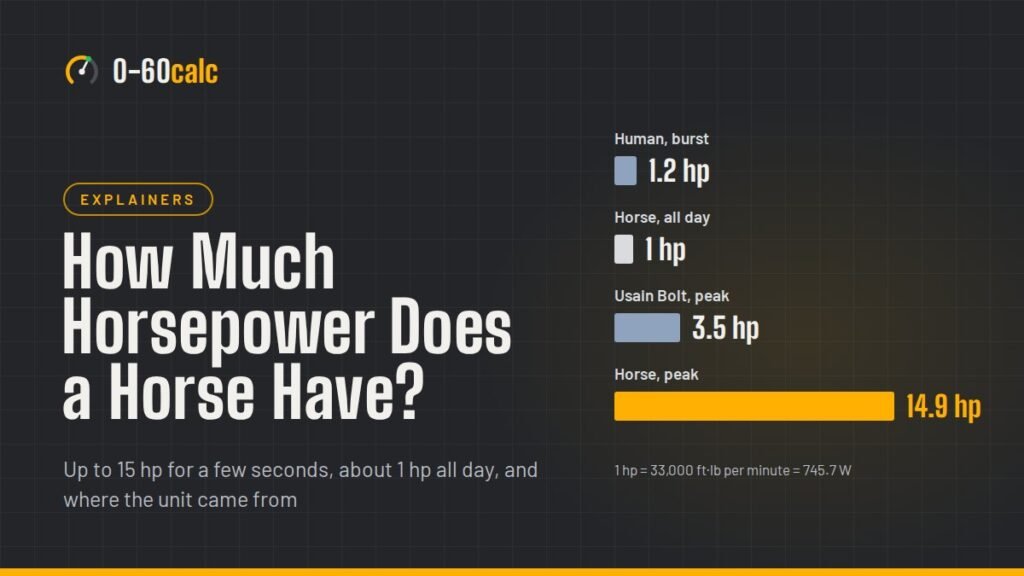
A horse can produce up to about 15 horsepower in a short burst: researchers measured a peak of 14.9 hp in 1993. Over a full working day, a horse sustains only about 1 hp, which is close to the figure James Watt used when he defined the unit in the 1780s. A healthy human peaks at about 1.2 hp.
In this guide
So one horse is not one horsepower, except when it’s working at a pace it can keep up all day. The unit was built to sell steam engines, not to measure horses. Here’s where the number came from, how horses compare with people and engines, and why a 300 hp car is not the same as 300 horses. To find your own car’s real output, the horsepower calculator works it out from a 0-60 time or a time slip.
Last updated 13 October 2026.
Peak vs sustained: two very different numbers
How much power a horse makes depends on how long it has to keep it up. Muscles can release a lot of energy for a few seconds, but over hours they’re limited by how fast the body can deliver oxygen and fuel.
Peak: up to 14.9 hp
In a 1993 paper in Nature, R. D. Stevenson and R. J. Wassersug found that a horse’s peak output over a few seconds can reach 14.9 hp (11.1 kW). The figure comes from a horse-pulling contest at the 1925 Iowa State Fair.
Sustained: about 1 hp
Over a working day, about 1 hp (0.75 kW) per horse is consistent with long-standing agricultural advice.
Theoretical ceiling
BBC Science Focus puts the theoretical maximum at about 24 hp. Horse Canada explains the arithmetic: in a 600 kg horse, muscle is about 45% of body mass and roughly 30% of it works at full effort, about 18 kW in all. No one has measured a horse doing it.
Why the gap matters
A peak figure is a sprint; a sustained figure is a shift. Engine ratings are peak figures, which is why comparing them with a horse’s all-day output flatters the engine.
Where “horsepower” came from: James Watt
In the late 18th century, James Watt needed a way to sell his improved steam engine to mill and mine owners who used horses. He watched horses turning mill wheels and estimated that a horse could pull with a force of about 180 pounds while walking in a circle, turning the mill 144 times an hour. That worked out to roughly 32,400 foot-pounds of work per minute, which Watt and his partner Matthew Boulton rounded to 33,000. An engine rated at 10 horsepower could replace ten horses.
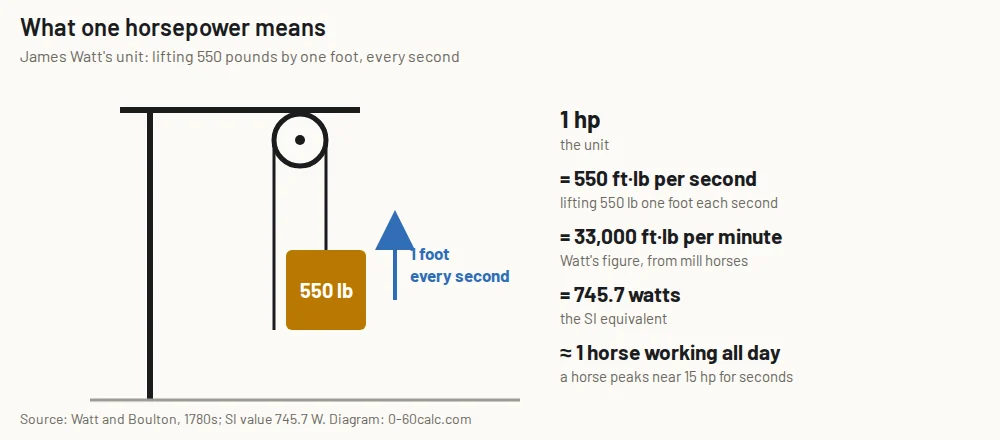
Watt’s unit survives unchanged. One mechanical horsepower is 33,000 foot-pounds per minute, which is 550 foot-pounds per second or 745.7 watts. Europe’s metric horsepower (PS or CV) is slightly smaller at 735.5 watts. Our kW to hp converter handles all three.
Horse vs human vs car
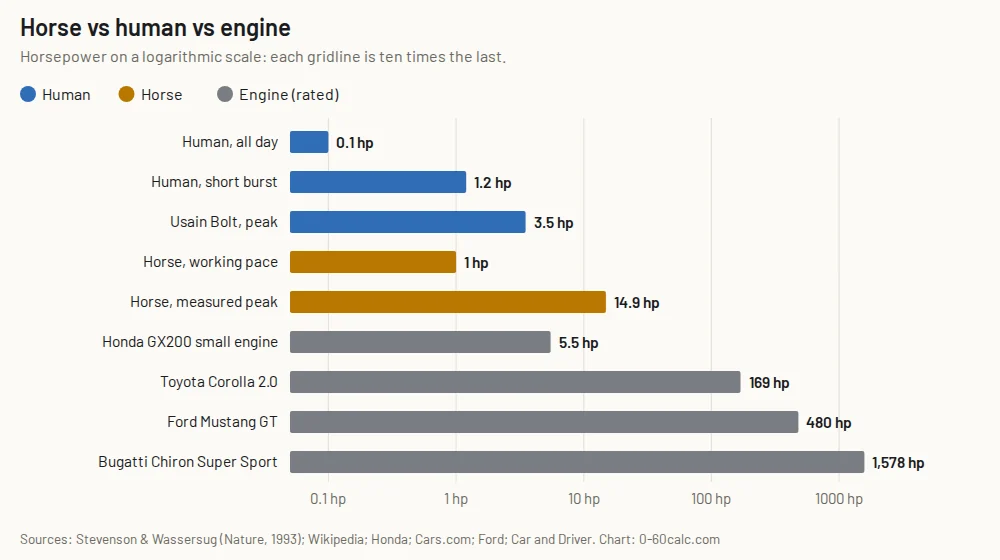
Put side by side, the numbers span four orders of magnitude, so the chart below uses a logarithmic scale, where each gridline is ten times the one before.
| Who or what | Horsepower | Watts | For how long |
|---|---|---|---|
| Healthy humanSteady effort | 0.1 hp | 75 W | Indefinitely |
| Trained athleteEndurance effort | 0.35 hp | 260 W | Several hours |
| Healthy humanShort burst | 1.2 hp | 890 W | A few seconds |
| Trained athleteShort burst | 2.5 hp | 1,860 W | A few seconds |
| Usain BoltPeak in his 9.58 s 100 m | 3.5 hp | 2,600 W | Under a second |
| HorseWorking pace | about 1 hp | 750 W | A working day |
| HorsePeak, measured | 14.9 hp | 11,100 W | A few seconds |
| Honda GX200 engine196 cc, in mowers and pumps | 5.5 hp | 4,100 W | As long as the fuel lasts |
| Toyota Corolla 2.0 (2026) | 169 hp | 126,000 W | Peak, at 6,600 rpm |
| Ford Mustang GT (2026) | 480 hp | 358,000 W | Peak rating |
| Bugatti Chiron Super Sport | 1,578 hp | 1,177,000 W | Peak rating |
A small 5.5 hp mower engine outworks five horses at their all-day pace, and a family sedan matches more than ten horses at their absolute peak.
How much horsepower does a human have?
A healthy adult can produce about 1.2 hp for a few seconds, for example sprinting up a flight of stairs, and sustain only about 0.1 hp (75 watts) all day. Trained athletes reach about 2.5 hp in a burst and hold roughly 0.35 hp for hours, which is why a strong cyclist can ride at around 250 to 300 watts. The best-known figure is Usain Bolt’s: a 2013 study in the European Journal of Physics modeled his 9.58-second 100 m world record and put his peak at 2,619.5 watts, about 3.5 hp, just 0.89 seconds after the start.
Even the world’s fastest sprinter reaches only about a quarter of a horse’s measured peak, and only for a moment. The horse wins on sheer size and on how long it can keep going.
Power per pound: horse vs human vs car
Raw horsepower favors anything big. Dividing power by weight shows how much each one has to move with it, which is what decides how quickly it accelerates. The horse figures assume a 600 kg (1,323 lb) horse, the size used in the theoretical estimate above.
| Who or what | Power | Weight | hp per tonne | lb per hp |
|---|---|---|---|---|
| Horse at workSustained | 1 hp | 1,323 lb | 1.7 | 1,323 |
| Healthy humanShort burst, 75 kg | 1.2 hp | 165 lb | 16 | 138 |
| Horse at its measured peak | 14.9 hp | 1,323 lb | 25 | 89 |
| Horse, theoretical ceiling | 24 hp | 1,323 lb | 40 | 55 |
| Usain Bolt at his peakModeled at 86 kg | 3.5 hp | 190 lb | 41 | 54 |
| Toyota Corolla LE (2026)Curb weight | 169 hp | 2,955 lb | 126 | 17.5 |
| Ford Mustang GT (2026)Fastback, manual, curb weight | 480 hp | 3,731 lb | 284 | 7.8 |
Two things stand out. Pound for pound, Usain Bolt at full effort briefly out-powered a horse at its measured peak, and matched the horse’s theoretical ceiling. And an ordinary Corolla carries about five times a sprinting horse’s power for every pound it has to move, for as long as the fuel lasts. Car weights are curb weights without a driver. Work out your own car’s figure with the power-to-weight calculator.
Speed over ground is a different contest. The American Quarter Horse, named after the quarter-mile races it was bred for, has covered 440 yards in about 20.3 seconds, as our guide to how long a quarter mile is explains.
Why a 300 hp car isn’t 300 horses
Horsepower is a unit of power, like watts, not a headcount. A 300 hp engine makes 300 × 745.7 = about 224,000 watts at its peak. To match that you’d need about 20 horses pulling flat out, or about 300 horses working at the steady pace Watt had in mind.
The engine’s figure is also a peak. It’s reached at one point near the top of the rev range, and at lower rpm the same engine makes much less power. That’s why torque and gearing matter as much as the headline number, as our guide to torque vs horsepower explains, and why weight matters too: the power-to-weight ratio is a better guide to acceleration than horsepower alone. For what counts as normal today, see average car horsepower.
How many horses is your car?
Estimate your engine’s real horsepower from a 0-60 time, a time slip or torque and rpm.
Horsepower CalculatorKey takeaways
- A horse peaks at about 14.9 hp for a few seconds and sustains about 1 hp over a working day.
- James Watt defined 1 hp as 33,000 foot-pounds per minute, now 745.7 watts.
- A healthy human peaks at about 1.2 hp; Usain Bolt hit about 3.5 hp.
- Pound for pound, Bolt at his peak beat a horse at its peak; a Toyota Corolla has about five times a horse’s peak power-to-weight.
- A 300 hp car equals about 20 horses at full effort, or about 300 at an all-day pace.
FAQ
How much horsepower does a horse have?
Up to about 14.9 horsepower for a few seconds, as measured in a 1993 study, and about 1 horsepower when working steadily through a day.
Is one horsepower equal to one horse?
Only at a sustainable working pace. At full effort a horse makes far more than 1 hp, up to about 15 hp for a few seconds.
How much horsepower does a human have?
About 1.2 hp for a few seconds and 0.1 hp over a full day for a healthy adult. Trained athletes reach about 2.5 hp in a burst.
Is a horse more powerful than a human, pound for pound?
An elite sprinter can briefly beat one. A 600 kg horse at its measured 14.9 hp peak makes about 25 hp per tonne of body weight, while Usain Bolt’s modeled peak of about 3.5 hp works out to about 41 hp per tonne. An average adult’s burst, about 16 hp per tonne, falls short, and the horse wins easily on total power and on how long it can keep going.
Who invented horsepower?
The Scottish engineer James Watt, in the 1780s, to compare his steam engines with the horses they replaced. He set 1 hp at 33,000 foot-pounds per minute.
How many horses is 300 horsepower?
About 20 horses at their peak output of roughly 15 hp each, or about 300 horses working at a steady, all-day pace of 1 hp.
How many watts is one horsepower?
745.7 watts for mechanical horsepower, the unit used for cars in the US. Metric horsepower (PS) is 735.5 watts.
Sources
- Stevenson, R. D. and Wassersug, R. J. (1993). Horsepower from a horse. Nature 364, 195
- Horse Canada: the 1925 Iowa State Fair pulling data and the 24 hp estimate
- Hernández-Gómez, Marquina and Gómez (2013). On the performance of Usain Bolt in the 100 m sprint. European Journal of Physics 34, 1227
- Ford: 2026 Mustang technical specifications, including curb weight
- Wikipedia: Horsepower (Watt’s derivation, human and horse output)
- BBC Science Focus: How much horsepower does a horse have?
- Honda: GX engine specifications
- Cars.com: 2026 Toyota Corolla specs and Ford: 2026 Mustang
- Bugatti Chiron Super Sport rating as listed in our fastest 0-60 cars guide
Related guides
What Is a Dyno? Dyno Testing, Tuning Costs & How to Read a Dyno Sheet
A dyno measures an engine's torque and rpm under load and calculates horsepower. Engine vs chassis…

What Is G-Force? Meaning, Examples in Cars & F1, and How Many G’s Humans Can Take
G-force is acceleration measured against gravity: 1 g is 9.80665 m/s². How to work it out,…
What Is Horsepower? Meaning, Formula & What It Means for Your Car
Horsepower is how fast an engine does work: 33,000 foot-pounds per minute, or 745.7 watts. The…