Torque vs Horsepower: What Each One Actually Does
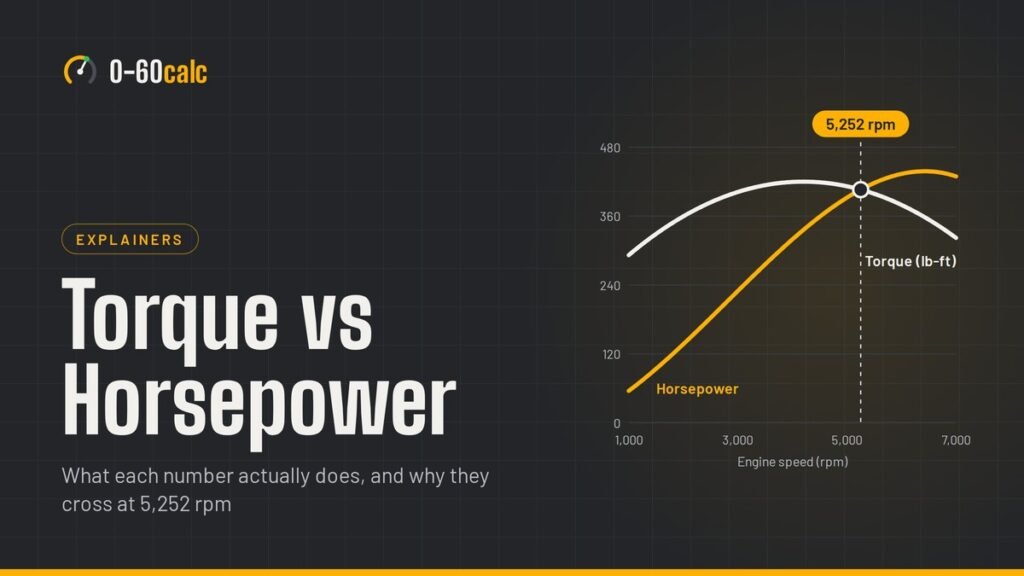
Torque is force, horsepower is how fast that force does work. Here's what each number really tells you, why they cross at 5,252 rpm, and which one matters for acceleration, towing and daily driving.
Torque is the engine’s twisting force. Horsepower is how fast that force does work: torque × rpm ÷ 5,252. For acceleration at any road speed, the power reaching the wheels is what counts. Torque figures tell you how that power arrives, which is why low-rpm torque makes a car or truck feel strong in everyday driving and towing.
In this guide
Most explanations stop at “torque gets you moving, horsepower keeps you moving.” That’s a useful feeling, but it’s only half right, and it leads to some expensive mistakes when you compare cars. This guide explains what the two numbers really are, how gearing links them, and which one to look at for the driving you actually do.
Last updated 29 September 2026: added how to read a dyno chart, torque vs horsepower in EVs, and a real-engine example.
Torque and horsepower in plain terms
Torque: twisting force
Push on the end of a one-foot wrench with 100 pounds of force and you apply 100 lb-ft of torque to the bolt. An engine does the same to its crankshaft. It’s measured in pound-feet (lb-ft) or newton-metres (Nm).
Horsepower: work per second
Power is how quickly work gets done. One mechanical horsepower is 33,000 foot-pounds of work per minute, or 745.7 watts. That’s roughly what a working horse can keep up all day, though a horse can briefly make close to 15 hp. The same bolt turned twice as fast takes twice the power.
An engine can make big torque slowly or modest torque very quickly and end up with the same horsepower. That’s the whole relationship in one sentence.
New to torque itself? Our guide to what torque is in a car starts from scratch, with real figures in lb-ft and Nm.
The formula that links them
Horsepower is torque multiplied by engine speed, scaled so the units work out:
- hp = torque (lb-ft) × rpm ÷ 5,252
- kW = torque (Nm) × rpm ÷ 9,549
- hp = torque (Nm) × rpm ÷ 7,121
| Torque and rpm | Horsepower | Kilowatts | Typical engine |
|---|---|---|---|
| 420 lb-ft at 4,000 rpmBig torque, low rpm | 320 hp | 239 kW | Turbo diesel or large V8 |
| 300 lb-ft at 5,000 rpmMiddle of the road | 286 hp | 213 kW | Turbo six or V8 |
| 150 lb-ft at 8,500 rpmSmall torque, high rpm | 243 hp | 181 kW | High-revving four |
A real example: Ford rates the 2026 Mustang GT at 415 lb-ft at 4,900 rpm and 480 hp at 7,150 rpm. At 4,900 rpm the formula gives 387 hp. At 7,150 rpm, 480 hp works out to about 353 lb-ft: torque has fallen, but the engine turns so much faster that power keeps climbing. If a spec sheet gives torque in newton-meters, convert it with the Nm to lb-ft converter first.
Try your own numbers in the horsepower calculator; it also works in reverse, from horsepower to torque.
Why the curves cross at 5,252 rpm
On a dyno chart drawn in horsepower and lb-ft, the two curves always cross at 5,252 rpm. It isn’t a coincidence of engine design; it falls out of the formula. At 5,252 rpm, torque × rpm ÷ 5,252 equals the torque figure, so the two numbers match. Below that speed torque is the bigger number; above it, horsepower is.
The crossing point moves if you change units. A chart in kilowatts and newton-metres crosses at 9,549 rpm, and one in horsepower and newton-metres at 7,121 rpm. If your curves cross somewhere else, the chart uses mixed units or different scales.
How to read a dyno chart
A dyno chart plots both curves against engine speed. (For the rest of the sheet, from correction factors to smoothing, see how to read a dyno sheet.) The example below is an illustrative engine rather than a real car, but it shows everything covered so far.
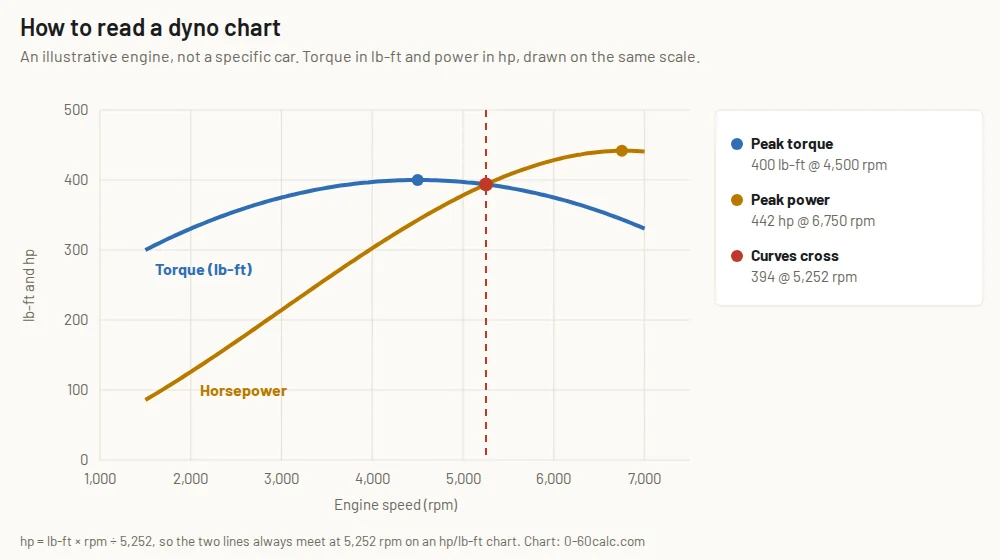
- Torque curve: how hard the engine twists at each rpm. A broad, flat top means strong pull across the rev range.
- Power curve: torque × rpm ÷ 5,252. It keeps rising past the torque peak because rpm climbs faster than torque falls, until torque drops off steeply near the redline.
- The crossing: exactly 5,252 rpm on an hp and lb-ft chart. If it isn’t, the axes use different scales or units.
- Area under the curves: strong output across the rpm you actually use beats a higher single peak.
- Wheel or crank: most dyno sheets show wheel figures, which read lower than the maker’s crank rating because of drivetrain losses.
To turn a wheel figure into an estimated crank rating, use the WHP to HP calculator, and see WHP vs BHP vs HP for why the two numbers differ.
Gearing: the part most explanations leave out
The wheels never see engine torque directly. The gearbox and final drive multiply it, and the shorter the gear, the bigger the multiplication. That’s why horsepower, not peak torque, decides how hard a car can accelerate at a given road speed.
Picture two engines driving the same car at 60 mph:
| Engine | At 60 mph | Horsepower there | Torque at the wheels |
|---|---|---|---|
| Engine A300 lb-ft, geared to run 3,000 rpm | 3,000 rpm | 171 hp | 1× baseline |
| Engine B200 lb-ft, geared to run 6,000 rpm | 6,000 rpm | 228 hp | 1.33× baseline |
Engine B makes a third less torque, but its gearing is twice as short to keep it at 6,000 rpm, so it delivers a third more torque to the wheels and pulls harder. The number that predicted the winner was horsepower: 228 against 171.
Turn a dyno sheet into horsepower
Enter torque and rpm, or work back from a quarter-mile or 0-60 time.
Horsepower CalculatorFour myths, corrected
“Torque gets you moving, horsepower keeps you moving”
At any speed, including pulling away, acceleration comes from wheel torque, which is engine torque times gearing. Low-rpm torque does make pulling away effortless without revving, which is the part of the saying that’s true.
“Diesels are quicker because they make more torque”
Diesels make big torque at low rpm but rev lower, so their horsepower is often modest. A gasoline car with the same horsepower and weight will usually match or beat it.
“More torque always means better towing”
Towing ratings depend on the frame, hitch, brakes, cooling and gearing too. Strong low-rpm torque makes towing relaxed, but it doesn’t set the limit on its own.
“Peak numbers tell the whole story”
How much torque and power an engine makes across its rev range, the area under the curve, matters more than a single peak. A flat torque curve feels stronger than a peaky one with the same maximum.
Which one matters for you
| Driving you do | Look at | Why |
|---|---|---|
| Daily commutingCity and suburbs | Torque below 3,000 rpm | Quick response without downshifts |
| Highway passing50-70 mph | Horsepower and gearing | Power at speed decides the pass |
| Towing and haulingTrailers, heavy loads | Low-rpm torque plus the tow rating | Relaxed pulling, cooler engine |
| Track days and drag racingMaximum acceleration | Peak horsepower and power-to-weight | Power at the wheels sets the pace |
For pure speed, weight matters as much as either number, which is why the power-to-weight ratio predicts acceleration better than horsepower alone.
Diesels, turbos and EVs
Diesel engines
Long strokes and high compression give big torque low down, but they can’t rev as high, which caps horsepower. Ideal for heavy, steady work.
Turbocharged gasoline
Boost arrives early and gives a flat torque curve from low rpm, then power holds on as revs rise. That’s why modern turbo cars feel stronger than their peak figures suggest.
Naturally aspirated
Torque builds with rpm and peaks high, so the engine rewards revving. Less low-end shove, more top-end rush.
Electric motors
Maximum torque is available from zero rpm up to a base speed, then power stays roughly constant and torque falls away. That’s why EVs launch so hard and feel less dramatic at high speed.
Torque vs horsepower in EVs
Electric cars often quote more torque than horsepower, which looks odd if you’re used to sports cars. It follows from how motors work: “electric motors can produce peak torque from zero RPM,” as Mazda puts it, and hold it up to a base speed before power levels off.
| Car | Horsepower | Torque | Peak torque arrives |
|---|---|---|---|
| Chevrolet Equinox EV, FWDElectric | 213 hp | 236 lb-ft | from standstill |
| Chevrolet Equinox EV, eAWDElectric | 288 hp | 333 lb-ft | from standstill |
| Toyota GR86Gasoline, non-turbo | 228 hp | 184 lb-ft | 3,700 rpm |
| Ford Mustang GTGasoline V8 | 480 hp | 415 lb-ft | 4,900 rpm |
The front-drive Equinox EV makes less horsepower than a GR86 but 28% more torque, all of it available from a standstill, so it feels strong in town while the GR86 needs revs to give its best. At highway speed, power decides again, which is why most EVs feel less dramatic above 60 mph than off the line. More in what is torque in a car.
Key takeaways
- Torque is force; horsepower is torque × rpm ÷ 5,252.
- Gearing multiplies torque, so horsepower decides acceleration at a given speed.
- Low-rpm torque makes a car feel strong in daily driving and towing.
- The curves cross at 5,252 rpm only when drawn in hp and lb-ft.
- For speed, look at horsepower and weight together.
- EVs make peak torque from 0 rpm, so they often quote more torque than horsepower.
FAQ
Is torque or horsepower more important?
For how quickly a car can accelerate at speed, horsepower, because gearing turns power into wheel torque. For how relaxed a car feels pulling away and towing, low-rpm torque. The best engines have both: strong torque early and power that keeps building.
Why do diesel trucks have more torque than horsepower?
Horsepower equals torque × rpm ÷ 5,252, and diesels make their peak torque far below 5,252 rpm and rarely rev much higher. Below that speed torque is always the larger number.
Does more torque mean faster acceleration?
Only at the same rpm and gearing. Compare cars on horsepower and weight instead: a lighter car with more horsepower will usually out-accelerate a heavier one with more torque.
How do I convert torque to horsepower?
Multiply torque in lb-ft by rpm and divide by 5,252. With newton-metres, divide by 9,549 for kilowatts or 7,121 for horsepower. The horsepower calculator does it for you in either direction.
What is wheel torque?
The torque that actually reaches the tires: engine torque multiplied by the gear ratio and final drive, minus drivetrain losses. It’s what pushes the car forward, and it changes every time you shift.
What is the difference between torque and horsepower?
Torque is the twisting force an engine produces; horsepower is the rate it does work, torque × rpm ÷ 5,252. An engine making 400 lb-ft at 3,000 rpm produces about 228 hp there; the same torque at 6,000 rpm would be about 457 hp.
Do electric cars have more torque than gas cars?
Often, for the same horsepower. Electric motors make peak torque from zero rpm: the front-drive Chevrolet Equinox EV makes 236 lb-ft from 213 hp, while the 228 hp Toyota GR86 makes 184 lb-ft.
Sources
- Ford: 2026 Mustang technical specifications
- Chevrolet: Equinox EV horsepower and torque
- Toyota: GR86 228 hp and 184 lb-ft at 3,700 rpm
- Mazda USA: electric motors and instant torque
- Motor Authority: why horsepower and torque cross at 5,252 rpm
- NIST SP 811: torque unit conversions
Related guides
What Is a Dyno? Dyno Testing, Tuning Costs & How to Read a Dyno Sheet
A dyno measures an engine's torque and rpm under load and calculates horsepower. Engine vs chassis…

What Is G-Force? Meaning, Examples in Cars & F1, and How Many G’s Humans Can Take
G-force is acceleration measured against gravity: 1 g is 9.80665 m/s². How to work it out,…
What Is Horsepower? Meaning, Formula & What It Means for Your Car
Horsepower is how fast an engine does work: 33,000 foot-pounds per minute, or 745.7 watts. The…