Quarter-Mile Times Explained: What’s Fast, 10-12 Second Cars & Reading a Time Slip
Quarter-mile benchmarks from street cars to race cars, 15 tested cars that run 10s, 11s and 12s, every line on a time slip explained, and what your ET and trap speed say about your launch and your power.
For a street car, a quarter mile under 14 seconds is quick, under 12 is fast, and under 10 is race-car territory, where NHRA tracks require a full roll cage. Your time slip splits the run into reaction time, 60-foot, 330-foot, eighth-mile and quarter-mile figures; ET shows the whole run, trap speed shows the power.
In this guide
The quarter mile is the oldest benchmark in performance cars: 1,320 feet from a standing start, timed to the thousandth. This guide covers what counts as a good time, what every line on your time slip means, and what the numbers say about where your car is gaining or losing time.
Last updated 7 October 2026.
What’s a good quarter-mile time?
The trap speed column is what a car with that ET would typically cross the line at, based on the same power-to-weight maths our quarter mile calculator uses.
| Class | 1/4 mile ET | Typical trap speed | At an NHRA track |
|---|---|---|---|
| RelaxedEconomy cars and base engines | over 16 s | under 85 mph | Basic tech inspection |
| Average street carFamily cars and crossovers | 14.5 to 16 s | 85 to 94 mph | Basic tech inspection |
| Brisk street carWarm hatches, sport sedans | 13 to 14.5 s | 94 to 105 mph | Check your track’s rules |
| QuickSports cars, V8 coupes | 11.5 to 13 s | 105 to 119 mph | Check your track’s rules |
| Very fastSupercars, tuned street cars | 10 to 11.5 s | 119 to 136 mph | Roll bar from 11.49 s |
| Race car territoryHypercars, drag builds | under 10 s | over 136 mph | Full roll cage |
For scale, Chevrolet ran the Corvette ZR1X through the quarter in 8.675 seconds at 159 mph on a prepared strip, and Car and Driver’s own test on an ordinary surface recorded 8.9 seconds. A handful of production EVs and hypercars now run in the 8s.
Is a 10, 11 or 12 second quarter mile fast?
Yes, all three are fast for a car you can drive on the street. For comparison, the family cars and hybrids in Car and Driver’s recent tests, from a Toyota Camry hybrid to a Honda Civic, ran the quarter mile in 15 to 17 seconds. Here’s what each bracket means.
12 seconds: quick
Sports-car pace. A Porsche 911 Carrera T, Toyota GR Supra, BMW M340i and Ford Mustang GT all ran 12s in testing. Under NHRA rules a convertible already needs a roll bar from 13.49 seconds.
11 seconds: very fast
Where the quickest electric family cars and all-wheel-drive sport sedans sit: a BMW M3 Competition xDrive ran 11.0 and a Tesla Model Y Performance 11.5. At 11.49 or quicker, NHRA rules call for a roll bar.
10 seconds: supercar territory
The Porsche 911 Turbo S, McLaren Artura and Corvette Z06 run 10s, and so does a three-row Lucid Gravity SUV. In most street-based cars, NHRA rules call for a roll bar here and a full cage from 9.99 seconds or 135 mph.
Under 10: hypercars and race cars
Car and Driver timed a Ferrari 296 GTB at 9.7 seconds at 150 mph. A handful of production cars now run 8s, as the Corvette ZR1X above shows. At the far end of the scale, a Top Fuel dragster no longer runs the full quarter: it races 1,000 feet in about 3.6 seconds, as our Top Fuel dragster guide explains.
Cars that run 10s, 11s and 12s
Fifteen road-tested cars, from Car and Driver’s instrumented tests, sorted by elapsed time. Car and Driver subtracts a one-foot rollout, as US magazines do, so a first run at your local strip will usually be a little slower.
| Car | Bracket | Quarter mile | hp | Weight |
|---|---|---|---|---|
| Porsche 911 Turbo S (2021)AWD, dual-clutch. Tested by Car and Driver | 10s | 10.1 s @ 137 mph | 640 | 3,646 lb |
| McLaren Artura (2023)RWD plug-in hybrid, dual-clutch. Tested by Car and Driver | 10s | 10.3 s @ 140 mph | 671 | 3,443 lb |
| Chevrolet Corvette Z06 (2023)RWD, dual-clutch. Tested by Car and Driver | 10s | 10.5 s @ 131 mph | 670 | 3,666 lb |
| Lucid Air Grand Touring (2022)AWD electric. Tested by Car and Driver | 10s | 10.7 s @ 132 mph | 819 | 5,212 lb |
| Lucid Gravity Grand Touring SUV (2026)AWD electric. Tested by Car and Driver | 10s | 10.9 s @ 131 mph | 828 | 5,912 lb |
| BMW M3 Competition xDrive (2023)AWD, automatic. Tested by Car and Driver | 11s | 11.0 s @ 124 mph | 503 | 3,929 lb |
| Hyundai Ioniq 5 N (2025)AWD electric. Tested by Car and Driver | 11s | 11.1 s @ 123 mph | 641 | 4,849 lb |
| Kia EV6 GT (2025)AWD electric. Tested by Car and Driver | 11s | 11.2 s @ 125 mph | 641 | 4,906 lb |
| Porsche Taycan 4S (2025)AWD electric. Tested by Car and Driver | 11s | 11.2 s @ 125 mph | 590 | 5,143 lb |
| Tesla Model Y Performance (2026)AWD electric. Tested by Car and Driver | 11s | 11.5 s @ 122 mph | 510 | 4,438 lb |
| Porsche 911 Carrera T (2025)RWD, manual. Tested by Car and Driver | 12s | 12.0 s @ 118 mph | 388 | 3,355 lb |
| Toyota GR Supra 3.0 (2021)RWD, automatic. Tested by Car and Driver | 12s | 12.1 s @ 117 mph | 382 | 3,347 lb |
| BMW M340i xDrive (2023)AWD, automatic. Tested by Car and Driver | 12s | 12.2 s @ 112 mph | 382 | 3,988 lb |
| Ford Mustang GT (2024)RWD, manual. Tested by Car and Driver | 12s | 12.5 s @ 114 mph | 486 | 3,947 lb |
| Nissan Z Performance (2023)RWD, automatic. Tested by Car and Driver | 12s | 12.7 s @ 115 mph | 400 | 3,592 lb |
What the table shows. All-wheel drive dominates: four of the five 11-second cars are electric, because instant torque to all four wheels makes for a hard launch. Trap speed tells the power story. The rear-drive McLaren Artura traps 140 mph, 3 mph more than the 911 Turbo S, yet its ET is 0.2 seconds slower, most likely because a rear-drive car can’t use all its power off the line. That’s the “good trap, slower ET” pattern explained below. And weight isn’t everything: the 5,912 lb Lucid Gravity, with 828 hp, runs 1.6 seconds quicker than the 3,947 lb Mustang GT.
To estimate what your own car will run, enter its horsepower and weight in the quarter mile calculator. To go the other way and estimate horsepower from your trap speed, use the horsepower calculator.
Reading your time slip, line by line
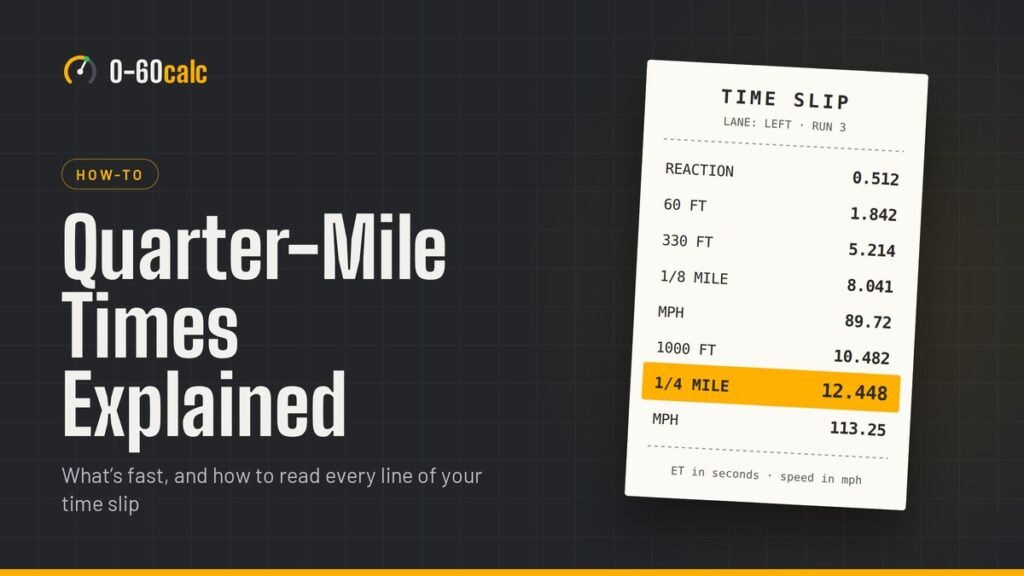
- R/T, reaction timeFrom the green light (or the last amber, on some trees) to the car leaving the starting beam. It’s not part of your ET. A negative number means you left early: a red light, and the round is lost.
- 60 ftTime to cover the first 60 feet. The clearest measure of launch quality, and the number most racers work on first.
- 330 ftAn early split that shows how the car pulls through first gear and the first shift.
- 1/8 mile ET and MPHTime and speed at 660 feet. Many local tracks finish here.
- 1,000 ftA late split, used on shorter tracks and for tuning the top end.
- 1/4 mile ET and MPHElapsed time from the start beam to the finish at 1,320 feet, and trap speed measured through a short speed trap just before the line.
- Dial-in and win lightIn bracket racing you predict your ET. Run quicker than your dial-in, a breakout, and you lose, even if you crossed first.
ET vs trap speed: what each tells you
ET is the whole run
It includes the launch, every shift and the power. A great launch can take tenths off without adding a single horsepower.
Trap speed is the power
By the finish the launch matters much less, so trap speed follows power-to-weight closely. That’s why estimating horsepower from trap speed is more reliable than from ET.
Good trap, slow ET
Your car has the power but is losing time off the line. Look at the 60-foot: wheelspin, bogging or a late shift.
Good ET, low trap
A great launch is carrying a car that’s short on power, or the engine is running out of breath at the top of a gear.
Turn your slip into horsepower
Enter your weight and trap speed or ET, or estimate a time from horsepower.
Quarter Mile CalculatorWhat’s a good 60-foot time?
Roughly: a stock street car on street tires runs 60-foot times in the low 2-second range, a well-launched sports car or AWD car in the high 1s, and cars on drag radials or slicks in the mid 1s. Racers often say each tenth saved in the 60-foot is worth about 0.15 to 0.2 seconds at the finish, because a better launch carries more speed all the way down the track.
1/8 mile vs 1/4 mile
An eighth-mile ET is roughly 64% of the quarter-mile ET, and eighth-mile speed about 80% of the trap speed. To estimate a quarter mile from an eighth, multiply the ET by about 1.56 and the speed by about 1.25. The 1/8 to 1/4 mile calculator converts in both directions, with factors for different cars and a full conversion chart.
Safety rules as you get quicker
Drag strips run NHRA or similar safety rules, and the requirements grow with your ET and speed. Under NHRA rules, a roll bar is required in cars running 11.49 seconds or quicker (13.49 in a convertible). A full roll cage is required from 10.99 seconds or above 135 mph, although full-bodied cars with an unaltered firewall and floor may keep the roll bar down to 10.00 seconds. For most street-based cars, that makes the cage mandatory at 9.99. Helmets and other gear are also required as cars get quicker, and rules change, so check with your track’s tech inspectors before you go quick.
How to improve your ET
- Tires first. Drag radials or even correct pressures and warm tires cut wheelspin more cheaply than anything else.
- Practice the launch. Find the launch rpm that gives slight, controlled wheelspin, or learn your car’s launch control.
- Lose weight. Empty the car, run less fuel, and leave passengers behind.
- Go when the air is good. Cool, dry, low-altitude air makes more power. Racers track density altitude for this reason.
- Shift at the right point. Shift where the next gear gives more wheel torque, which isn’t always at redline.
Key takeaways
- Under 14 seconds is quick for a street car; under 12 is fast; under 10 is race-car territory.
- In Car and Driver tests, sports cars run 12s, all-wheel-drive sport sedans and performance EVs 11s, and supercars 10s.
- Reaction time isn’t part of your ET.
- ET shows the whole run; trap speed shows the power.
- The 60-foot time is where most gains hide.
- NHRA requires a roll bar from 11.49 seconds and a full cage in most street-based cars from 9.99 or 135 mph.
For the 0-60 side of the same question, see what counts as a good 0-60 time.
FAQ
What is a good quarter-mile time for a street car?
Under 14 seconds is quick, under 12 is fast and under 10 is race-car territory. Most family cars and crossovers run 14.5 to 16 seconds.
Is a 12 second quarter mile fast?
Yes. It’s sports-car pace: a Porsche 911 Carrera T, Toyota GR Supra and BMW M340i all ran about 12 seconds in Car and Driver testing, while family cars and hybrids need 15 to 17 seconds.
What cars run a 10-second quarter mile?
In Car and Driver testing, the Porsche 911 Turbo S (10.1 s), McLaren Artura (10.3 s), Chevrolet Corvette Z06 (10.5 s), Lucid Air Grand Touring (10.7 s) and Lucid Gravity SUV (10.9 s).
Does reaction time count in the quarter-mile ET?
No. The ET clock starts when the car leaves the starting beam. Reaction time is measured separately and only decides who wins a side-by-side race.
Why is my trap speed good but my ET slow?
Trap speed mostly reflects power, while ET also depends on the launch. A strong trap with a slow ET usually means wheelspin, a bog or a slow 60-foot time.
When do I need a roll bar at the drag strip?
Under NHRA rules, from 11.49 seconds in most cars and 13.49 in convertibles. A full roll cage is required from 10.99 seconds or 135 mph, or from 9.99 seconds in full-bodied cars with an unaltered firewall and floor. Check with your track, as local requirements vary.
How do I convert an eighth-mile time to a quarter mile?
Multiply the eighth-mile ET by about 1.56 and the eighth-mile speed by about 1.25. It’s a rule of thumb; the quarter mile calculator does it for you.
Related guides
What Is a Dyno? Dyno Testing, Tuning Costs & How to Read a Dyno Sheet
A dyno measures an engine's torque and rpm under load and calculates horsepower. Engine vs chassis…

What Is G-Force? Meaning, Examples in Cars & F1, and How Many G’s Humans Can Take
G-force is acceleration measured against gravity: 1 g is 9.80665 m/s². How to work it out,…
What Is Horsepower? Meaning, Formula & What It Means for Your Car
Horsepower is how fast an engine does work: 33,000 foot-pounds per minute, or 745.7 watts. The…