F1 Car 0-60: How Fast Does a Formula 1 Car Accelerate?
An F1 car reaches 60 mph in about 2.6 seconds. How that compares with hypercars, IndyCar and Top Fuel dragsters, where F1 pulls away, and what the 2026 power units changed.
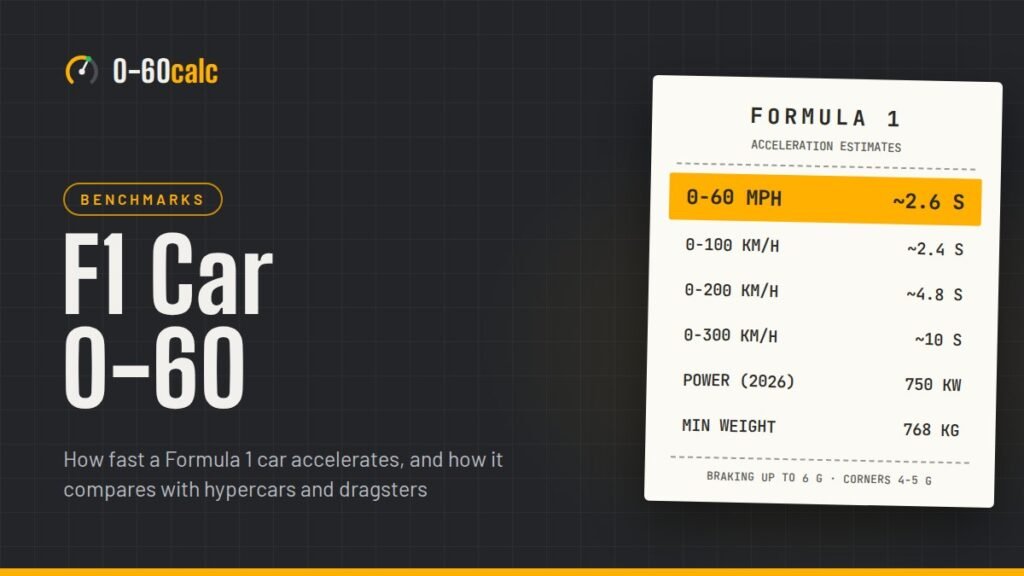
A Formula 1 car reaches 60 mph in about 2.6 seconds, by Autosport’s estimate. That is quick, but not the quickest: the fastest road car in independent testing now does it in 1.8 seconds, and a Top Fuel dragster in under half a second. Where F1 pulls away is above 60 mph, with roughly 0-200 km/h in 4.8 seconds, braking at up to 6 g and cornering at 4 to 5 g.
In this guide
F1 cars are built to go round corners, not to win drag races. Rear-wheel drive, no launch control and very little downforce at low speed hold them back off the line. Once they are moving, almost nothing on a race circuit can keep up. Here are the numbers, how they compare with IndyCar, hypercars and dragsters, and what changed with the 2026 power units.
Last updated 29 September 2026.
F1 acceleration in numbers
Neither the FIA nor the teams publish official acceleration times, so every figure below is an estimate from a named source. Treat them as a range, not a spec sheet.
| Sprint | Time | Source |
|---|---|---|
| 0-60 mph97 km/h | about 2.6 s | Autosport |
| 0-100 km/h62 mph, 2026 cars | about 2.4 s | F1 Chronicle |
| 0-200 km/h124 mph | about 4.8 s | F1 Chronicle |
| 0-300 km/h186 mph | about 10 s | F1 Chronicle |
The two low-speed figures don’t quite agree: 100 km/h is a higher target than 60 mph, yet F1 Chronicle’s 2026 time is quicker than Autosport’s. That gap is typical of unofficial numbers, and a fair summary is “roughly 2.5 seconds, give or take a couple of tenths”.
2.6 seconds to 60 mph works out to an average of about 1.05 g. You can check any time yourself with the g-force calculator.
Why an F1 car isn’t quicker to 60
Two driven wheels
F1 cars are rear-wheel drive. The quickest road cars send power to all four wheels, which gives them twice the tires to push with off the line.
No launch control
Launch control has been banned in F1 since 2004 and traction control since 2008. The driver meters the clutch paddle by hand to avoid wheelspin.
Downforce needs speed
An F1 car’s aerodynamic grip grows with speed. At a standstill it has almost none, so the tires alone decide how hard it can launch.
Built for corners
Gearing, aero and tires are chosen for lap time, not for a standing start. The payoff shows up at 100 mph and above, and in braking zones.
This is why a road-legal hybrid or electric hypercar with all-wheel drive and a computer managing each wheel can beat an F1 car to 60 mph. Past about 1 g, traction rather than power sets the limit, as our list of the fastest 0-60 cars shows.
F1 vs IndyCar vs hypercars vs Top Fuel
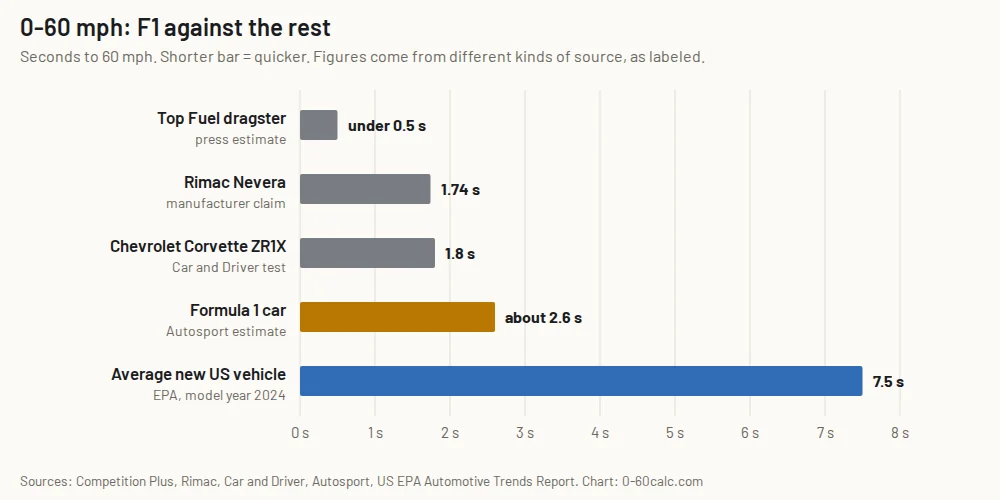
| Vehicle | 0-60 mph | Average g | Type of figure |
|---|---|---|---|
| Top Fuel dragster11,000+ hp | under 0.5 s | 5.5 g or more | Press estimate |
| Rimac NeveraElectric hypercar | 1.74 s | 1.57 g | Manufacturer claim |
| Chevrolet Corvette ZR1XQuickest road car tested | 1.8 s | 1.52 g | Car and Driver test |
| Formula 1 carRear-wheel drive | about 2.6 s | 1.05 g | Press estimate |
| IndyCar0-100 km/h, not 0-60 mph | about 3 s to 100 km/h | about 0.9 g | Press estimate |
| Average new US vehicleModel year 2024 | 7.5 s | 0.36 g | EPA calculation |
The dragster is in a class of its own because it is built for nothing but straight-line acceleration. For how it manages under half a second, see our guide to Top Fuel dragster 0-60. The average-g column is our arithmetic: 60 mph divided by the time, expressed in multiples of gravity.
Where F1 pulls away: 60 mph and up
Off the line an F1 car is merely very quick. From there, the gap to road cars opens fast. On F1 Chronicle’s figures it doubles its speed from 100 to 200 km/h in about 2.4 seconds and reaches 300 km/h (186 mph) in roughly 10 seconds from a standstill. Downforce presses the car harder into the track as speed rises, so the tires can keep putting the power down where a road car starts to run out of grip or gearing.
Braking is even more striking. Brembo’s data for Turn 1 at the 2025 Bahrain Grand Prix shows cars slowing from 313 to 66 km/h at 4.2 g, and Formula1.com puts peak braking at up to 6 g. A road car on good tires brakes at around 1 g.
The 2026 power unit: half electric
For 2026, F1 rewrote its engine rules. The combustion engine lost power, the electric motor gained almost three times as much, and the car got lighter.
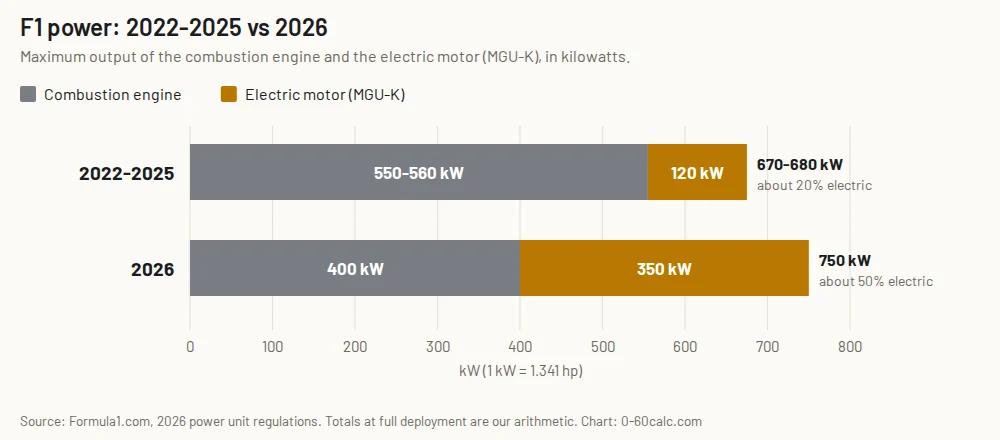
| Rule | 2022-2025 | 2026 |
|---|---|---|
| Combustion engine | 550 to 560 kW | 400 kW |
| Electric motor (MGU-K) | 120 kW | 350 kW |
| Total, at full deploymentOur arithmetic | 670 to 680 kW (about 900 to 910 hp) | 750 kW (about 1,000 hp) |
| Electric share | about 20% | about 50% |
| MGU-H (turbo energy recovery) | Yes | Deleted |
| Minimum weight | 800 kg | 768 kg |
Many outlets quote 2022-2025 cars at 950 to 1,000 bhp, a little above the sum of the official kW limits, so you will see both numbers. On the 2026 figures, 750 kW in a 768 kg car is roughly 1,300 hp per tonne, more than any road car we list in our power-to-weight benchmarks. Convert any rating with the kW to hp converter.
G-forces: braking, corners and crashes
| Situation | G-force | Source |
|---|---|---|
| 0-60 mph launchAverage, from a 2.6 s time | about 1 g | Our arithmetic |
| Heavy brakingBahrain Turn 1, 313 to 66 km/h (2025) | 4.2 g | Brembo |
| Peak braking | up to 6 g | Formula1.com |
| Fast corners, sustained | 4 to 5 g | Formula1.com |
| Cornering peakLewis Hamilton, Mugello Turn 7, 2020 | 5.6 g | Formula1.com |
| Crash: Max VerstappenSilverstone, 2021 | 51 g | Formula1.com |
| Crash: Romain GrosjeanBahrain, 2020 | 67 g | Formula1.com |
| Crash: Robert KubicaCanada, 2007 | up to 75 g | Formula1.com |
The interesting part is the contrast: F1’s launch is its gentlest moment. The car spends far more of each lap braking and turning at four to six times gravity than it ever spends accelerating from rest, which is why drivers train their necks as hard as their cardio.
How many g is your car?
Enter any 0-60 mph or 0-100 km/h time and see the average g-force, from family cars to F1.
G-Force CalculatorKey takeaways
- An F1 car does 0-60 mph in about 2.6 seconds; estimates range from about 2.4 to 2.6.
- The quickest road cars beat it to 60 thanks to all-wheel drive and launch control, which F1 banned in 2004.
- F1 pulls away above 60 mph: roughly 0-200 km/h in 4.8 seconds and 0-300 km/h in about 10.
- 2026 cars pair a 400 kW engine with a 350 kW electric motor, about 1,000 hp at full deployment.
- Braking and cornering reach 4 to 6 g, several times the launch force.
For how road cars compare, see what counts as a good 0-60 time.
FAQ
How fast does an F1 car go 0-60?
About 2.6 seconds, according to Autosport. Teams don’t publish official figures, and estimates range from roughly 2.4 to 2.6 seconds.
What is an F1 car’s 0-100 km/h time?
Around 2.4 to 2.6 seconds. F1 Chronicle quotes about 2.4 seconds for 2026 cars, and about 4.8 seconds to 200 km/h.
Is an F1 car faster than a Bugatti or a Tesla to 60?
No. The quickest road cars now beat it: the Corvette ZR1X ran 1.8 seconds in Car and Driver’s test, and the Tesla Model S Plaid 2.07 seconds in MotorTrend’s. They have all-wheel drive and launch control; an F1 car has neither.
How many g does an F1 driver feel?
About 1 g on a standing start, 4 to 5 g through fast corners with peaks near 6 g, and up to 6 g under the heaviest braking, according to Formula1.com.
How much horsepower does a 2026 F1 car have?
The 2026 rules allow 400 kW from the combustion engine and 350 kW from the electric motor, 750 kW or about 1,000 hp when both are at full output.
Do F1 cars have launch control?
No. Launch control has been banned since 2004 and traction control since 2008. Drivers control the start with the clutch paddles.
How fast is an IndyCar 0-60?
Autosport puts an IndyCar at about 3 seconds to 100 km/h (62 mph), a little slower off the line than an F1 car.
Sources
- Autosport: how fast is an F1 car, with IndyCar comparison
- F1 Chronicle: 0-100, 0-200 and 0-300 km/h estimates for 2026 cars
- Formula1.com: 2026 power unit regulations explained
- Formula1.com: 2026 power units, electric share and MGU-H
- Formula1.com: beginner’s guide to the 2026 regulations (768 kg)
- Formula1.com: how F1 drivers train, with g-force figures
- Formula1.com: Verstappen’s 51 g Silverstone crash
- Brembo braking data for the 2025 Bahrain GP (via F1-Fansite)
- Wikipedia: launch control, banned in F1 from 2004 and F1 Chronicle: traction control ban from 2008
- US EPA Automotive Trends Report (2025 edition): average 0-60 of 7.5 s for model year 2024
- 0-60calc: fastest 0-60 cars, for the Corvette ZR1X, Rimac Nevera and Model S Plaid figures and their sources
Related guides
What Is a Dyno? Dyno Testing, Tuning Costs & How to Read a Dyno Sheet
A dyno measures an engine's torque and rpm under load and calculates horsepower. Engine vs chassis…

What Is G-Force? Meaning, Examples in Cars & F1, and How Many G’s Humans Can Take
G-force is acceleration measured against gravity: 1 g is 9.80665 m/s². How to work it out,…
What Is Horsepower? Meaning, Formula & What It Means for Your Car
Horsepower is how fast an engine does work: 33,000 foot-pounds per minute, or 745.7 watts. The…