What Is a Good Power-to-Weight Ratio?
Power-to-weight benchmarks for cars and bikes in hp per tonne and lb/hp, why the ratio predicts acceleration better than horsepower, and the cheapest ways to improve it.
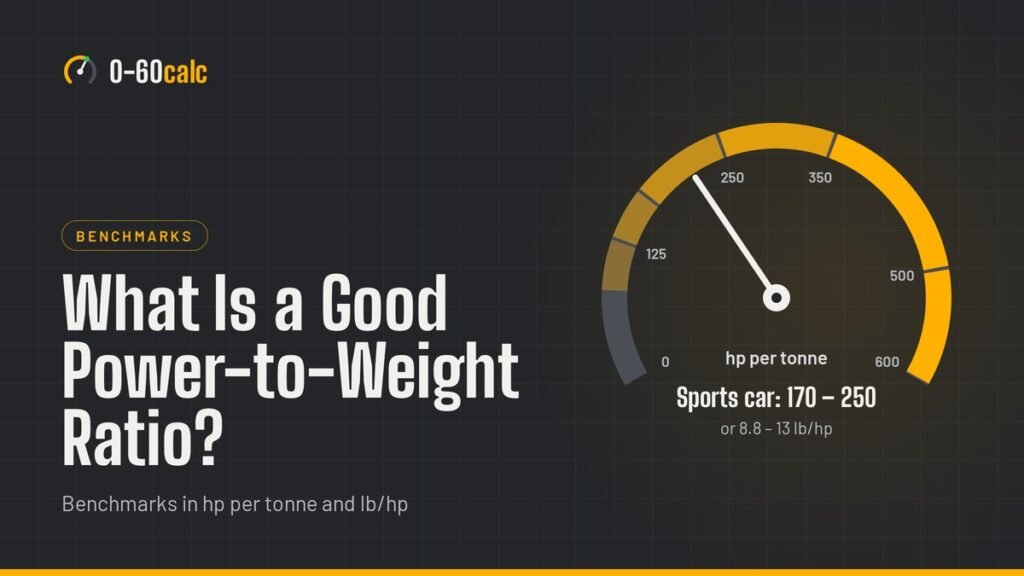
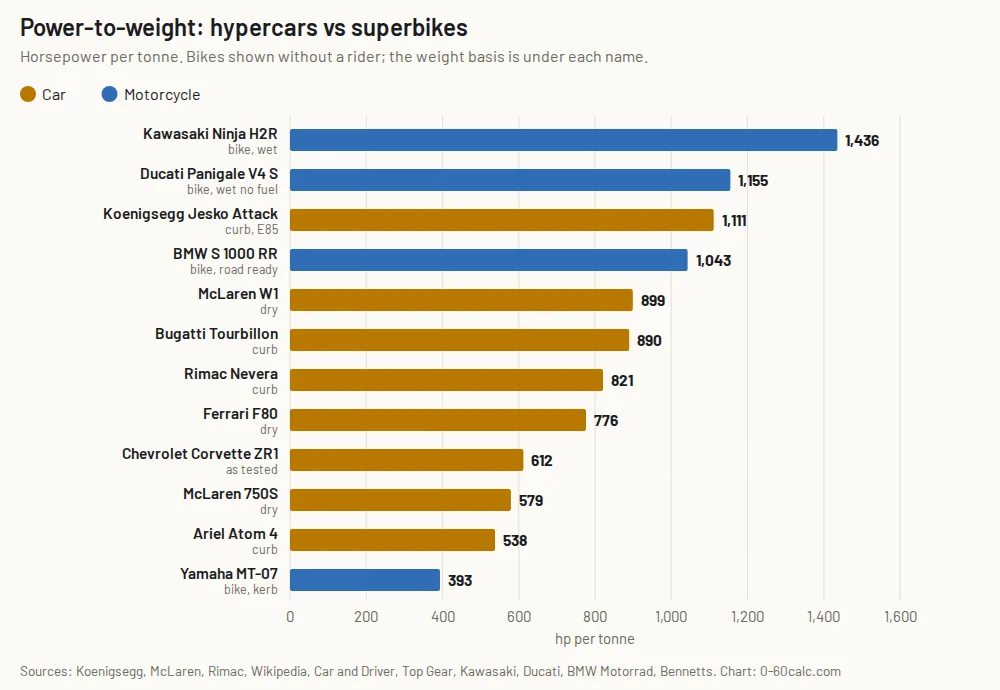
For a car, 125 hp per tonne or more feels quick, 170 to 250 is sports-car territory and over 350 is supercar level. In lb/hp, under 13 feels fast and under 6.3 is supercar pace. Today’s quickest hypercars pass 800 hp per tonne, and the top superbikes exceed 1,000 before adding a rider.
In this guide
Horsepower is the number on the badge, but it’s only half of the story. A heavy SUV and a light roadster with the same engine feel nothing alike. Power-to-weight ratio puts the two halves together, which is why it predicts acceleration so well. Here’s what a good figure looks like, in every unit you’ll meet.
Last updated 29 September 2026: added the best power-to-weight cars you can buy and motorcycle benchmarks.
What power-to-weight ratio means
It’s engine power divided by the mass that power has to move. You’ll see it two ways round:
- Power-to-weight, such as hp per tonne or W/kg. Higher is quicker.
- Weight-to-power, such as lb/hp or kg/hp. Lower is quicker.
Both describe the same thing. hp per tonne is common in the UK and Europe; lb/hp is the American and drag-racing habit.
The scale, with estimated 0-60 times
The 0-60 column shows what our 0-60 calculator estimates at each boundary for a rear-drive car with a manual gearbox, so you can see how the ratio turns into time.
| Class | hp per tonne | lb per hp | About 0-60 mph |
|---|---|---|---|
| Economy carCity cars and basic compacts | under 80 | over 27.6 | slower than 8.9 s |
| Everyday carFamily cars and crossovers | 80 to 125 | 17.6 to 27.6 | 6.8 to 8.9 s |
| Warm hatchQuick hatchbacks, sport sedans | 125 to 170 | 13.0 to 17.6 | 5.7 to 6.8 s |
| Sports carHot hatches, coupes, quick EVs | 170 to 250 | 8.8 to 13.0 | 4.5 to 5.7 s |
| Performance carV8 coupes, track-focused cars | 250 to 350 | 6.3 to 8.8 | 3.7 to 4.5 s |
| SupercarMid-engine exotics | 350 to 500 | 4.4 to 6.3 | 3.0 to 3.7 s |
| HypercarThe quickest road cars | 500 to 800 | 2.8 to 4.4 | 2.3 to 3.0 s |
| Superbike territorySport bikes without a rider | over 800 | under 2.8 | traction-limited |
Why it beats horsepower alone
Take a 300 hp SUV weighing 5,000 lb and a 200 hp roadster weighing 2,300 lb. The SUV has 50% more power, but each of its horsepower moves 16.7 lb, against 11.5 lb in the roadster. With the same drivetrain, our model puts the SUV at about 6.6 seconds to 60 mph and the roadster at about 5.3. The lighter car wins, and power-to-weight told you so before either left the line.
Work out your ratio
hp per tonne, lb/hp, kg/hp and W/kg, plus the power or weight you’d need for a target.
Power-to-Weight CalculatorThe units you’ll see
hp per tonne
Horsepower per 1,000 kg. Divide horsepower by the weight in kilograms and multiply by 1,000.
lb per hp
Weight in pounds divided by horsepower. The drag-racing favourite; lower is quicker.
kg per hp
The metric version of lb/hp, common on European and Asian spec sheets.
W/kg
Watts per kilogram, the unit cyclists and engineers use. 1 hp per tonne equals 0.7457 W/kg.
Cars, bikes and EVs
Motorcycles live off the end of the car scale: a 200 hp superbike weighing 440 lb is about 1,000 hp per tonne on its own and still over 700 with a rider. They can’t use it all off the line, because a single rear tire and the risk of a wheelie limit the launch.
EVs are the opposite case. They’re heavy, but their motors make so much power that many land in the sports-car or supercar bands anyway, and their instant torque helps them turn the ratio into time more efficiently than a gas car can.
Best power-to-weight cars you can buy
The newest hypercars have pushed past the top of our car scale. The table uses each maker’s power figure and the weight basis shown; dry weights leave out fuel and fluids, so they flatter the ratio compared with curb weights.
| Car | Power | Weight | hp per tonne | lb per hp |
|---|---|---|---|---|
| Koenigsegg Jesko Attack | 1,578 hp1,600 PS on E85 | 1,420 kg curb | 1,111 | 1.98 |
| McLaren W1 | 1,258 hp | 1,399 kg dry | 899 | 2.45 |
| Bugatti Tourbillon | 1,775 hp | 1,995 kg curb | 890 | 2.48 |
| Rimac Nevera | 1,888 hp1,408 kW | 2,300 kg curb | 821 | 2.69 |
| Ferrari F80 | 1,184 hp | 1,525 kg dry | 776 | 2.84 |
| Chevrolet Corvette ZR1 (2025) | 1,064 hp | 1,738 kg (3,831 lb) as tested | 612 | 3.60 |
| McLaren 750S | 740 hp | 1,277 kg dry | 579 | 3.80 |
| Ariel Atom 4 | 320 hp | 595 kg curb | 538 | 4.10 |
The Corvette is the only car here weighed by an independent tester, Car and Driver. The Ariel Atom shows the other route to a big number: modest power in a car with almost nothing else to carry. Check any car with the power-to-weight calculator.
Motorcycle benchmarks
Bikes are light enough that the rider changes the answer. The last column adds an 80 kg (176 lb) rider, our assumption, to each bike’s listed weight.
| Bike | Power | Weight | hp per tonne | With 80 kg rider |
|---|---|---|---|---|
| Kawasaki Ninja H2RTrack only | 310 hp | 216 kg wet | 1,436 | 1,048 |
| Ducati Panigale V4 S | 216 hp | 187 kg wet, no fuel | 1,155 | 809 |
| BMW S 1000 RR | 207 hp154 kW | 198 kg road ready | 1,043 | 743 |
| Yamaha MT-07 | 72 hp | 184 kg kerb | 393 | 274 |
| Kawasaki Ninja 650 | 67 hp | 193 kg (425.6 lb) curb | 347 | 245 |
| Harley-Davidson Street Glide | 105 hp | 368 kg (811 lb) running order | 285 | 234 |
| Honda Grom (MSX125) | 9.8 hp7.3 kW | 103 kg kerb | 95 | 53 |
Even with a rider, a superbike’s 740 to 1,050 hp per tonne rivals the hypercars on paper. It still won’t out-launch them to 60 mph: one rear tire and the risk of a wheelie limit how much of that power it can use from a standstill. A heavy touring bike like the Street Glide sits in sports-car territory, and a 125 cc Grom with a rider falls well inside our economy-car band.
How to improve your ratio
Weight and power trade almost evenly
Cutting 10% of the weight raises the ratio by about 11%, the same as adding 11% more power.
Weight helps everywhere
A lighter car also stops shorter, corners harder and wears its brakes and tires less. More power only helps when you accelerate.
Start with what you carry
Tools, spare wheels, subwoofers and a full tank can add 50 kg or more. It’s the cheapest weight you’ll ever lose.
Rotating weight counts extra
Lighter wheels and tires help acceleration more than the same saving elsewhere, because they also have to be spun up.
What the ratio doesn’t tell you
Power-to-weight ignores traction, gearing, aerodynamics and the shape of the power curve. Two cars with identical ratios can differ by half a second to 60 if one is all-wheel drive with a quick-shifting gearbox. That’s why our calculators adjust for drivetrain and gearbox, and why the ratio is a guide rather than a guarantee.
Key takeaways
- Everyday cars: 80 to 125 hp/tonne. Sports cars: 170 to 250. Supercars: 350 and up.
- In lb/hp, under 13 feels fast and under 8.8 is sports-car territory.
- The ratio predicts acceleration better than horsepower alone.
- Losing 10% of the weight is worth about 11% more power.
- Traction and gearing decide how well the ratio turns into time.
- The quickest hypercars now exceed 800 hp per tonne; superbikes pass 1,000 without a rider.
To see what those ratios mean in seconds, read what counts as a good 0-60 time.
FAQ
What is a good power-to-weight ratio for a car?
Around 125 hp per tonne or more feels quick in daily driving; 170 or more is sports-car territory. In weight-to-power terms, that’s under about 17.6 and 13 lb/hp respectively.
How do I calculate power-to-weight ratio?
Divide horsepower by the weight in kilograms and multiply by 1,000 for hp per tonne, or divide the weight in pounds by horsepower for lb/hp. The power-to-weight calculator shows every unit at once.
Is lower lb/hp better?
Yes. lb/hp is weight-to-power, so fewer pounds per horsepower means a quicker car. It’s the same comparison as a higher hp per tonne, just written the other way round.
Should I include the driver’s weight?
To compare cars, use curb weight, as manufacturers and magazines do. To see your own car as you drive it, add yourself, passengers and fuel.
What power-to-weight ratio does a supercar have?
Roughly 350 to 500 hp per tonne, or about 4.4 to 6.3 lb/hp. The quickest hypercars go beyond 500 hp per tonne.
What car has the best power-to-weight ratio?
Among the cars we list, the Koenigsegg Jesko Attack: about 1,111 hp per tonne on E85 at its 1,420 kg curb weight. The McLaren W1 is close to 900 hp per tonne, measured on dry weight.
What is a good power-to-weight ratio for a motorcycle?
A popular middleweight like the Kawasaki Ninja 650 sits around 350 hp per tonne on its own; superbikes pass 1,000. Add an 80 kg rider and those become roughly 245 and 740 to 1,050.
Sources
- Koenigsegg: Jesko Attack specifications
- McLaren: W1 press release and McLaren 750S press release (via Automotive World)
- Wikipedia: Bugatti Tourbillon and Wikipedia: Ferrari F80
- Rimac: Nevera
- Car and Driver (via Yahoo): Corvette ZR1 test weight
- Top Gear: Ariel Atom 4 specifications
- Wikipedia: Kawasaki Ninja H2R and Kawasaki: Ninja 650
- Ducati: Panigale V4 and BMW Motorrad: S 1000 RR technical data
- Bennetts BikeSocial: Yamaha MT-07 (2025)
- Honda UK: MSX125 Grom and Harley-Davidson: Street Glide
Related guides
What Is a Dyno? Dyno Testing, Tuning Costs & How to Read a Dyno Sheet
A dyno measures an engine's torque and rpm under load and calculates horsepower. Engine vs chassis…

What Is G-Force? Meaning, Examples in Cars & F1, and How Many G’s Humans Can Take
G-force is acceleration measured against gravity: 1 g is 9.80665 m/s². How to work it out,…
What Is Horsepower? Meaning, Formula & What It Means for Your Car
Horsepower is how fast an engine does work: 33,000 foot-pounds per minute, or 745.7 watts. The…